Universities must seize on the disruption triggered by artificial intelligence to pivot their assessments towards judging processes, not end products, and to put essential human skills front and centre, according to an expert.
Tansy Jessop, pro vice-chancellor for education and students at the University of Bristol, said that institutions had moved beyond simply policing what AI use was acceptable in coursework to designing assessments which measured not just an end product but the process by which students reached that point.
Other key principles at Bristol included transparency about AI use and use of more “authentic” tasks, some of which should have AI and utilising more “authentic” tasks, some of which should have AI integrated to them, with Jessop arguing that by doing all these things, “you’ll end up with a kind of Swiss cheese arrangement where your assessment is secure”.
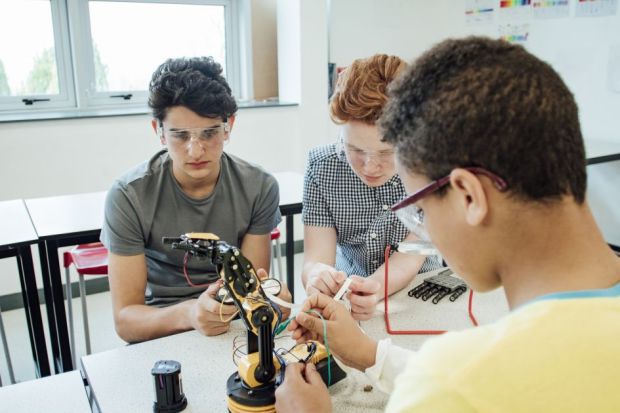
Assessing process meant getting students to “show [their] workings”, said Jessop, who spent 17 years leading a research project focused on higher education assessment. She gave the example of a computer scientist colleague who had tasked with students to design a robot, but then found that too often the submission was “purely AI-generated”.
His response the next time was to start the assessment by giving the students the fully programmed robot, and to ask them to work in groups to work out how he had made it.
“It’s iterative, it’s messy and it offers you windows of insight into how students have got there,” Jessop said of the suggested approach, speaking at Times Higher Education’s Student Success UK&IE event.
“I think one of the most important cultural shifts about this is [that] it’s about enabling students to learn from mistakes and to see where their mistakes are, and to see that as part of the learning rather than having AI-polished perfect outputs.”
Quoting the Durham University learning developer Sam Nolan, Jessop said that there were five essential human skills which we should not hand over to AI – curiosity, creativity, critical thinking, collaboration and communication.
For higher education, Jessop argued that this meant returning to the Humboldtian vision of “unsettled knowledge”, with staff and students co-creating knowledge together, noting that AI “collapses hierarchies in the whole university”.
“Learning is a struggle, and we need to design the curriculum, the teaching, and our assessment to enable students to struggle in productive ways,” Jessop told the event at the University of Bath.
She added: “We need to teach hyperproductivity with caution. I think we are sold this a lot by the tech bros, that you can be hyperproductive [with AI] and go and walk the dog.
“I think it’s a nonsense. I think we need to be careful about speed and pace. We need to attend to a more slow, contemplative, and open-space type of learning.
“We need to clear our curricula of clutter to enable students to do the valuable stuff. So, let’s hold on to depths of scholarship, slow learning, and keep the human in the loop.”
Register to continue
Why register?
- Registration is free and only takes a moment
- Once registered, you can read 3 articles a month
- Sign up for our newsletter
Subscribe
Or subscribe for unlimited access to:
- Unlimited access to news, views, insights & reviews
- Digital editions
- Digital access to THE’s university and college rankings analysis
Already registered or a current subscriber?