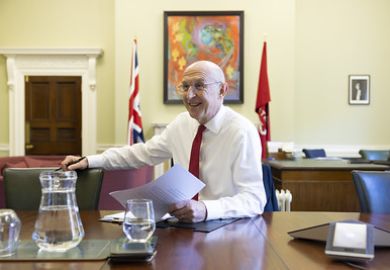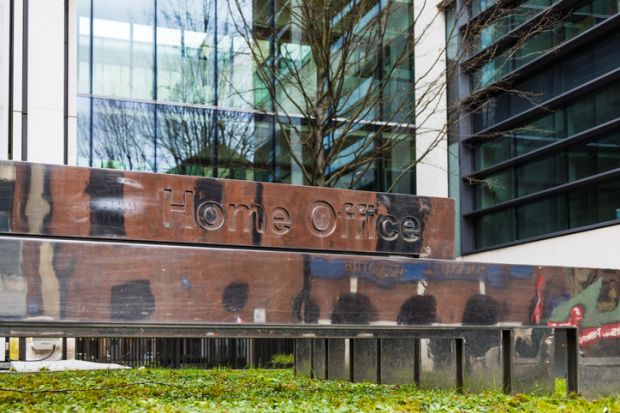
Universities must do more to “proactively” engage with the Home Office, including sharing data on current trends before things go wrong, according to a high-ranking official at the department.
Oliver Rae, head of work, study, family and Ukraine services at the Home Office, urged institutions to consider updating UK Visas and Immigration on internal data on completion and enrolment rates for students “rather than just waiting for the [visa] application stage”.
“We would very much expect universities to be proactive and be reaching out to our engagement teams as well as to be having those conversations about what we can do in the recruitment space, what is the data showing us, what are the current trends we need to be aware of,” Rae told the Universities UK International student recruitment conference.
Another “challenge”, he said, was lack of communication between different teams within universities.
“We’ve spoken to universities and there’s a clear disconnect between departments within universities that just aren’t speaking to each other properly,” he said.
“There’s clearly evidence to suggest and show that [student data] is just not being shared sufficiently, and that’s something that the better universities that we’ve worked with have really shown improvement in joining up departments to share that information.”
Rae was speaking after recent updates to Basic Compliance Assessment rules, introduced in June, under which universities risk losing their sponsorship licence to recruit overseas students if more than 5 per cent of applicants are rejected.
The changes have coincided with reports of visa officials turning down far more applicants from overseas, with those from so-called high-risk countries such as Pakistan, Nigeria, India and Ghana particularly likely to face refusals.
Rae said that it wasn’t “necessarily rocket science” to understand UKVI’s fixation on a genuine desire to study in the UK as a prerequisite of securing a visa.
He said this was the “subjective element” in any application, and the individual “has got to convince the caseworker in question that they are a genuine student”.
Rae said he would “thoroughly suggest” that hopeful students provide any additional statements expressing why they’re choosing a particular course, university and the UK as a study destination “upfront as part of the initial application process” so that if they then have to proceed to an interview stage, their intentions are already well-founded.
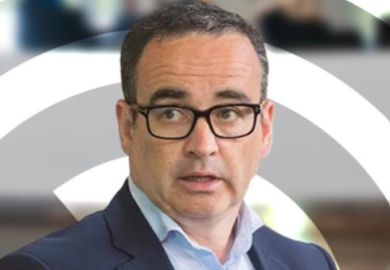
Chris Chang, deputy vice-chancellor for global engagement and student life at the University of Portsmouth, said the problem was “more than just government policy”.
“It used to be the ‘Big Four’,” said Chang, referring to the leading study destinations of the US, UK, Australia and Canada. “There are lots more choices [now] and they are cheaper than us,” he said.
Chang said universities had “to be realistic”, suspecting that there would be no return to the days of 600,000 international students enrolling each year, although he predicted a recovery to reach approximately 300,000 enrolments.
He also weighed in on the question of proving genuine desire to study in the UK, warning that he’d seen a rise in reliance on AI answers.
“Students are using AI to help them in interviews and they are being served up with generic responses,” he said, “and that therefore affects their credibility…we are starting to warn students, ‘be careful how you do your research’”.
Register to continue
Why register?
- Registration is free and only takes a moment
- Once registered, you can read 3 articles a month
- Sign up for our newsletter
Subscribe
Or subscribe for unlimited access to:
- Unlimited access to news, views, insights & reviews
- Digital editions
- Digital access to THE’s university and college rankings analysis
Already registered or a current subscriber?