Australia is considering “targeted financial support” for academics applying to the world’s biggest research funding scheme, with direct access to Horizon Europe only four months away.
A discussion paper says extra cash could boost locals’ prospects of securing their share of the €95.5 billion (£81.9 billion) funding pool, a year before it is scheduled to almost double to €175 billion.
After years of delays, Australia has secured formal ascension to the programme from next January. While its researchers have had access to the fund since the late 1990s, through invitations from institutions in participating countries, Australian groups will now be able to apply directly.
“Comparable countries…report an average application success rate of around 20 per cent,” says the Department of Industry, Science and Resources (DISR) discussion paper. “Broad financial support for all applications may help develop a stronger pipeline of high-quality applications [and] help Australia achieve a competitive success rate.”
While “no decision has been made” about financial incentives, the paper mulls different approaches. It says “modest” support could be made available at project development stage or after applicants have secured Horizon Europe grants.
The former approach could reduce the barriers to lodging applications, the paper says. “Entities could use the financial support to develop expertise in writing research proposals, forming international partnerships and understanding Horizon Europe…requirements.” The latter approach could “help offset indirect research costs or retrospectively compensate organisations for the resources invested in preparing an application”.
Another approach could involve “ranking” Horizon Europe funding opportunities according to their relevance to Australian priorities, with different levels of financial support for “each tier”. Australian groups should seek out “research calls” that “best align with the National Science and Research Priorities and the Future Made in Australia agenda”, the paper says.
The proposals follow years of government indecision about whether to join Horizon Europe, with responsibility to contribute funds thought to have been the main stumbling block – a reservation only overcome after the Group of Eight universities volunteered to pay half of the estimated A$40 million (£21 million) joining fee.
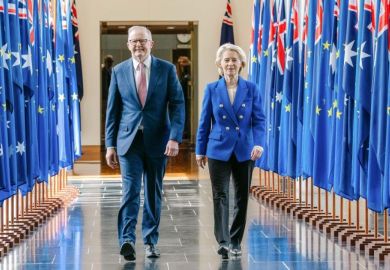
The European Union’s (EU’s) recently departed ambassador to Australia, Gabriele Visentin, said the negotiations had been finalised in a “world record” 69 days after European Commission (EC) president Ursula von der Leyen visited Canberra in March.
The treaty meant that Australia would no longer be at the “kids’ table” for Horizon Europe funding. “You don’t have to come any more with…the invitation and someone who would bear your participation cost,” Visentin told the Australian Financial Review Higher Education Summit, days before his post Down Under concluded in late August.
Visentin said applying for funding “might be easier…than one could think” because Australia had already participated indirectly in more than 150 Horizon Europe projects. “You don’t start from scratch,” he said. “You’re already in the system.”
The EU had been “eager” to secure Australia’s association because of its “like-minded” approach to academic freedom and its “incredibly high” scientific output. The agreement had boosted Australia’s potential as a “regional research power” promoting “democratic” science values in the Indo-Pacific.
“An Australian coordinator of a project might…invite participants from the Pacific states or from South-east Asia,” Visentin said. “The participation cost of these entities would be borne by the EU budget.”
DISR is providing a secretariat to help meet Australia’s commitments under the agreement, along with centralised support for the “national contact points” that intermediate between the EC and each participating country’s research community.
The discussion paper poses a dozen questions about how to structure these contact points, including whether they should be located within government, research institutions, industry associations or representative bodies.
Stakeholders have until 18 September to respond. The discussion paper urges researchers to act quickly in positioning themselves for Horizon Europe grants. “It would benefit potential applicants to begin exploring collaboration opportunities and forming consortia as early as possible,” it says. “It can take several months to develop suitable research proposals.”
Register to continue
Why register?
- Registration is free and only takes a moment
- Once registered, you can read 3 articles a month
- Sign up for our newsletter
Subscribe
Or subscribe for unlimited access to:
- Unlimited access to news, views, insights & reviews
- Digital editions
- Digital access to THE’s university and college rankings analysis
Already registered or a current subscriber?