Academics and higher education professionals have worked progressively closer together in recent decades, whether they like it or not. But such collaboration has not always extended to catering staff – until now.
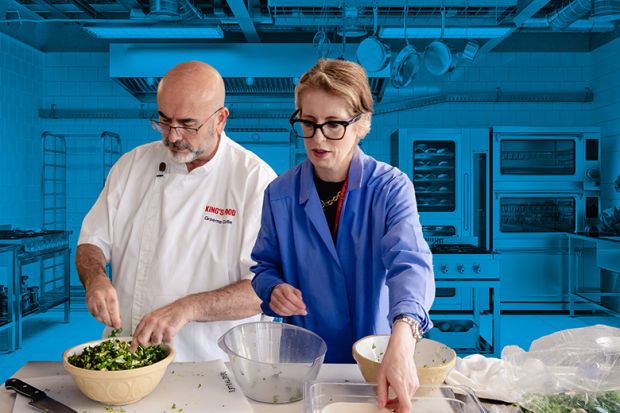
Rachel Gibson, reader in nutrition and dietetics at King’s College London, and Graeme Collie, associate director of catering and events, co-lead the university’s Living Laboratory initiative and its Root-to-Tip research.
The success of the project, which has been researching how cooking every part of different fruits and vegetables might boost fibre intake, means the pair are now working to develop a repository of their recipes, in the hope of inspiring other universities, and eventually other public sector settings such as hospitals.
“For us the important bit is that link between professional services and academics. Because what we did didn’t seem particularly special; we were just doing what we did every day,” Collie said.
“But merging the two together has clearly created something that people find very interesting, that’s coming up with really good results for business, sustainability and health.”
For some time, Collie’s team had been using frequently discarded parts of produce, including broccoli stalks and carrot skins, in university catering.
Collie, who left school at 15 to become a chef, said this was driven by both “the practicality of the business” in terms of saving time otherwise spent needlessly chopping and peeling, and the “sustainability thought process” that looks to limit food waste.
Gibson’s suggestion that researchers and the catering team joined forces to investigate how using more of the food could increase fibre intake has led to a collaboration the pair believe could be a model for higher education.
“It wasn’t something I expected to do in my career as a chef,” Collie said. “It feels unique. It’s been a bit of a journey for all of us.
“[In] my first meeting I went to with academics, there were about eight of them and me. I’ve always been quite straight-talking; it was a bit intimidating being in a room full of people with degrees…then someone said, ‘You can cook. You’ve got one of the best skills in the world.’ I started to realise we’ve all got different knowledge and different input you can put into a project.”
Gibson suggested that the work was particularly significant in light of the ever-competitive funding landscape for research.
“It’s that upskilling of catering staff to understand how the research environment works…but also from an academic’s perspective, increasingly a lot of where we’ll need to apply for funding needs to be joined with industry,” she said.
So far, key findings include that butternut squash peel contains five grams of fibre per 100 grams – more than twice what is found in the flesh.
Removing the peel therefore results in about a fifth of the weight of the squash being wasted.
The scheme has previously been nominated for a Times Higher Education Award, and its research has received more than £50,000 from the One King’s Impact Fund – which supports initiatives addressing “urgent and deep-rooted challenges” relating to the environment, social mobility and global conflict – as well as the TUCO Foundation, a professional membership body for in-house caterers.
But they now hope to win more money to investigate other potential health benefits for eating from root to tip.
“We suspect that there are other health beneficial components to rinds and peels,” Gibson said, particularly when it comes to polyphenols – compounds found in plants believed to be anti-inflammatory and to support cardiovascular health.
“What’s really important as well is the safety aspect, because not everything’s going to be safe to eat root to tip, so it’s looking at what guidance is out there…this is a really important next step,” she continued.
The team is now preparing resources for TUCO’s website, including a toolkit for universities looking to emulate the model, and a recipe bank caterers can access and also contribute to.
So far, they have developed recipes including a ragu sauce using unpeeled peppers, leek tops and whole tomatoes, and a rubbed kale, fennel and mixed seed salad.
There are also ambitions to develop a recipe book for household use.
“The impact we’ve had within the King’s community is getting everyone involved in research,” Gibson said.
“I’m really keen to break down those barriers in terms of [the idea] that it’s only academics that can do research – professional services should be working with academics and sharing knowledge.”
Register to continue
Why register?
- Registration is free and only takes a moment
- Once registered, you can read 3 articles a month
- Sign up for our newsletter
Subscribe
Or subscribe for unlimited access to:
- Unlimited access to news, views, insights & reviews
- Digital editions
- Digital access to THE’s university and college rankings analysis
Already registered or a current subscriber?