Head of school/department
Neoliberalism is many academics’ bête noire, but it is also a litmus test of their democratic sensibilities, says Steve Fuller
The entanglement of the university and tech worlds faces increased scrutiny following the Cambridge Analytica scandal. Could joint positions in industry and academia offer a workable and ethically defensible way forward? David Matthews reports
What is it like to be a bat?; writing about yourself; when safety compromises freedom; a pioneer of the history of medicine; and rethinking the Garden of Eden
Driverless cars are limited in their understanding and inherit their coders’ biases, warns John Gilbey
If you want to learn to argue better, don’t ditch emotion, argues Tony Mann
What separates the maverick from the herd? Helga Drummond wonders
Book of the week: the values of research must be preserved despite political and economic pressure, says Harry Collins
Results from the European Student Survey underpinning the rankings reveal key differences in teaching across the Continent
Renowned Harvard particle physicist and humanitarian campaigner remembered
Learning outcomes are very well intentioned, but their use discourages students from thinking outside the tick box, says Robert Nelson
New government body for research predicts cost of £15 million per year if tax problem not resolved
Visa data, contradicted by Home Affairs figures, raise questions over treatment of Chinese doctoral applicants
In a world transformed, we need a radical new blueprint – for a flexible, less centralised network of scholars and students, says a former Berkeley chancellor
Social scientists’ inexplicable failure to conduct research on their own campuses is holding back quality in undergraduate education, says Richard Arum
There is no holding back the king tide that is the Asian country’s higher education ambition – yet while the torrent carries some riches, what will it sweep away?
Is the 4* researcher who is also a stellar teacher a realistic expectation? Times Higher Education surveyed academics to find out. Jack Grove reports
Some commentators have urged the UK to replicate German universities of applied science. It’s not that simple, says Neil Shirtcliffe
Home Office says records on international academics are ‘not collated in a manner which can be reported on’
Many students are struggling with stress-related health problems after switch to postgraduate programmes, research suggests
Shift in focus at transcontinental African Leadership University prompts some staff to quit
Increasing research investment could see country lead the region in higher education, but experts say it needs to balance capacity with culture
Cambridge researcher dreams of returning home to war-stricken country
Institutions accused of only ‘wanting to be about Shakespeare’ in wake of proposal to merge US Education and Labor departments
Nobel laureates call for early career researchers to be freed from ‘publish or perish’ mentality
At a gathering of young scientists and Nobel prizewinners, David Matthews detects a whiff of mutiny in the air stirred by the pressures of a modern research career
Submissions will be published alongside reviewers’ comments and author responses
Chemistry laureate Michael Levitt also warns younger scientists are now far less likely to be awarded grants
Treating staff and students like children discourages the kind of experimentation that will yield solutions to the challenges we face, says Frank Furedi
In the wake of Malcolm Anderson’s death, universities need to wake up to the need to take better care of their senior lecturers, says Andrew Oswald
The geriatrician and television star on hitch-hiking to Paris, the secret of ageing well, and how an elderly man’s rectal prolapse helped him realise his vocation
Experts in technology and education must work hand in hand if genuinely innovative teaching is to be delivered in the digital environment, says Simone Buitendijk
Scholars keep feelings of inferiority well cloaked yet self-doubt can strike any of us and only disclosure alleviates the pain of this hidden epidemic
Book of the week: memoirs of the Weimar generation are formed into a powerful social history, writes Hester Vaizey
If the Australian government wants to link university funding to student satisfaction, it must ensure that scores reflect more than students’ gender, wealth or ease of passage, says Julie Hare
Neve Gordon lauds a forensic examination of the Palestinian territory and its 2 million inhabitants
This study of God and country could ask more questions of its subjects, says Angelia Wilson
Cat Zero, a novel by Jennifer Rohn, an infectious disease researcher, shines light on the backbiting and tensions of lab life as an unlikely team of scientists work to save the cats of Kent from a mysterious virus
Open prejudice against his sexuality has seen the career of one academic slowly wither
A weekly look over the shoulders of our scholar-reviewers
An insider’s view of the 2016 US election that lacks insight frustrates Lennard Davis
The Oakland Promise, like a number of local schemes in the US, aims to be a ‘cradle to career’ programme moving more of the city’s children into higher education. John Morgan visits California to assess it
Do you feel you’re just winging it, waiting for the day when your incompetence is exposed? Six academics show that you’re far from alone
Calls for additional funding to help colleges police controversial events
Janet Todd’s memoir considers the humiliations of illness and admits to ‘some embarrassment at not being dead’
National strategies also debate merits of basic versus applied research in rapidly expanding field
France’s new ‘Parcoursup’ system for university entry is intensifying the nation’s historical agonies over whether selectivity is compatible with égalité, says Louise Lyle
Concerns about whether internationalisation and English usage has gone too far should be addressed from the perspective of quality assurance, says Michèle Wera
Dean says that institutions may have to rely on part-time staff if they cannot match industry remuneration
Concerns about the teaching excellence framework’s rigour and integrity have not been addressed. The exercise needs a fundamental rethink, says Guy Nason
The best of those universities founded since the year 2000
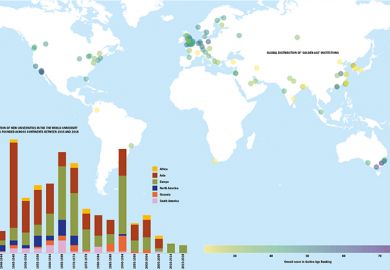
Our data visualisations show how institutions were established in three distinct waves, and the global distribution of ‘Golden Age’ universities
Young universities appreciate diversity and are particularly adept at responding to the needs of society, says Judy Genshaft
We unveil the top 250 universities under 50 years old and explain our generational and nuanced approach to young institutions
This year’s ranking showcases a much greater range of Golden Age universities and has been expanded to include 200 universities
Because the passing of a year is an arbitrary measure of maturity, we have added more gradation into our rankings, says Phil Baty
Bold by nature, young institutions are tailor-made for ambitious projects such as the EU’s plan to create disruptive ‘super-networks’, says Anthony Forster
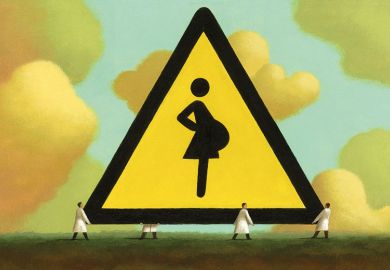
Legal action should not be required to convince universities to do more to help expectant mothers graduate without delay, says John Kaag
As a Brit leading HKU, Peter Mathieson had no baggage. The University of Edinburgh’s new v-c tells Ellie Bothwell about academic freedom, internationalisation and being treated to taxi drivers’ views on students
With more data from more institutions, our 2018 Young University Rankings explore the growing higher education sector. Here we explain the methodology that underpins the tables
For all the criticism it gets, the Australian Tertiary Admission Rank remains a cheap and efficient selection system that plausibly links entry criteria to academic outcomes, says Andrew Norton