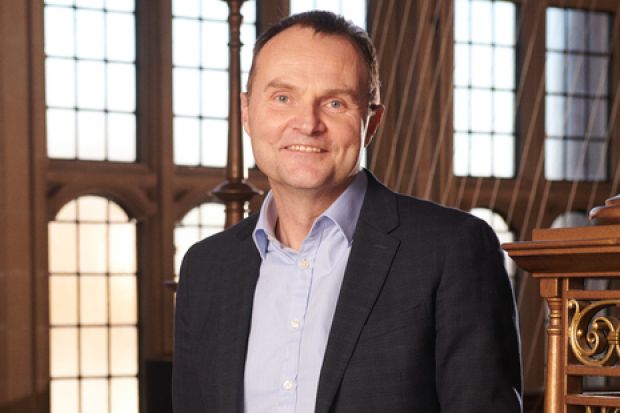
A review of higher education funding is required because England’s current system “is just not working” for students, universities or taxpayers, a leading Russell Group vice-chancellor has said.
Speaking at the British Academy Shape conference, Adam Tickell, who heads the University of Birmingham, argued that a rethink on how universities are funded was required because “we have a system where more state money goes in, students are more indebted and universities are on the brink of failure”.
“In terms of the taxpayer, the provider and the student, the system just isn’t working,” he explained at the event on 4 March.
“I don’t think tweaking the margins will really address things”, continued Tickell, adding that he did not think the post-16 education White Paper, published in October, “addressed this in any meaningful way”.
One key consideration of any review should include the academic level at which students are entitled to draw on student loans, said Tickell. “We are getting students without a single A level or equivalent getting access to the student loan book,” he said, adding that the “problem with that is investment in students is investment in human capital…and we’re investing so much money in people who…we are not really capable of graduating.”
Asking those “difficult questions” at a time of funding crisis as part of a review was necessary because universities faced an “almost existential challenge” amid falling support from the public, politicians and business, said Tickell, who led the University of Sussex prior to taking over at Birmingham in August 2022.
“Now is the time to ask, what does the public want from universities? How do we want to fund it? How many people do we want to go to university? And I think those are really difficult questions, because as providers, it’s hard enough already,” he said.
Reflecting on how the former Conservative prime minister David Cameron had once, when asked to name the “best part of Britain” just over a decade ago, listed UK universities, Tickell argued “it is inconceivable that any political leader would say anything like this, which shows just how far the politics has shifted”.
With universities facing increased scrutiny over the visas awarded to students, the situation might become much tougher if a Reform-led government were elected, continued Tickell, who said that allowing “universities without any research intensity” to grow their master’s by research programmes (MRes) was a “massive mistake”.
“It very seriously undermines [the sector’s] legitimacy with the Home Office,” he said. “We could have a government that is utterly hostile to the sector and, unless we have some answers [to why higher education is important], we could be in real trouble,” he added.
Speaking on the same panel, Philip Augar, who led the 2019 review of higher education funding, agreed that funding should be revisited, arguing that the cost of undergraduate teaching should be split roughly 50-50 between the individual and the state – as imagined when £9,000 tuition fees were introduced in 2012.
“Some graduates are now paying 70 per cent in loans, some are paying 83 per cent – this is not 50-50, it is the privatisation of university teaching,” he said, adding: “This is unfair and wrong.”
However, Vivienne Stern, chief executive of Universities UK, disagreed with Tickell and Augar on whether it was time to hold another review of higher education funding.
“It is too febrile and unpredictable to open up a Pandora’s box when we don’t know what we’re asking for,” said Stern. The recent post-16 education paper “contains about 35,000 policy recommendations which we are trying to implement”, said Stern of what she called “policy chaos”. “If we are going to end with a review then the focus should be tightly constrained,” said Stern.
Register to continue
Why register?
- Registration is free and only takes a moment
- Once registered, you can read 3 articles a month
- Sign up for our newsletter
Subscribe
Or subscribe for unlimited access to:
- Unlimited access to news, views, insights & reviews
- Digital editions
- Digital access to THE’s university and college rankings analysis
Already registered or a current subscriber?