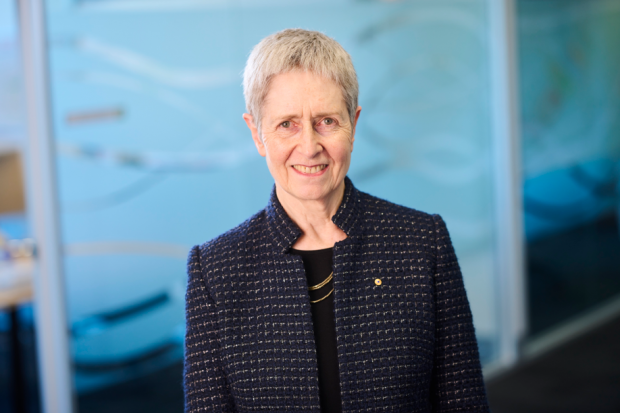
Anne Kelso loved lab work. She honed her T-cell cloning skills during her 1980s postdoc at “a terrific T-cell lab in Switzerland”, just as researchers in her native Victoria were planning treatments based on the colony stimulating factors (CSFs) they had discovered a few years earlier.
CSFs stimulate stem cells in bone marrow to form specialised white blood cells that fight infection. Since their 1990s approval as a supportive therapy for cancer patients, they have been used to treat tens of millions of people with bone marrow damage from chemotherapy.
In 1984, the Walter and Eliza Hall Institute needed a prolific source of CSFs for preclinical animal tests. One of Kelso’s “hardy” T-cell clones turned out to be a “very good” source of messenger RNA for use in cloning CSF genes.
“I was a minor player, but it was great to be able to contribute,” Kelso said. “I always imagined I’d be a lab scientist forever because it was just so rewarding. It’s a very individual activity. Each person brings their own mindset to the way they do science. I loved that stage of my life.”
But her career led from lab to leadership during stints at the Queensland Institute of Medical Research, the Cooperative Research Centre for Vaccine Technology and a World Health Organisation influenza reference and research centre. By 2015, when she became CEO of Australia’s National Health and Medical Research Council (NHMRC), her bench science skills had been complemented with a wealth of knowledge about research commercialisation and global public health.
That “unusual set of experiences” took Kelso from her “happy place in the lab” to “a broader perspective on the world. That’s what ultimately led to me being appointed at NHMRC, or even to consider such a job. It seemed like a great opportunity to build on everything I’d done.”
The opportunity was not wasted, according to the Honours Secretariat at Government House. In January, she was named a Companion of the Order of Australia – the country’s highest civilian award – for eminent service to health and medical research sciences and administration.
Kelso’s early career insights served her well as NHMRC chief, a position she held until July 2023. “Knowing what it’s like to work in a lab, to apply for grants, to miss out, to lose your salary funding; if the people in your lab don’t get their salary funding, if a project you are really committed to doesn’t get supported. To understand all that in a personal way is incredibly valuable when you’re running an agency like NHMRC.”
But such insights fade over time, Kelso admits. “It’s important not to stay in those jobs forever. You might start as a scientist and end up as a bureaucrat. There’s nothing wrong with bureaucrats – I met many outstanding bureaucrats in Canberra – but the sector starts to see you in a different way, and that makes it harder to be influential.”
She says the NHMRC council and advisory committees helped her and staff “keep it real” with feedback from the coalface. The council and committees are NHMRC’s “greatest strength”, Kelso said.
“They’re made up of people from across the country who help you see the positive and negative implications if you go down a certain path. One of the biggest things I learned in my jobs was that you don’t have to do everything on your own. You have a much better outcome if you take advice, listen and work with others to achieve what you want to do.”
But Kelso was surprised at some seasoned researchers who misinterpreted her role. “It’s not a private fiefdom. It’s constrained by legislation, history and what the government wants to achieve. Those constraints are there to make sure public funds are used wisely.
“During the pandemic, we had people saying, ‘just distribute the money to the institutions and then let them decide how to dole it out’, or ‘give an extra year of funding to everybody who’s already funded’. Even if we thought they were good ideas, they wouldn’t have been consistent with the legislative role.”
Some of the toughest challenges were interpersonal. “For some people you’re public enemy number one. The decision about what to fund depends on peer review, not the CEO. Scientists know that, but you’re still the face of the organisation that denied their grant. It’s difficult when colleagues and friends see you as having rejected them in some way. But you can’t do jobs like that if all you want to do is be popular and maintain stress-free relationships with everybody. You have to roll with it.”
Kelso was also surprised at how often she was asked why she was not lobbying publicly for more NHMRC funding. “That’s the last thing you can talk about. When you work within the public service, your attempts to get more funding happen behind closed doors.
“It made me realise just how many researchers don’t really understand how government works. There’s a role for institutions in helping to ensure that researchers know how to speak to ministers or their advisors if they have the opportunity. Being able to put yourself into their frame of mind, understand their perspective and what’s useful for them to know – that can be quite powerful.
“Ministers have huge portfolios. We can’t expect that a minister is going to understand us as researchers. It’s easy for us to think there should be more funding for health and medical research – which, of course, I believe there should be – but that’s not self-evident for everyone else.”
Kelso’s award citation also commends her service to gender equity, one of her more “controversial” areas of NHMRC reform. Funding in the leadership categories of its flagship Investigator Grants is now split evenly among men and women to help rectify a glaring gender imbalance at the most senior levels.
The changes had many supporters but also critics, including men and women “who strongly believed we shouldn’t be intervening at all”. Opponents argued that the reforms undermined merit. But data analysis revealed minimal difference in the peer reviewer scores of successful applicants and many who had just missed out.
“If you lower the threshold a little for senior women, you don’t materially affect the quality of the grants you’re funding,” Kelso said. “You’re in that band where you can’t tell them apart.”
Another objection was that the “brilliant” young women starting out in medical research just needed “time to get to the top”. Statistics suggested otherwise. “We looked at 20 years of data and saw no shift at all in the representation of women at the highest levels of the applicant pool,” Kelso said. “Twenty years is a long time to see no movement.”
Yet another objection was that the changes took no account of parenthood. Kelso said parental responsibilities were among the “personal circumstances” addressed at peer review stage – a process that had been “refined over and over”, although “it’s impossible to do it well”.
“We were trying, with this gender equity intervention, to deal with systemic disadvantage for women compared with men. It goes beyond individual caring responsibilities. It goes, in a way, to the nature of our social structures and our socialisation.”
Kelso had warned of possible unintended consequences before the reforms were finalised. Gender equity was a wicked problem, she said, where any solution had inevitable downsides.
Male researchers at mid-career level turned out to be “most disadvantaged” by the eventual changes. “That was the hardest aspect of the decision we made,” she said. “I’d love not to have to do anything at all.”
Register to continue
Why register?
- Registration is free and only takes a moment
- Once registered, you can read 3 articles a month
- Sign up for our newsletter
Subscribe
Or subscribe for unlimited access to:
- Unlimited access to news, views, insights & reviews
- Digital editions
- Digital access to THE’s university and college rankings analysis
Already registered or a current subscriber?