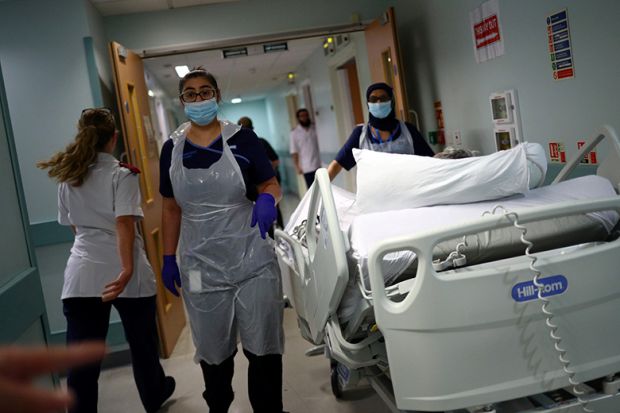
A planned tax on international students could impact the pipeline of NHS workers, with reduced foreign student numbers making it harder to deliver health and social care courses, universities have warned.
Responding to a government consultation on the incoming international student levy which closed this week, institutions have also called for exemptions for PhD candidates and exchange students, including those coming through the Erasmus+ scheme, which the UK recently committed to rejoin.
While institutions largely remain opposed to the tax, which will see them charged £925 per year for each foreign student they enrol, sector mission groups are now focusing on lobbying for more favourable rules and limiting the potential damage wrought by the policy.
MillionPlus, which represents modern universities, warned about the impact of the tax on health and social care courses, where international fees typically subsidise domestic students.
Many, including the government, have predicted that the number of international students coming to the UK will fall as a result of the levy, making it harder for universities to afford high-cost courses.
“There are concerns about the unintended consequences of the international student levy on the domestic pipeline of talent into the NHS,” the group writes in its submission.
It says the government should “exclude health and social care courses from the scope of the international student levy to ensure that this policy does not frustrate the government’s stated priority to tackle waiting lists and build an NHS fit for the future”.
This follows the government’s decision to cut funding for Level 7 degree apprenticeships, which also stoked concerns about the impact on the NHS.
Policymakers subsequently backtracked, announcing a mitigation fund that would ensure funding was retained for key health-related professions, including nursing and advanced clinical practitioners.
Rachel Hewitt, chief executive of MillionPlus said she hoped for a “pragmatic approach” to implementing the levy, “including recognising the pressures institutions already face, and the importance of protecting strategically important courses to the skills needs of the country”.
The Russell Group has also called for exemptions for PhD students, arguing that including them would jeopardise the UK’s research talent pipeline at a time when policymakers are keen to attract foreign scientists.
They said international students constitute nearly 50 per cent of PhDs achieved in the UK and applying a tax to them would contradict the government’s objective to improve the cost recovery and financial sustainability of research.
Similarly, given many PhD students benefit from UKRI funding, GuildHE argued applying a levy to them would mean the government is in effect taxing itself.
“Exempting PhD students is a low-cost but highly effective way to alleviate potential harm to the country’s research talent pipeline,” said Tim Bradshaw, chief executive of the Russell Group. “It will support efforts to attract more global talent, helping sustain our growth in research and development.”
The Russell Group also recommended that the government clearly define the intended aims and scope of the policy, following fears within the sector that, if enshrined in law, future governments which may be more hostile towards international students could significantly increase the levy.
“A legislative provision for the levy to expire at the end of the current parliament, unless renewed by a vote, would give the government a mechanism to review the impact of the policy,” the Russell Group writes in its submission.
“This would allow the levy to be withdrawn if unintended consequences emerge, or continued if it is meeting its objectives without harming sector sustainability.”
There are also concerns about the impact of the levy on exchange students, including those coming through the Erasmus+ scheme, which the UK committed to rejoining shortly after the tax was confirmed.
Students coming through Erasmus+ do not typically pay tuition fees to their host universities, yet the policy could mean institutions will still be charged for these students.
And, while the levy will not apply to students on short-term study visas, students on university exchange programmes or coming to the UK as part of articulation programmes from transnational education ventures are not generally eligible for these visas and so would be in scope.
“These arrangements directly benefit UK students, including disadvantaged students, by facilitating outward mobility and partnership exchange,” Independent Higher Education writes in its submission. “Including inbound exchange students within the levy would undermine reciprocal arrangements and conflict with broader internationalisation objectives.”
MillionPlus also pointed out that foreign nationals in the UK on skilled worker visas who take professional development courses may fall within the scope of the tax, despite the courses potentially costing less than the levy would.
“There is agreement across the sector that the international student levy will likely damage the UK’s reputation as a study destination and global R&D leader – with knock-on effects on long-term economic growth,” Bradshaw said.
“However, there are opportunities to mitigate this impact if government takes sensible decisions about the scope and implementation of the levy.”
Register to continue
Why register?
- Registration is free and only takes a moment
- Once registered, you can read 3 articles a month
- Sign up for our newsletter
Subscribe
Or subscribe for unlimited access to:
- Unlimited access to news, views, insights & reviews
- Digital editions
- Digital access to THE’s university and college rankings analysis
Already registered or a current subscriber?