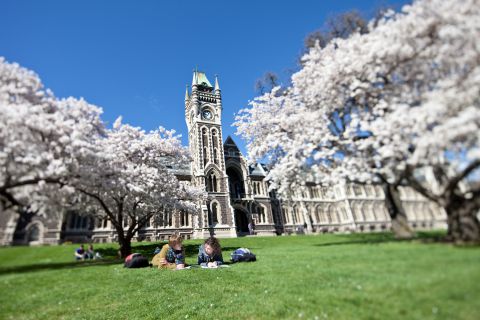
Administrators in New Zealand’s iconic student town have taken a harm minimisation approach to the unofficial week of frolics and foolhardiness that prefaces the academic year.
Students, many from other regions, comprise about one-fifth of Dunedin’s population and their numbers swell ahead of semester one at the University of Otago. The influx is marked by “Flo-Week” – flat orientation week – when renters return to apartments in neighbourhoods such as Castle Street in the student quarter.
Flo-Week has evolved from “flatmates having a few beers” to massive gatherings with bands and disk jockeys, according to “campus cop” John Woodhouse, a police officer based on the university campus. Young people from across the country and even Australia come to join in the fun, knocking on strangers’ doors to find the best parties.
Woodhouse said police had decided to shut off the area to contain the revelry in Castle Street and avoid having to manage scattered parties. “We will have…well over 1,000 people on the street, and essentially no offences,” he told Stuff news.
“Locals might see the mess…the next morning but it’s a small price to pay. The drinking will continue whether we like it or not. Don’t be afraid to come out to Castle and have a good time. The police are there to ensure a safe environment; we’re not here to be the party police.”
University administrators start their “behind the scenes” work weeks earlier, according to a spokeswoman, with staff from Campus Watch – Otago’s round-the-clock pastoral care service – making door-to-door visits to counsel student renters about safety, security and “waste and recycling requirements”.
This year, the university’s safety czars – proctor Dave Scott and his deputy Geoff Burns – took the extra step of organising preparatory meetings with the occupants of dozens of student apartments.
The university has also lobbied the city council to install extra glass recycling bins and called for local liquor shops to stop selling alcohol in bottles. Students who break glass on or off campus risk code of conduct consequences, including fines and community work penalties.
That has not saved Castle Street from becoming a field of glass shards, according to second-year student Charlie. “Everyone was just smashing bottles on the road,” he told Radio New Zealand.
Police draw the line at glass missiles. “If you smash a bottle deliberately on the ground you are going to the proctor, but if you throw one into the crowd you are going to court,” Woodhouse warned.
The parties are a source of both community identity and ire for Dunedin citizens, who have been suffering noise, rubbish, burning couches and, occasionally, riots and overturned cars, for years. This year’s festivities took a tragic turn when a non-student incurred critical injuries, reportedly after falling 10 metres from a ledge on a campus building – the second such incident in the past five months. “I cannot stress enough about the importance of staying off roofs,” vice-chancellor Grant Robertson said.
Pop culture website The Spinoff repeated the message in survival tips posted on Instagram. “If you find yourself at a party, check the location of your nearest roof. Ideally, it should be above you. Roofs are for keeping the rain off; they’re not for standing on. You’re thinking of floors. This information could save your life.”
Otago’s student newspaper Critic Te Ārohi, which celebrated its centenary last year, chronicled a week of Castle Street parties in 2019. Drinking, fights, sexual exploits and bodily secretions are prominent themes. A students’ association office holder related how partygoers had teamed up to kick down a fence. “People just want to connect,” he said.
O-Week, which follows Flo-Week, is university-sanctioned and considerably more sedate. Activities this year include campus tours, workshops, seminars and a non-alcoholic curtain raiser to the student association’s annual toga party, organised by a student support community called Locals.
Later this year, Otago will be able to turn the tables on non-locals by sending students into their backyards. Under a pilot exchange programme with Auckland University of Technology and Victoria University of Wellington, second-year domestic undergraduates will have the opportunity to swap institutions for a semester.
Register to continue
Why register?
- Registration is free and only takes a moment
- Once registered, you can read 3 articles a month
- Sign up for our newsletter
Subscribe
Or subscribe for unlimited access to:
- Unlimited access to news, views, insights & reviews
- Digital editions
- Digital access to THE’s university and college rankings analysis
Already registered or a current subscriber?