
The world is not a case study: teaching business judgement with the Bloomberg Terminal


You may also like
Can you teach hindsight?
We teach students concepts, theories and frameworks to build decision-making skills. The natural limit of the classroom, however, is that we cannot impart the raw experience of making a call with real consequences. What we can do is provide a proxy for that reality: forcing students to notice nuances, choose one option among many and practise accepting accountability for that choice.
I use hindsight as shorthand for what accumulates through that process – not simply knowing what happened after the event, but the judgement that develops from having navigated the problem yourself. Theory can give students someone else’s explanation, someone else’s hindsight. It cannot replace the mental work they must do to figure out how that theory functions in their own hands.
That capacity grows through exposure. Yet much of what we give students has already been organised for them. A case study may be complex, but someone has decided where it starts and ends, what information belongs and what deserves attention.
That is entirely appropriate, but the trade-off is that it removes some of the work through which judgement is developed.
The world is not a case study
Professional information is messier. Relevant and irrelevant material live together. Context is incomplete. Significance is uncertain. The challenge, in many cases, is recognising which question is worth asking and how to formulate that question.
Students need opportunities to practise that part, too: what am I looking at? Why might it matter? What can I ignore? What do I not understand? What should I investigate next?
This is where I find the Bloomberg Terminal educationally compelling. It is software that seamlessly integrates real-time and historical data, market moving news and analytics to help leading business and financial professionals worldwide make better informed investment decisions. Among many other things, students can analyse supply chains, compare financial trends over time, and visualise geospatial relationships. Bloomberg is not organised around a university curriculum. I bring the disciplinary lens and frame the problem; the Terminal provides the information environment through which students investigate it.
- Spotlight guide: Soft skills for hard times
- Spotlight guide: Get your students workplace-ready
- How your graduates can beat AI in the job market of tomorrow
Every business decision happens somewhere
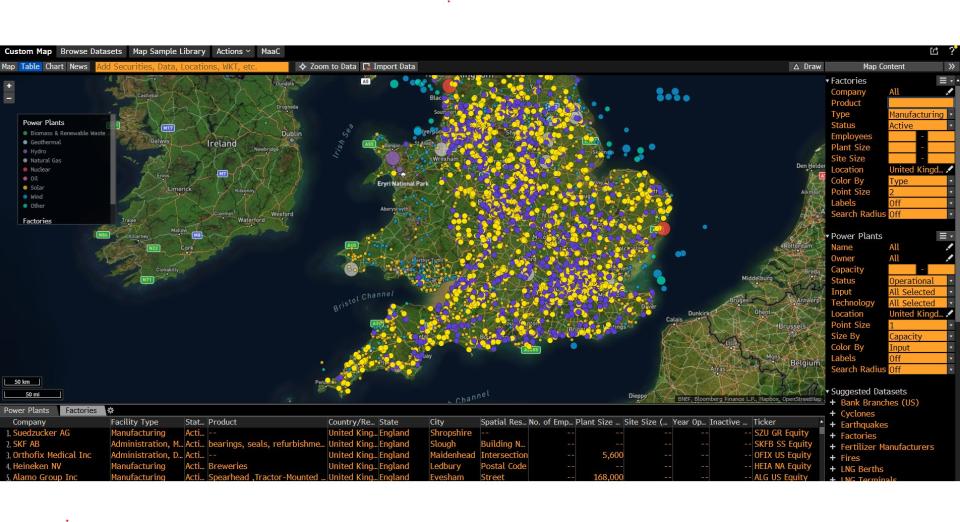
In international business, the “where” moves to the foreground. Geography shapes access to markets, suppliers, energy and transport. Some conditions are difficult to change: a country either has direct access to the sea or it does not. Others evolve. Ports expand. Transport networks develop. Energy systems shift. Business activity clusters in particular places. Bloomberg’s interactive MAP <GO> function makes these relationships visible.
Start with one type of information, such as factory locations. Let students zoom into a country or region and simply look. Where are factories concentrated? Do they cluster around major cities, coastlines or borders? Does anything stand out as unexpectedly isolated?
Now add another dataset to the same map: power plants. See how the patterns overlap. A cluster that initially looked commercially attractive may now raise another question: what powers it? Is there renewable capacity nearby? Does the new information support the initial interpretation?
Remove that dataset and add another or keep both visible and add a third. Ports and shipping activity illuminate connectivity. A place that appeared peripheral may suddenly look different. Each new dataset adds nuance that could change the previous interpretation.
When something does not make sense, don’t explain
Ask instead: What would you need to know to explain this?
A factory on the map may prompt a student to investigate the company further. That may raise another question and lead the student to search the Terminal’s news coverage. What they find may confirm the original interpretation, contradict the company’s own narrative or reveal something neither student nor educator expected.
Enquiry begins to snowball because students decide what deserves investigation, rather than merely follow a predetermined sequence of steps.
The Terminal helps because students move across different types of information within the same platform: from a map to company data, news or financial information, while continuing to investigate the same problem.
Next, ask students to reflect on their enquiry and present to the class.
Anyone can make a choice. Judgement is harder
Judgement means being able to explain why you made the choice you did, given the constraints, uncertainty and information available at the time. Ask students to revisit their reflections a couple of weeks later.
New information may have appeared. Conditions may have changed. Or nothing may have changed at all. The important comparison is between what students thought then, what they can see now and how they account for the difference in their own thinking. That return reconnects the exercise with hindsight.
Repeat the cycle across different problems and those comparisons begin to accumulate. Students are learning to read their own reasoning in addition to reading the business landscape.
This may be as close as the classroom gets to teaching hindsight.
Irina Gokh is an associate professor at De Montfort University.
If you would like advice and insight from academics and university staff delivered direct to your inbox each week, sign up for the THE Campus newsletter.
