
Understand the motivations involved in research-policy exchange



You may also like
Better-evidenced policy decisions are crucial for delivering government priorities – and policymakers are realising that. But while both governments and higher education institutions have ramped up their research-policy engagement initiatives, we’re seeing a lack of systemic thinking on how best to design structures and processes for research-policy exchange. Critics have described activity as “busy rather than effective”.
- Spotlight guide: An academics’ guide to policy impact
- From peanut butter to effective policy impact
- What I learned about knowledge transfer with policymakers during my parliamentary fellowship
A key aspect, missing from these debates, is what’s driving government and researchers to engage in research-policy exchange in the first place. Our framework, outlined in a report supported by the Royal Society of Edinburgh and Universities Scotland, can help researchers make sense of these different motivations.
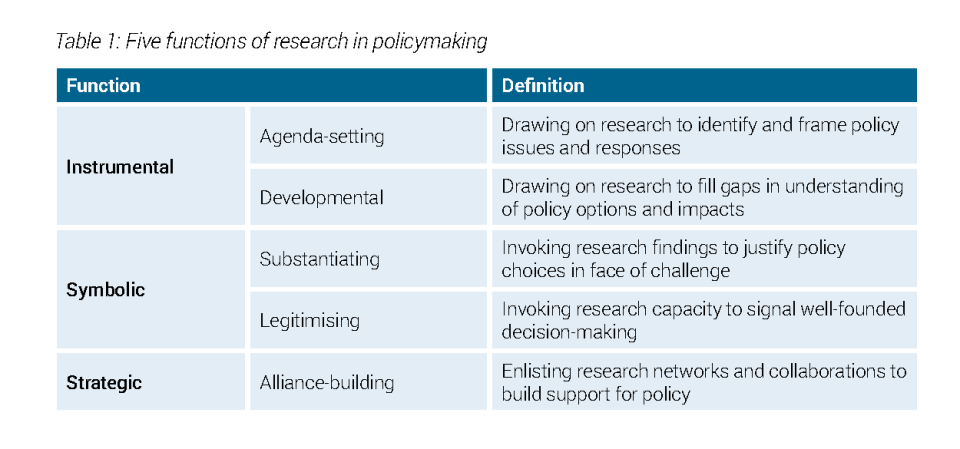
For policymakers, research-policy exchange can help identify new policy problems and develop responses – the “instrumental” function of knowledge. This can take two main forms:
- Agenda-setting: harnessing knowledge to identify new problems or responses to them
- Policy development: acquiring knowledge that helps policymakers flesh out and operationalise already chosen policies
While the first type of knowledge is typically initiated by researchers, the second is more likely to be commissioned by civil servants.
Beyond this instrumental function, research can have other crucial roles for policymakers. It can help substantiate policy: provide an evidence base for contested decisions. And it can legitimise policymakers: signal the competence of departments or agencies to make well-grounded decisions – both crucial in our current age of misinformation. Engaging with researchers can also help governments build stakeholder alliances to help elaborate and deliver policy.
For the research community, research-policy exchange often aligns with their personal and institutional ambitions to secure impact. But academics also need to evidence the impact of their research to funders, and have strong incentives to gain recognition for their particular project or research grouping. This often leads to a fragmented approach to engagement, where multiple researchers or research groups with overlapping projects are jostling to influence government.
Researchers engaged in research-policy exchange are not always savvy about the different roles research may play in government. And policymakers might not understand what researchers and universities want and need in terms of impact recognition. Too often, this means that research-policy exchange does not meet the goals of those involved, leading to frustration and wasted resources.
Recognising these challenges, our new report has developed a framework for helping understand the different motivations for research-policy exchange and, crucially, for designing structures that help address these challenges – whether these take the form of advisory structures, in-house capacity, commissioned research, thematic research centres or mobility schemes.
Scotland offers an excellent test bed for trying out new approaches, with a national government, parliament and outstanding universities. Its smaller scale and strong connectivity also enable coordinated initiatives that can get buy-in from across the research-policy ecosystem. We are therefore working with government, universities and broker organisations in Scotland to develop more detailed proposals for improving research-policy exchange, on which we will be consulting over the next few months.
We hope Scotland can inspire other parts of the UK and beyond to work together to improve how we design and deliver research-policy exchange. Given what is at stake, we need to make sure our activity is rigorously designed to meet the needs of all parties, in a way that is effective, rather than just busy.
Christina Boswell is a fellow of the Royal Society of Edinburgh, professor of politics and vice president of the British Academy.
If you would like advice and insight from academics and university staff delivered direct to your inbox each week, sign up for the Campus newsletter.
