

StrikePlagiarism.com at WCRI 2026: strengthening global academic integrity and AI governance


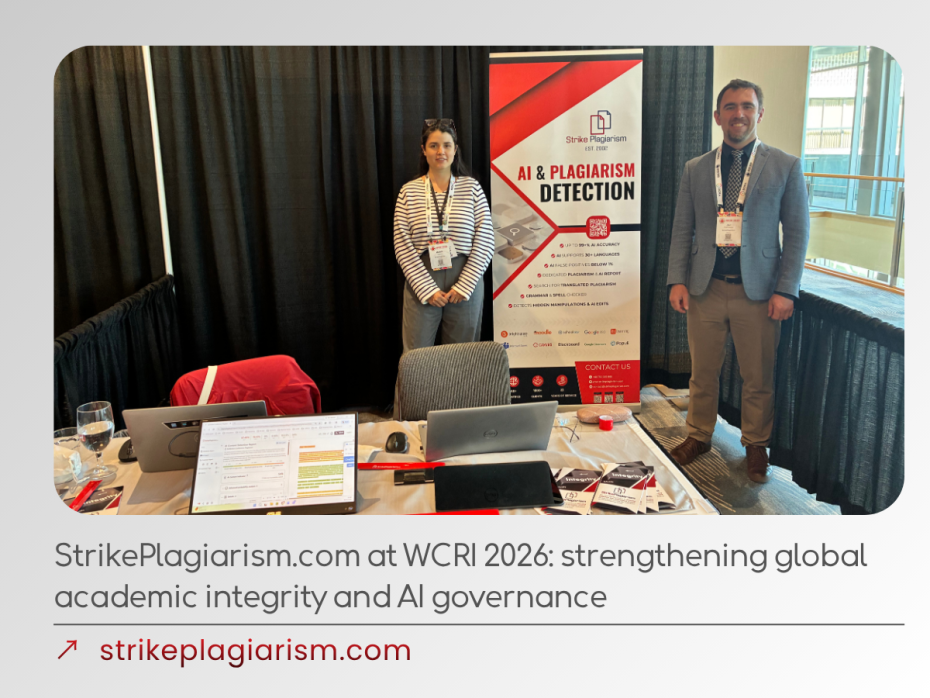

As one of the world’s leading conferences dedicated to research ethics and academic integrity, WCRI brought together universities, publishers, and educational technology leaders to address the growing impact of generative AI on higher education and research.
AI governance as a strategic priority
Throughout the conference, one message repeatedly emerged: institutions are no longer debating whether AI will transform education and research — that transformation is already under way. The real challenge is preserving academic integrity, transparency and trust while integrating AI responsibly into teaching, learning and research.
Across sessions, universities shared a common concern: there is still no universal framework for AI governance in higher education, leaving institutions to build policies and operational models in real time as the technology continues to evolve. As a result, demand is growing for solutions that combine AI detection, authorship verification, explainability and policy integration within a single coherent framework.
From AI detection to institutional confidence
One of the most discussed topics at WCRI concerned the reliability and responsible use of AI detection technologies. Universities continue to ask the same questions:
- How accurate are AI detection systems?
- How should institutions interpret AI-probability results?
- How can these technologies be implemented ethically and transparently?
StrikePlagiarism.com presented its broader approach to AI-supported academic integrity, positioning AI detection as a decision-support mechanism rather than an automated disciplinary system. Under specific testing conditions, its AI Content Detection technology reaches accuracy levels of up to 98%, helping institutions identify high-probability AI-generated content while preserving transparency and human academic review.
Strengthening international collaboration
Participation at WCRI also marked the continued development of StrikePlagiarism.com’s international partnerships, including its ongoing collaboration with the Ontario Education Collaborative Marketplace (OECM). Conversations throughout the conference confirmed growing global demand — not only for detection software, but for strategic guidance and long-term integrity frameworks capable of adapting as AI-assisted education continues to evolve.
Why it matters
WCRI 2026 confirmed a broader shift in higher education: universities are no longer looking only for plagiarism-detection tools — they are looking for partners that can help them navigate AI governance and authorship verification at institutional scale.
As generative AI continues to transform higher education globally, academic integrity is becoming not just a technological challenge, but a strategic priority for universities worldwide. StrikePlagiarism.com continues to support institutions with solutions that combine technological precision, explainability and responsible academic evaluation.
StrikePlagiarism.com → Real detection. Real integrity.
