
The five levels of learning designer support



Created in partnership with

Created in partnership with
You may also like
What causes tension between learning designers and academic teaching staff? Although they can form powerful collaborative relationships, mismatched expectations on both sides can spell trouble. For example, an academic expecting hands-on support may be caught short when the learning designer only has the capacity to provide advice. Alternatively, learning designers might expect to have responsibility for the final appearance and structure of teaching materials, while the academic only wants support with some aspects of their development.
Here, I’ll propose a five-point scale that articulates the type of support provided by learning designers and other third-space professionals, referenced against the responsibilities that lie with the academic. Level one is the baseline, where the academic is fully self-guided in their engagement, while level five implies the highest level of hands-on individual support.
- Using design sprints to reimagine university learning experiences
- How to support staff across all departments to design quality online courses
- Spotlight guide: How to advance collaboration across higher education
The scale assumes that the collaboration between an academic and a learning designer produces a tangible output: this could be a course syllabus, teaching materials, videos or other media, or an entire end-to-end online course build. Furthermore, the scale refers to learning designers but may be applicable to anyone working in similar third-space roles: educational technologists, course builders, learning media specialists, academic developers and so on. Just note that the descriptions below may not encompass the full scope of those other third-space roles.
The scale is not intended as a hierarchy because it is important for support to exist at all five levels, and all levels require deep and complex knowledge in educational design. Higher levels on the scale typically involve closer collaboration and rely on learning designers understanding the context and details of the learning material more deeply, with more direct influence on the final outputs. By contrast, lower levels imply less direct influence from the learning designer, but potentially a wider reach.
Finally, I’ve named a “persona” that describes the role of the learning designer or third-space professional at each level. For learning designers, adopting a persona could help clarify your role, the role of the academic and where your responsibilities start and finish.
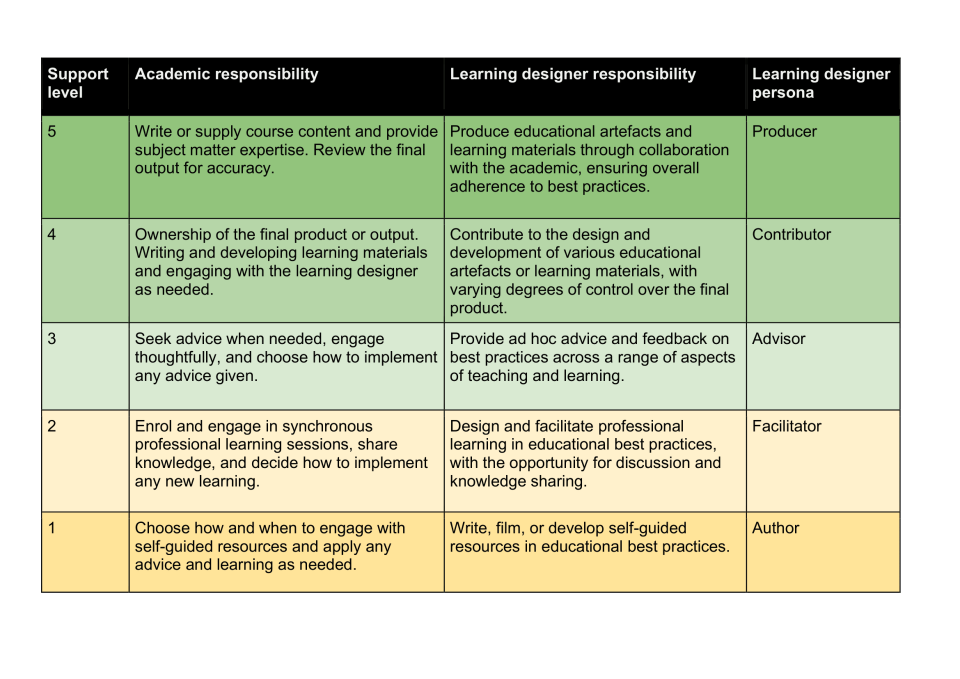
To unpack this further, consider the examples below.
Level five: learning designer as producer
In the production of fully online micro-credentials and courses, academics are contracted by the university to write and supply course content. A team of learning designers and media specialists helps define the course structure, edit content for clarity and arrange the filming and production of course videos, as well as building the finalised content in a learning management system.
Level four: learning designer as contributor
Learning design units are engaged for targeted uplifts to existing university courses and programmes. Learning designers help to present content in a more structured fashion in the learning management system, or design specific interactive media and videos. Although the learning designers may contribute strongly to these specific aspects of the course, they are not responsible for its overall quality and delivery.
Level three: learning designer as adviser
Learning designers and other third-space professionals are available for one-to-one consultations for academics seeking personalised advice, in areas ranging from constructive alignment and assessment design to the use of educational technology. Academics may also seek feedback on specific learning materials or other educational artefacts such as rubrics.
Level two: learning designer as facilitator
Learning designers can provide workshops to academic staff, in various topics encompassing educational technology and pedagogical best practices. As opposed to training, which can imply a one-way transfer of knowledge, facilitation invites collaboration, knowledge-sharing and questioning from those attending.
Level one: learning designer as author
Learning designers from a central teaching and learning unit write and publish self-guided resources to support teaching and learning. These take the form of web pages, downloadable resources, online courses and instructional videos.
Applying the five-point scale
So why is a scale useful? As someone who has worked across all five levels of support, I envisage this as a tool for situating our roles as learning designers in a new project or initiative. It can help form collaborative partnerships with academics by articulating the level of support – and hence, influence – up front. This specification may happen within the third space, or by an academic choosing from the levels, like a menu for how they wish to engage.
For those working in a third-space role, you might wish to consider where your work sits on the scale. If you are consistently working at a given level and are seeking more diversity in your role, then consider what you can provide at other levels. For example, if you are always working on level-five course design, you might find consistent issues appearing that warrant the development of a professional learning workshop (level two) or documentation (level one). This also holds true at an institutional, or unit, level. Central teaching and learning units can provide more diverse forms of support by addressing all levels on the scale, giving academic staff multiple means of engagement that suit their preferences and capacity.
Daniel Searson is a learning designer at Adelaide University.
If you would like advice and insight from academics and university staff delivered direct to your inbox each week, sign up for the Campus newsletter.
Additional Links
For further advice and insight on this topic, see our spotlight guide: Connecting the dots between academic and professional services staff.
