

Ensuring trust and security in global research


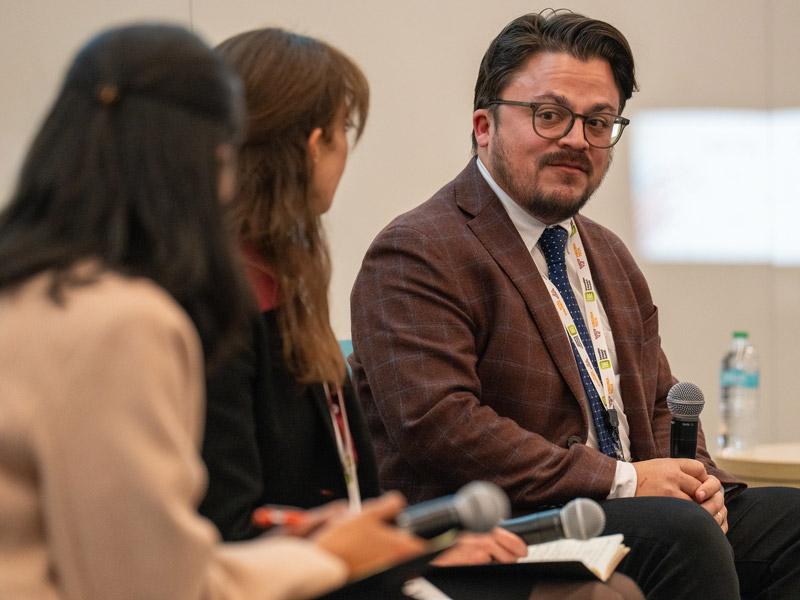

Maintaining trust and security in international research can be a delicate balancing act. During a panel discussion, held in partnership with Digital Science during the 2025 THE Innovation and Impact Summit, academics and industry experts came together to discuss how institutions can navigate openness, integrity and partnerships in global research.
“The idea of trust spans many levels,” said Jonathan Breeze, executive vice-president for academic markets at Digital Science. Trust in the scientific method is essential as a basis for the research being carried out. Confidence in researchers is also key, which encompasses their expertise, honesty and approach to research. “And there is trust in institutions that they work for and work with, and in research output and scholarly records of research activity,” said Breeze.
Effective leadership in research security requires finding a balance between being reactive when certain situations arise and being proactive in building understanding and trust within the community. This demands being curious about different perspectives and ideas within the research ecosystem.
Leading research offices is fundamentally about change management, said Deepika Bhatia, associate vice-president for research compliance and regulatory affairs at Emory University in the US. It requires constant monitoring of trends and changes across the state and the country. “Unfortunately, it also means looking at worst-case scenarios and doing ‘what if’ planning to be prepared,” said Bhatia.
Similarly, creating a culture of security and integrity at institutions requires strong leadership to shift the focus of research security from being a bureaucratic compliance task to a core institutional imperative. Leveraging relevant case studies and academic networks can help educate academics and researchers.
“Feedback is important to getting buy-in from the people who are critical of the motives behind changes in procedure,” said Amanda Humphrey, chief research operations officer at Northeastern University in the US. “Invite them to engage with you specifically, by joining a committee or ask them proactively what their comments are on a new policy. Because those are the people who are really going to look at it with a critical eye and give you the best feedback.”
However, even when research institutions take the utmost care to maintain trust, integrity failures can occur. When they do, it is vital that trust is quickly rebuilt among funders, the academic community and the public. Technology, scenario planning and transparent outreach are critical here.
Treating any response like an internal audit finding, creating a management plan to shape the official response, is another useful approach to an integrity failure, said Gregory Smith, director at Huron Consulting Group. Smith spoke about the importance of demonstrating due diligence and preparation among leaders when responding to an investigator or agency.
The panellists agreed that it would be a mistake for institutions to view security and integrity as separate pillars. Research integrity should be built on values like honesty, rigour and accountability. Framing security through this lens gives it greater relevance for all faculty members, as it connects directly to their existing priorities.
Institutions must create an environment where researchers can bring all spokes in a wheel together. All security and compliance components are interconnected, said Bhatia. “It is essential to connect the dots and make sure that if people are not using any stopgap measures for when they are sharing or utilising data.”
The panel:
- Deepika Bhatia, associate vice-president for research compliance and regulatory affairs, Emory University
- Jonathan Breeze, executive vice-president for academic markets, Digital Science (chair)
- Amanda Humphrey, chief research operations officer, Northeastern University
- Gregory Smith, director, Huron Consulting Group
Discover how you can strengthen research security at your institution.
