
Bridging the academic-commercial divide: a practical guide for university researchers



Created in partnership with

Created in partnership with
You may also like
Popular resources
The terrain between laboratory and commercial impact is often unfamiliar to academic researchers. Scientists are trained to generate knowledge, but translating insights into real-world applications brings considerations such as intellectual property (IP), regulatory pathways and market alignment into the journey. Early decisions around disclosure, collaboration and development can shape whether a discovery even leaves the bench.
With the right guidance and partnerships, though, researchers can bridge the gap from innovation to implementation, ensuring their work delivers societal and commercial value.
Identifying commercial potential
The first step in commercialisation is determining whether the research addresses an unmet need. Researchers should consider:
- Market relevance: Who experiences the problem, and how is it being solved?
- Competitive advantage: Do the research results offer superior performance, cost-effectiveness or scalability?
- Feasibility and readiness: Can the technology be developed into a practical, reliable solution?
Early engagement with potential users, industry partners and stakeholders helps validate assumptions and ensures that the research aligns with real-world demand.
Impediments to commercialising university intellectual property
Despite strong research output, universities often face structural and cultural barriers that slow or limit commercialisation of IP. A key challenge is misalignment between academic and commercial incentives; promotion and tenure systems tend to reward publications and grant funding rather than technology translation, reducing faculty motivation to pursue commercialisation.
- The path from ‘eureka’ to patent
- When should scientists think about trademarks?
- Spotlight guide: How academia can work well with industry
Early-stage technology risk also poses a hurdle. Many university inventions are at low technology-readiness levels and require substantial proof of concept, validation or regulatory work before they will attract industry or investor interest. Limited access to translational funding can further delay progress.
IP complexity can compound these challenges. Unclear ownership, multiple inventors, overlapping rights or obligations tied to sponsored or federally funded research may complicate licensing negotiations and increase transaction costs.
Resource constraints within technology transfer offices are another factor. They might face limited staffing, marketing capacity or specialised industry expertise, which can slow or otherwise hinder outreach to potential partners.
Finally, cultural and communication gaps between academia and industry can impede progress. Differences in timelines, risk tolerance and expectations – particularly around publication, confidentiality and development milestones – may discourage industry engagement.
None of these challenges are insurmountable. But it does require better-aligned incentives, early market engagement, clear IP policies, sufficient translational resources and close collaboration among researchers and commercialisation teams.
Balancing open research and commercialisation
Open research fosters collaboration, accelerates scientific progress and aligns with academic values. At the same time, premature disclosure can jeopardise IP rights. To balance these priorities, consider:
- Strategic disclosure: Submit invention disclosures before publishing or presenting results.
- Collaborative agreements: Use non-disclosure agreements (NDAs) when engaging with potential industry partners.
- Selective openness: Share research outputs in ways that advance science without compromising patentable elements.
Role of corporate engagement
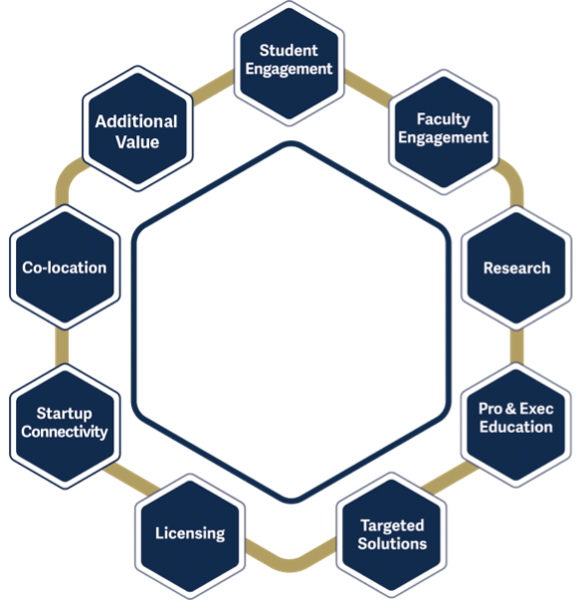
Corporate engagement is vital to advancing the research, teaching and public missions of higher education institutions. Strategic partnerships with industry (see Figure 1) expand the impact of research, provide experiential learning and accelerate the translation of innovation into societal and economic value.
In research, corporate engagement offers access to industry expertise, real-world problems and additional funding through sponsored projects, joint development and consortia. These collaborations help align academic work with market needs, inform technology development and support commercialisation pathways, while preserving academic independence.
Corporate partners also enhance education and workforce development. Internships, co-ops, industry-led projects and guest instruction give students hands-on experience with emerging technologies and professional practices. These opportunities strengthen career readiness and keep curricula responsive to evolving workforce demands.
From an innovation perspective, corporate engagement supports technology transfer through licensing, start-ups and strategic investment. Industry partnerships help de-risk early-stage technologies, validate market applications and accelerate adoption. Effective engagement requires clear governance, transparent IP and publication policies, and strong coordination across research administration, technology transfer and academic units.
Advice for academics collaborating with industry
Industry collaborations can accelerate research impact, provide resources and reveal market insights. To start, researchers should first clarify objectives, whether testing technology, co-developing products or gaining funding. IP protection is crucial; work with the university’s technology transfer office on IP ownership, licensing and publication plans. Formal agreements such as NDAs and sponsored research contracts define responsibilities, confidentiality and deliverables. Balance industry goals with freedom to publish and pursue independent research, while regular communication and mutual benefit are key.
The transition from laboratory discovery to commercial impact demands thoughtful planning and engagement beyond the bench. By working closely with technology transfer and industry partners, researchers can amplify the reach of their work and convert scientific breakthroughs into enduring societal and commercial impact.
Mary Albertson is director of the Office of Technology Licensing and Kashmira Kulkarni is a senior licensing associate, both at Georgia Tech.
If you would like advice and insight from academics and university staff delivered direct to your inbox each week, sign up for the Campus newsletter.
