
AI use tailored to creative-industry programmes requires institution-wide support


You may also like
Popular resources
The context for artificial intelligence in creative industries in higher education is awash in contradiction. Although students pursuing creative and design programmes are entering industries that are among the most affected by AI, some (including whole cohorts) are opposed to generative AI to the point that they do not even want to discuss it. While many have objections on ethical or environmental grounds, some students have told us that they do not want to use AI because they do not want it to replace their jobs. Staff also hold wide-ranging views, even within the same programmes.
There is clearly some basis for this fear. Brave New World? Justice for Creators in the Age of GenAI, a joint report from the Association of Photographers, the Society of Authors, the Association of Illustrators and the Independent Society of Musicians, found a proportion of job loss and reduced income owing to the use of GenAI. However, an article from Gallup last month paints a more complex picture. Based on a recent study published in the Journal of Cultural Economics that used Gallup Panel workforce studies and labour market data, it describes an industry undergoing a process of reorganisation rather than displacement.
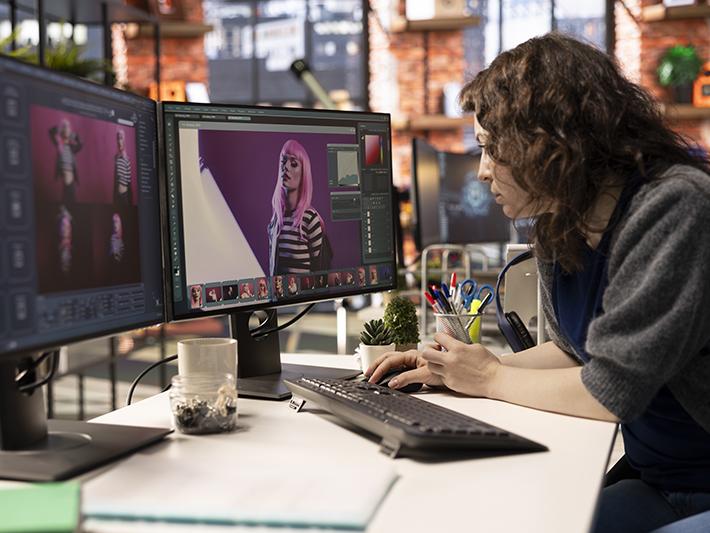
Whatever the reality for individual practitioners, the creative industries are actively using AI to broaden skill sets and iterate more quickly. The tools complement and are increasingly part of design software. Students and staff need to be aware of what it means to employ AI in the design process. So education in these fields must consider the best practice in the application of tools but also teach students the design fundamentals that underpin effective critical and creative processes.
- Spotlight guide: Boosting AI literacy across your institution
- Campus Talks podcast: What does ‘AI across the curriculum’ look like in practice?
- Why AI literacy must be discipline specific
In creative disciplines, Alan Beattie, head of education in the School of Design Innovation and programme leader for Fashion Textile Design at De Montfort University (DMU), offers a useful illustration of how the programme is redesigning assessments to adapt to changing industrial practice. AI here is just one tool in a broader creative toolbox, no different in principle from a pencil, a paintbrush or a pair of scissors, and students must exercise distinct skills to use it with genuine authorship. Students are now required to reference the tools they use and the prompts they write, making visible how much of the work is theirs and how much is generated.
This approach addresses the homogenisation risk inherent in uncritical AI use: without grounding in design knowledge and creative judgement, AI-generated work converges towards the generic. Teaching students to resist that tendency, and to evaluate critically what AI produces, is both a disciplinary and an industry-readiness imperative. Students who are not well versed in AI will not be industry ready in a sector that has always moved quickly and is now moving even faster.
Thom Corah, as lead for digital pedagogy and AI in the School of Creative Industries and Culture, provides critical leadership in advancing AI literacy among students entering creative fields. His initial research draws on graduate outcome data to identify common career pathways, which, when combined with findings from studies such as the PwC Global AI Jobs Barometer and the McKinsey Global Tech Agenda, highlights the growing demand for AI-skilled graduates. This evidence supports programme-specific discussions about AI, further enriched by guest speakers from the creative industries who share practical insights, encouraging students to view AI not only as a challenge but also as a tool for enhancing creativity and professional practice.
This speaks to a subject-level approach to the use of AI in the curriculum. AI cannot be standardised across disciplines. While institutional principles provide direction, effective implementation requires understanding subject differences in professional expectations and the attitudes of staff and students in each area. The right approach will not be the same across subjects but must be tailored to each area, with reference to the evolving industrial applications each targets, and with respect for the programme teams and their students.
That said, we take an institution-wide approach to the role of AI in industry and the extent to which it is reflected across curricula. Resources that cover authorship, copyright, ethical, environmental and privacy concerns have been developed, with CPD for students and staff, as part of the DMU AI Campus Collective.
Preparing AI-literate graduates for workplaces is critical; our graduates are already working in environments where AI is used, and more employers will encourage or expect effective use of AI to increase productivity. The question is not whether to enable them to use it, but rather how to ensure that they do so ethically and responsibly and that AI adoption does not widen inequalities between those with the resources and knowledge to use these tools and those without.
Shushma Patel is pro vice-chancellor (artificial intelligence), dean of the Faculty of Technology, Arts and Culture and a professor of information systems at De Montfort University.
If you would like advice and insight from academics and university staff delivered direct to your inbox each week, sign up for the Campus newsletter.
