
The Battery in Your Wall: How VinUniversity Researchers Are Turning Dead Batteries into Stronger Buildings
Every year, billions of Zinc-Carbon batteries are thrown away. The metals get some attention, but the carbon-rich black mass inside — the part nobody wants — goes straight to landfill, quietly leaching zinc and manganese into soil and groundwater. Researchers at VinUniversity's Digital Materials Science Laboratory, part of the Center for Environmental Intelligence (CEI), decided that waste deserved a second life. They collected spent batteries on campus, dismantled them by hand, and extracted two materials: graphene sheets and carbon black nanoparticles. Both were then mixed into cement. The results, published in Resources, Conservation & Recycling, were striking—cement strength improved by up to 34.5%, while embodied carbon and cost per unit strength dropped by around 22%. The materials worked by filling microscopic pores and accelerating cement hydration, producing a denser, stronger matrix. No rare elements, no expensive processes—just smarter thinking about what we usually throw away.

Sponsored by

Sponsored by
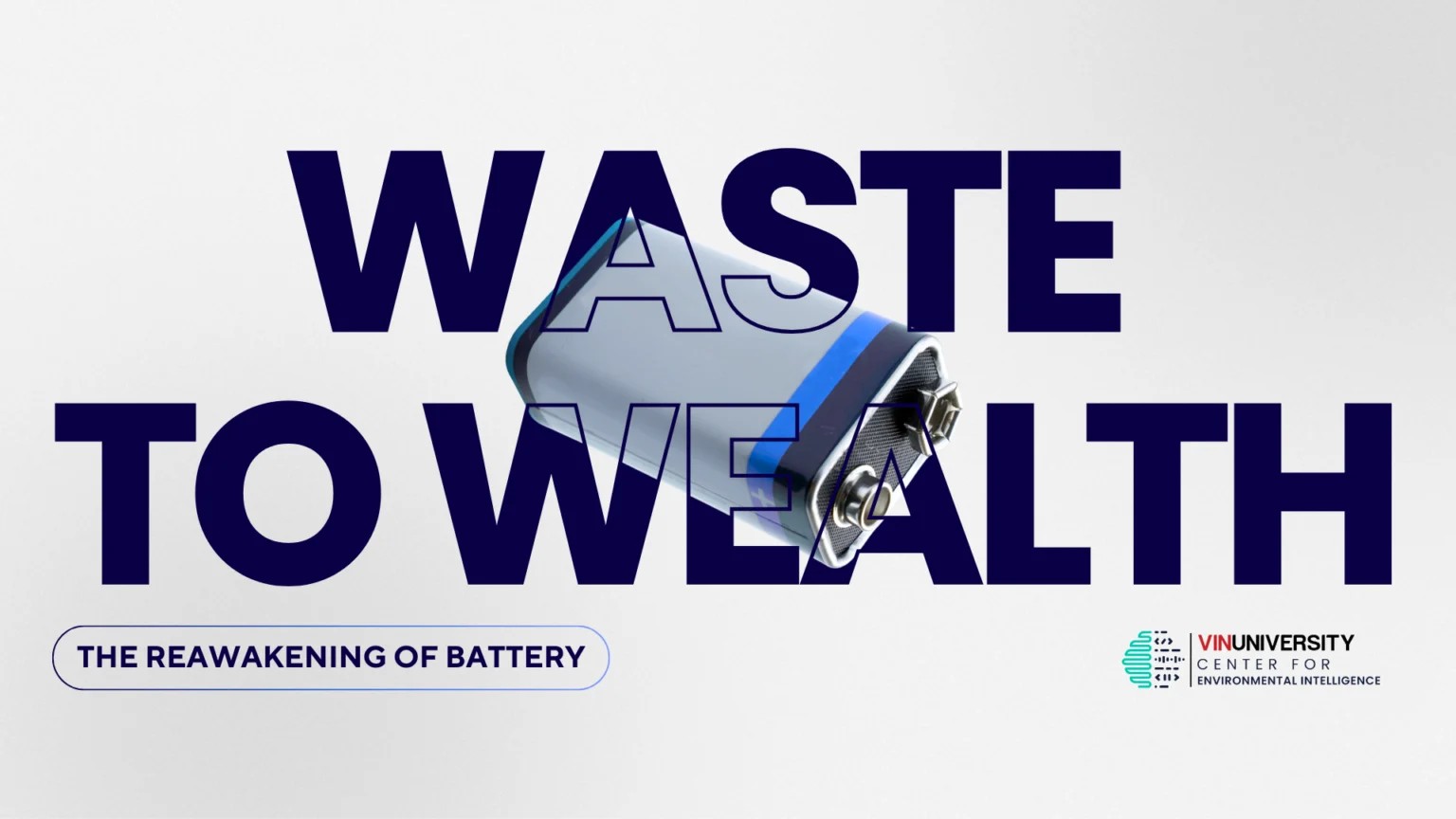
Waste to Wealth: The Reawakening of Battery
April 09, 2026
Inside every spent battery is carbon that could be strengthening the concrete beneath your feet. Researchers at CEI’s DMS Laboratory decided to put it there.
Most recycling conversations about batteries fixate on the metals: lithium, cobalt, nickel. These are finite, expensive, and politically fraught, obvious targets for recovery. But they are not the whole story.
When a Zinc-Carbon battery dies, it leaves behind something less glamorous: a carbon-rich internal black mass that conventional recycling largely ignores. It goes to landfill, where the chemicals corrode into soil and water over years. This is the part of the battery lifecycle that nobody talks about at climate conferences.
Researchers at the Digital Materials Science (DMS) Laboratory, Center for Environmental Intelligence (CEI), VinUniversity, decided to ask a different question. Not what to do with battery waste but what it could actually do.
The team collected spent Zinc-Carbon batteries at VinUniversity, dismantled them by hand, and processed the internal black mass into two distinct materials: carbon black nanoparticles and graphene sheets. Both were then tested as additives in cement.
The logic is refined once you see it. Cement, at the microscale, is full of flaws, tiny pores and hairline cracks that form as it cures and limit how much load it can bear. Carbon black, when added in small quantities, permeates and fills those gaps. Graphene, with its famously strong molecular structure, reinforces the matrix around them. Together, they address weaknesses that conventional cement additives also try to solve except these came from a bin.
The question was not how to dispose of battery waste but what it could actually do.
These figures, published in Resources, Conservation & Recycling, represent theoretical estimations but they are grounded in controlled experimental conditions and point clearly in one direction: materials derived from battery waste can compete with and in some cases outperform the purpose-built commercial additives.
The part recycling has been getting wrong
There is a quiet assumption embedded in how we approach recycling: value lives in scarcity. We recover what is rare or expensive and leave the rest. It is a reasonable perspective but also a self-limiting one.
This research makes a case for a different logic. Carbon black and graphene are not rare nor glamorous. They are the part of the battery that nobody thought was worth saving and yet, properly processed and applied, they deliver results that matter in one of the most widely used in construction.
The study does not create a revolution, it shows a proof of concept that is practical and does not require a fancy technology to arrive. The materials are already in circulation. The infrastructure that needs strengthening already exists. What was missing is the question and the new perspective to answer that.
Source: Recycling carbon nanomaterials from spent battery waste for enhanced cementitious composites – Resources, Conservation & Recycling. Research conducted at DMS lab, Center for Environmental Intelligence, VinUniversity
Find out more about the research here:
Recycling carbon nanomaterials from spent battery waste for enhanced cementitious composites