
AI-Driven Energy Research: VinUni and SK South East Asia Investment Launch Multi-Year R&D Partnership
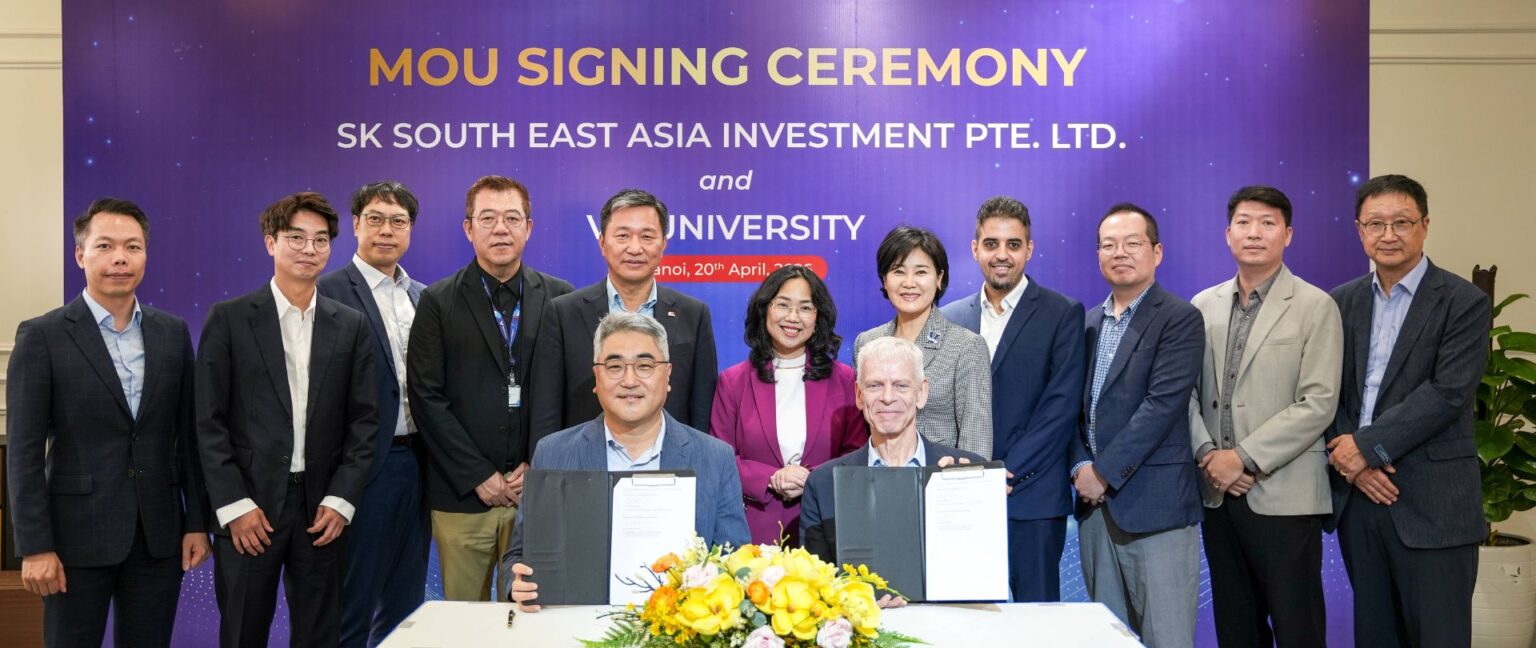
"On April 20, 2026, VinUni signed an MOU and Joint Development Agreement with SK South East Asia Investment PTE. LTD., a subsidiary of South Korea's SK Innovation. The partnership, led by VinUni's Center for Environmental Intelligence (CEI), carries an initial funding commitment of USD 300,000, with potential total R&D investment of up to USD 1 million over three years. The collaboration centers on two AI-focused research projects running from 2026 to 2028: optimizing Battery Energy Storage Systems (BESS) integrated with data center thermal management, and developing AI-based forecasting for EV-charging Virtual Power Plants. Expected outputs include advanced algorithms, digital twin platforms, publications, patents, and technology prototypes. University leaders emphasized the deal as recognition of VinUni's growing research reputation and its relevance to Southeast Asia's energy challenges. Both parties plan to expand the collaboration through broader research programs, talent development, and technology transfer initiatives in the future."

Sponsored by
Sponsored by
VinUni and SK Innovation Establish Joint Research Collaboration on Energy Systems and Digital Infrastructure
VinUniversity, through its Center for Environmental Intelligence (CEI), has entered into a three-year research collaboration with SK Innovation Co., Ltd. and SK South East Asia Investment Pte. Ltd. The collaboration, structured as an R&D contract valued at up to USD 1 million for three years, focuses on the development of application-oriented technological solutions in energy systems and digital infrastructure.
This partnership reflects a growing alignment between academic research and industrial problem-solving, particularly in areas where energy demand, digitalization, and sustainability intersect. It also signals increasing engagement of global industry partners with research capabilities developed in Vietnam.
Research Scope and Objectives
The collaboration is organized around two joint research projects addressing distinct but interrelated challenges in contemporary energy systems. Both projects respond to the need for more efficient, adaptive, and scalable energy solutions under conditions of rising demand, system complexity, and uncertainty.
Project 1 – Integrated Optimization of BESS and Server Thermal Management
Duration: 2026–2028
Principal Investigators (VinUni): Dr. Ahmad Hajjar and Dr. Pham Hai Hung
This project addresses the increasing convergence between energy storage systems and digital infrastructure, particularly in data centers and BESS-integrated environments. As both systems operate under dynamic electrical and thermal loads, ensuring energy efficiency and thermal reliability has become a critical technical challenge. The research focuses on developing integrated optimization approaches that jointly consider energy storage operation and server thermal management. The aim is to improve system performance while maintaining operational stability and scalability.
The project is structured into four work packages:
- WP1: System design basis and technical coordination for integrated BESS-server configurations
- WP2: Development of AI-based models for thermal behavior and cooling energy prediction
- WP3: Optimization methodologies for system sizing and operational scheduling
- WP4: Design of a testbed and development of a digital prototype
Through these components, the project seeks to establish a methodological and experimental foundation for next-generation energy-efficient digital infrastructure.
Project 2 – AI-based Forecasting and Optimal Scheduling for EV-Based Virtual Power Plants
Duration: 2026–2028
Principal Investigators (VinUni): Dr. Nguyen Phi Long and Dr. Pham Hai Hung
The second project focuses on the integration of electric vehicles (EVs) into power systems, particularly within the framework of Virtual Power Plants (VPPs). As EV adoption increases, their aggregated charging demand presents both challenges and opportunities for grid operation.
This research aims to develop AI-driven forecasting models and optimization algorithms to enable coordinated scheduling of EV charging and distributed energy resources. The objective is to enhance system flexibility while improving efficiency and cost-effectiveness.
The project includes four work packages:
- WP1: Definition of VPP system architecture and coordination of data inputs
- WP2: Development of forecasting models for energy generation and demand
- WP3: Design of forecast-informed optimization algorithms for scheduling
- WP4: Development of system architecture and testbed for algorithm validation
The expected outcomes include improved peak load management, reduced operational costs, and a scalable framework for EV-integrated energy systems.
Division of Roles and Research Approach
The collaboration is structured to combine academic research capabilities with industry-driven requirements.
VinUniversity is responsible for:
• Experimental studies and system modeling
• Development of algorithms and optimization frameworks
• Implementation of digital twin environments for testing and validation
SK Innovation contributes:
• Industrial requirements and system specifications
• Validation perspectives grounded in operational conditions
• Benchmarking against real-world performance criteria
This division of roles allows the research to remain both scientifically rigorous and practically relevant.
Implications for Research and Innovation
The collaboration illustrates a model of research engagement in which universities take an active role in addressing complex industrial problems through interdisciplinary approaches. It also highlights the increasing importance of areas such as energy storage, AI in energy systems, and digital infrastructure optimization.
For VinUniversity, the partnership contributes to the development of research capacity in applied engineering and data-driven systems, while providing opportunities for faculty and researchers to work on real-world challenges with direct industry relevance.
More broadly, the collaboration reflects a shift toward closer integration between research and application, particularly in fields critical to sustainable energy transitions and digital transformation.