
Five faculties established to advance science and technology
Advancing technology-driven development and nurturing future innovators

Sponsored by
Sponsored by
As the University of Macau (UM) marks its 45th anniversary, it has completed a major academic restructuring aimed at strengthening science, engineering, and medicine while achieving a better balance among the humanities, social sciences, and the sciences. Five science and technology faculties—the Faculty of Medicine, the Faculty of Information Science and Computing, the Faculty of Engineering, the Faculty of Science, and the Faculty of Design—officially began operations in August 2026, marking a new stage in UM’s development. According to Prof Yonghua Song, rector of UM, the restructuring goes beyond changes to the university’s academic structure. It is an important step in supporting national strategies for education, science and technology, and talent development, as well as the development of the Guangdong-Hong Kong-Macao Greater Bay Area and Macao’s economic diversification. The restructuring lays a solid foundation for UM’s medium- and long-term development.
Fostering integration across medicine, engineering, information science, and intelligent technologies
Over the years, UM has established strong foundations in the humanities, social sciences, and business, and has nurtured generations of talent who have contributed to Macao’s development. With the rapid rise of artificial intelligence (AI) and accelerating technological and industrial transformation, demand for high-calibre talent in science and technology continues to grow. The five faculties have reshaped UM’s academic landscape in science and technology, covering modern medicine, information science and intelligent technologies, engineering and technology, creative design, and the basic sciences.
As part of the restructuring, the former Faculty of Science and Technology has been reorganised into the Faculty of Information Science and Computing, the Faculty of Engineering, and the Faculty of Science, allowing each to focus more closely on its respective fields. The Faculty of Health Sciences has also been reorganised into the Faculty of Medicine to meet the evolving needs of medical education and the healthcare sector. The newly established Faculty of Design, meanwhile, focuses on AI and design, with the aim of nurturing the next generation of design talent and enhancing Macao’s international profile in design education and the creative industries. Through greater disciplinary specialisation, UM is building a more comprehensive and competitive system for nurturing talent in science and technology.
While developing their respective strengths, the five faculties will pursue closer interdisciplinary integration across medicine, engineering, information science, and intelligent technologies to cultivate talent and drive innovation. As AI is increasingly applied to areas such as healthcare, smart city development, robotics, and automated systems, interdisciplinary research has become an important global trend. Through closer collaboration among the faculties, UM aims to nurture talent with interdisciplinary knowledge and innovative capabilities, better preparing students for the evolving needs of future industries while fostering research breakthroughs and real-world applications.
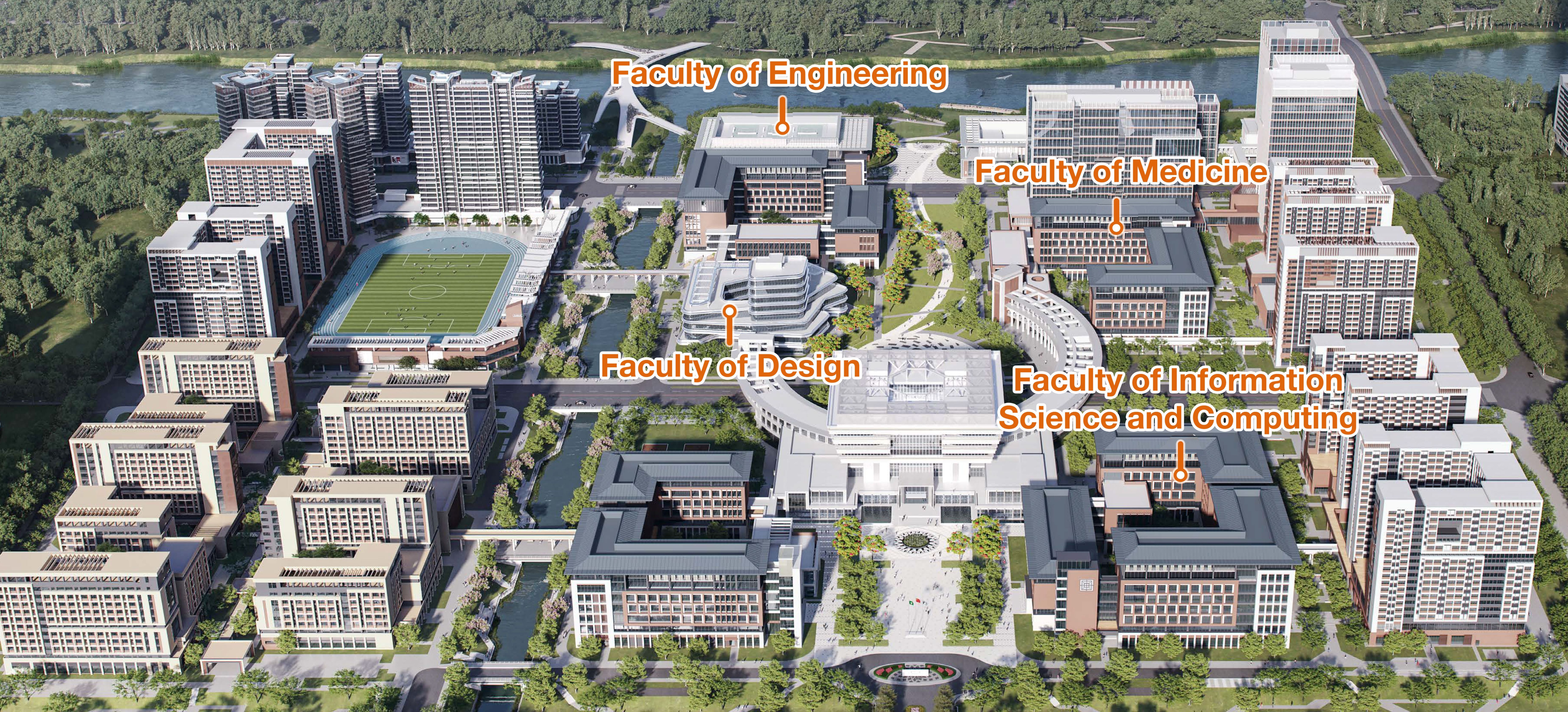
The academic restructuring is also closely aligned with UM’s ‘one university, two campuses’ model. As part of this model, the Faculty of Medicine, the Faculty of Information Science and Computing, the Faculty of Engineering, and the Faculty of Design will be based at UM’s campus in the Guangdong-Macao In-Depth Cooperation Zone in Hengqin. There, the faculties will leverage Hengqin’s geographical advantages, supportive policies, and industrial resources to strengthen postgraduate education, research, and innovation. The Faculty of Science will remain based at UM’s main campus in Macao, where it will continue to advance research in the basic sciences and provide a strong theoretical foundation for cutting-edge scientific and technological research. The two campuses will share resources and draw on their complementary strengths to build an international platform for research, innovation, and talent development.
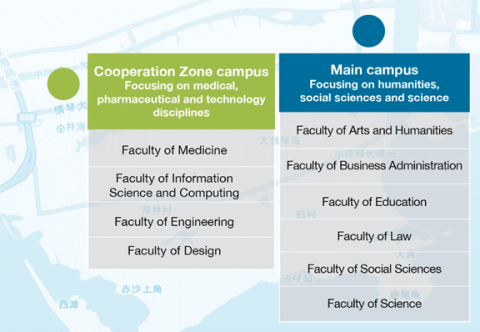
UM’s academic structure across two campuses
Strengthening Macao’s capacity to nurture high-calibre talent in science and technology
The five faculties will also play an important role in enhancing UM’s global competitiveness. Building on the advantages of the ‘one country, two systems’ policy and its international education model, UM will further strengthen collaboration with leading universities and research institutions worldwide. It will promote joint education programmes, collaborative research, international initiatives, and academic exchange, while attracting more outstanding academics and students to Macao and contributing to the development of an international hub for education and technological innovation.
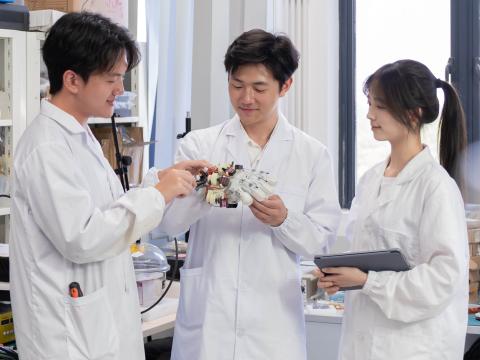
UM aims to nurture more high-calibre talent in science and technology
Under UM’s development plan, by the 2030/2031 academic year, the university aims to achieve a more balanced student composition, with a 1:1 ratio between students in the humanities and social sciences and those in science, engineering, and medicine. UM will also gradually expand its student population to more than 22,000, with postgraduate students accounting for 55 per cent. These developments will significantly enhance Macao’s capacity to nurture high-calibre talent and enable UM to better respond to national and regional development needs.
By optimising its disciplinary profile, deepening interdisciplinary integration, expanding international collaboration, and strengthening Macao-Hengqin synergy, UM aims to nurture more innovative talent equipped to shape the future. These efforts will also enable the university to make greater contributions to the integrated development of education, science and technology, and talent cultivation in the Guangdong-Hong Kong-Macao Greater Bay Area, as well as to Macao’s economic diversification.