
A new furnace design advances thin-film solar cell research
A novel furnace system enables the production of Sb₂Se₃ thin films, supporting research into low-cost materials for future solar cell technologies.

Sponsored by

Sponsored by
A study presents a novel furnace system for producing antimony selenide thin films, a promising material for next-generation solar cells.
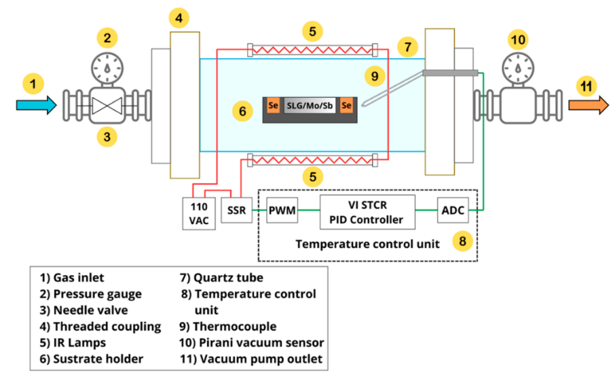
Published in Results in Engineering, the research focuses on solar cells based on Sb₂Se₃ thin films grown through the chalcogenization of antimony metallic precursors. The study proposes a reactor that enables the growth of Sb₂Se₃ films through the selenization of an Sb layer previously deposited on molybdenum-coated glass substrates.
The research addresses a key challenge in thin-film photovoltaics: how to produce absorber layers with suitable structural, optical and morphological properties using a controlled and reproducible fabrication process. Sb₂Se₃ is considered a promising photovoltaic material because it can be used as the active absorber layer in solar cells, offering potential for low-cost and scalable solar technologies.
The team designed a chalcogenization process in which antimony thin films were first deposited by evaporation and later transformed through selenization in a controlled atmosphere of argon and hydrogen. The process was followed by thermal annealing under elemental selenium in a tubular furnace heated by infrared lamps.
By varying key deposition parameters, including furnace heating rate, final annealing temperature, annealing time and partial pressure of the gas mixture, the researchers identified conditions that produced single-phase Sb₂Se₃ films with strong structural, optical and morphological properties. These results support the use of the films as absorber layers in thin-film solar cells.
The study also reports the fabrication of solar cells using the developed Sb₂Se₃ films, contributing to the broader search for emerging photovoltaic materials that can complement existing solar technologies. This line of research is particularly relevant for countries seeking to expand renewable energy generation while strengthening scientific capacity in semiconductor materials.
For Latin America and the Caribbean, the work illustrates how materials science, experimental reactor design and renewable energy research can converge to support cleaner energy transitions. By participating in this international publication, UNICARIBE contributes to applied research on solar energy technologies and the development of advanced materials for sustainable power generation.
Read the full article: https://www.sciencedirect.com/science/article/pii/S2590123025016718