
ISAAC 2025 marks Kazakhstan’s rise as a hub for research exchange
The 2025 International Society for Analysis, its Applications and Computation congress brought together leaders from around the world to promote mathematical analysis and its applications
Nazarbayev University


Sponsored by
Sponsored by
The global research community witnessed a milestone moment as the International Society for Analysis, its Applications and Computation (ISAAC) held its biennial congress in Astana, Kazakhstan from 21 to 25 July, 2025. The event was hosted by Nazarbayev University (NU), marking a significant recognition of the institution’s growing stature as an international hub for academic exchange.
“This is the first time ISAAC is held in Central Asia, and only the second time in Asia. There is no more suitable place than Kazakhstan, where we have a large and active community of ISAAC members,” noted ISAAC president Uwe Kähler.
ISAAC 2025 was exceptional in many ways. For the first time in its history, the congress featured dedicated sessions on AI, reflecting the emergence of new research areas, the growing diversity of participants and the increasing global relevance of ISAAC. Fittingly, the 15th ISAAC Congress coincided with the 15th anniversary of NU, an institution that has, in just over a decade, become a regional leader in high-impact research and intellectual exchange.
Since its inception in 1997 in the United States, ISAAC has been hosted in countries with rich academic traditions, including Germany, Japan, the United Kingdom and China. Kazakhstan’s addition to this list is not only a regional first but also a powerful endorsement of NU’s emergence as a research-intensive university of global relevance.
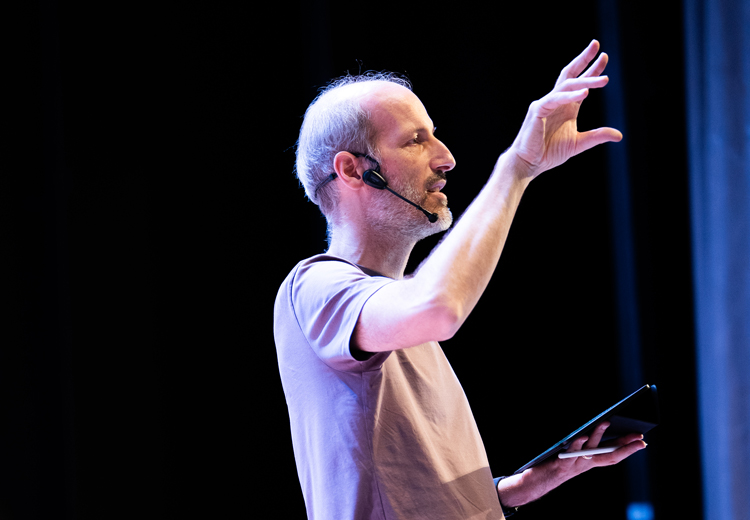
Martin Hairer, professor at the Swiss Federal Technology Institute of Lausanne
A convergence of minds
Over several days, the NU campus welcomed leading researchers working at the frontiers of mathematics, finance, AI, biology and neural networks. NU offered an ideal setting: a spacious, modern campus with world-class academic infrastructure, peaceful gardens and inviting social spaces that encourage collaboration and connection.
Among the prominent participants were renowned scientists such as Martin Hairer, a Fields Medalist celebrated for his work on randomness in nature; and Carola-Bibiane Schönlieb, a leader in mathematical imaging applied to medicine and digital art restoration.
“Congratulations to my colleagues in mathematics for hosting this flagship global event. With around 700 participants, the ISAAC Congress offers not only a platform for scholarly exchange but also a rare opportunity for our students to engage directly with leaders in the field,” remarked NU president Waqar Ahmad.
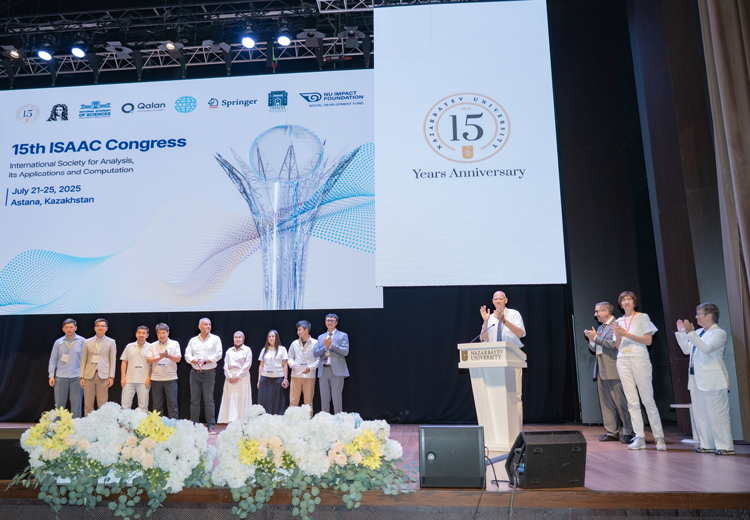
The ISAAC 2025 organiser committee
An earned honour
While international conferences are sometimes viewed as ceremonial, ISAAC 2025 stood out for its substance. Hosting rights are not automatically granted but awarded through a competitive, merit-based process. This selection speaks volumes about NU’s rising academic reputation and Kazakhstan’s growing role in global scientific dialogue.
“Bringing ISAAC to Kazakhstan, and specifically to NU, directly supports the country’s global academic integration,” said Durvudkhan Suragan, NU faculty member and ISAAC 2025 organiser. “While mathematics remains the core, today’s research is inherently interdisciplinary. This congress reflected that, spanning over 20 fields.”

Nader Masmoudi, professor in the Courant Institute of Mathematical Sciences at New York University
More than a congress – a movement
Hosting ISAAC is just one chapter in NU’s ambitious 15th anniversary celebration, which includes more than 20 international conferences throughout 2025. These events span disciplines from physical sciences and engineering to education, policy and the humanities.
Notable events include the 4th International Symposium on Emerging Materials and Devices, the 13th International Conference on Nanomaterials and Advanced Energy Storage Systems, the Belt and Road Initiative Conference on Sustainable Energy Materials and Smart Technologies, NU’s flagship Annual Research Conference, and Towards New Transnational/Transimperial Histories of Central Asia: Sources, Directions, Interpretations conference, which is focused on cultivating Kazakhstan’s next generation of innovators.
The university’s world-class campus, complete with cutting-edge laboratories, conference infrastructure and open, walkable spaces, enables it to host both major global events and more friendly academic gatherings. Its strategic location in Kazakhstan, at the crossroads of East and West, positions NU as a natural convening space for scholars and thought leaders working on today’s most pressing global issues.
In that sense, ISAAC 2025 was more than a mathematics congress. It was part of a broader story: Nazarbayev University’s growing role as a global platform for research dialogue, where science meets society and where the next generation of scholars is shaped through direct encounters with the frontiers of knowledge.