
An end-to-end innovation pipeline to strengthen food security
Macau University of Science and Technology’s biotechnology and epigenetics hub is designed to tackle global issues in food security

Sponsored by Macau University of Science and Technology

Sponsored by
Sponsored by
Science rewards those who think big. At a time when the world is seeking solutions to society’s most urgent challenges, we need universities with innovative ideas about how to deliver impact at scale and how progress can be sustained to support economic development.
Macau University of Science and Technology (MUST) offers a compelling case study in how this might look in practice. It positions its biotechnology and epigenetics facilities as not just an integrated hub for cutting-edge research but as a bridge that connects regional academic innovation with the global market.
“We believe that through our exploration in gene editing, epigenetics and biomedical innovation, we can not only respond to the existential challenges facing humanity but also infuse technological substance into Macao’s development as a base for cultural exchange and cooperation,” says Jian-Kang Zhu, president and vice-chancellor at MUST and a leading molecular geneticist and plant biologist.
This research is conducted through a network of interlinked laboratories, and is based on four pillars: gene editing technology development, epigenetic regulation mechanisms, biomedical applications of biotechnology, and sustainable biotechnological solutions for agriculture and the environment.
“We continue to advance our internationally recognised research in plant abiotic stress biology, focusing on molecular mechanisms of plant resistance to drought, salinity and low temperature,” says Zhu. Climate-resilient varieties of crops could increase yields, which is significant for meeting the rising demand for food as the global population continues to grow. At the same time, climate change is causing unpredictable weather conditions, adversely affecting agricultural production. “Our cut-dip-budding technology enables rapid, non-sterile gene editing of crops in the field, bypassing laboratory tissue culture and accelerating the deployment of drought and salt-tolerant crop varieties.”
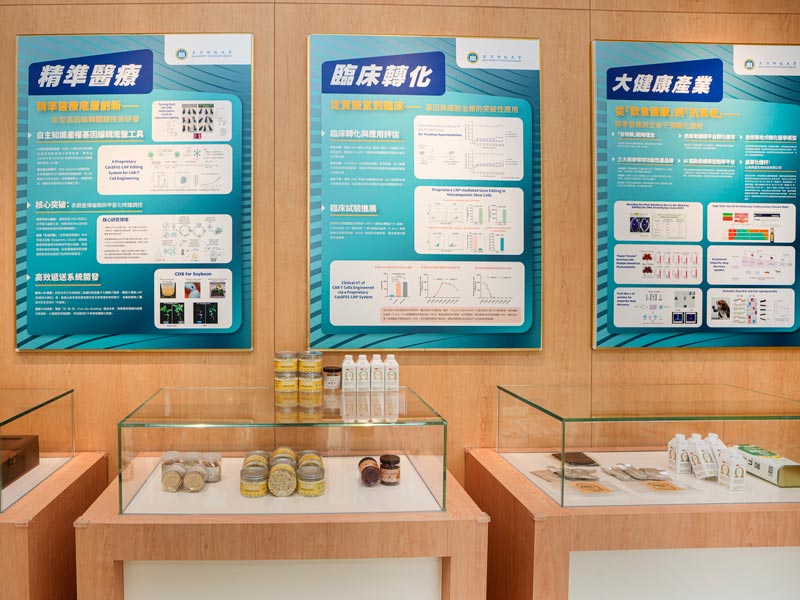
According to Zhu, the university’s initiatives are guided by the concept of “food as medicine”. Researchers at MUST have developed nutrient-dense crops, such as a “super tomato”, created using precision breeding techniques to increase nutritional compounds. Among the crops developed to support health are high-protein soybeans that help lower cholesterol, and low-glycemic index rice and wheat designed for people with diabetes.
Shaping food futures
While the university’s biotechnology research tackles global concerns, its five-year strategy aligns closely with the local and national economic goals and contributes to the Macao government’s economic diversification strategy. Its work in food security supports China’s seed industry revitalisation initiative for promoting innovative crop types.
MUST plays a proactive role in advising policymakers in the field of food production and biotechnology, working with international organisations such as the Food and Agriculture Organisation and CGIAR (originally the Consultative Group on International Agricultural Research), a global agricultural research network dedicated to advancing food security. “We serve as a think tank to influence regional and national guidelines, including gene editing regulations, biotechnology ethics frameworks and pharmaceutical development policies,” Zhu says.
The researchers at MUST achieved another breakthrough in advancing from DNA cutting (in which the DNA is altered using genome-editing tools) to epigenetic tuning (where cellular gene expression is changed without modifying the underlying DNA sequence). Their findings have the potential to offer clinicians a more effective strategy for preventing cardiovascular disease by reprogramming cells to improve cholesterol regulation.
“We integrate biotechnology with AI and big data analytics, constructing multiomics databases that provide intelligent decision support for precision breeding, drug discovery and personalised medicine,” says Zhu. For example, a project on medicinal plants and natural products uses AI-driven diagnostics to address longstanding global issues such as antimicrobial resistance, widening the search for new treatments that tackle superbugs that are unresponsive to antibiotics.
MUST collaborated with the Southern University of Science and Technology in China to develop an AI-driven platform to track traits of ageing in fruit flies. This is one of the research projects that focuses on automated lifelong monitoring of different organisms using high-throughput video tracking, microfluidic chips and infrared sensors. The findings from these studies could offer valuable clues for identifying the factors that support longevity and developing new therapies for degenerative diseases.
Forging impactful partnerships
MUST’s research efforts are spread across eight interconnected, world-class laboratories. They form an innovation chain that includes the Macau Institute for Artificial Intelligence in Medicine, the State Key Laboratory of Mechanism and Quality of Chinese Medicine, and the Guangdong-Hong Kong-Macao Greater Bay Area joint innovation hubs. These cross-border platforms bring together institutions and business ventures across the region for resource sharing, joint drug development programmes, clinical trial coordination and technology transfer – acting as a vital link in taking discoveries from the lab to the clinic and industry.
MUST’s engagement with industry partners in the Greater Bay Area accelerates this process. It works with pharmaceutical companies on natural product drug development, agricultural biotechnology firms on crop improvement solutions, medical institutions on precision oncology and regenerative medicine applications, and technology companies to create AI-integrated diagnostic platforms.
Apart from industry, MUST’s outreach with other research organisations is a central plank of its strategy. Zhu believes its collaborations with institutions in mainland China, including the Chinese Academy of Agricultural Sciences and Tianjin Institute of Pharmaceutical Research, are a sign that Macao’s capabilities in biotechnology are widely recognised. It has filed international patents for multiple gene editing tools, epigenetic analysis technologies and biotechnology applications, some of which have attracted interest from global industry leaders.
MUST’s goal is to take these solutions off-campus and into the real world to expand its influence as a global centre at the forefront of biotechnology research and solutions. “Over the next five years, MUST will continue to increase investment, attract global top talent and build an internationally influential innovation centre for biotechnology and epigenetics,” says Zhu.
Find out more about Macau University of Science and Technology.