
Understanding How Religion Influences Cluster Development in Controversial Industries / Yi-Sook Lim
A new theory explores the important role of oppositional religiosity in industrial cluster development, offering new insights

Sponsored by
Sponsored by
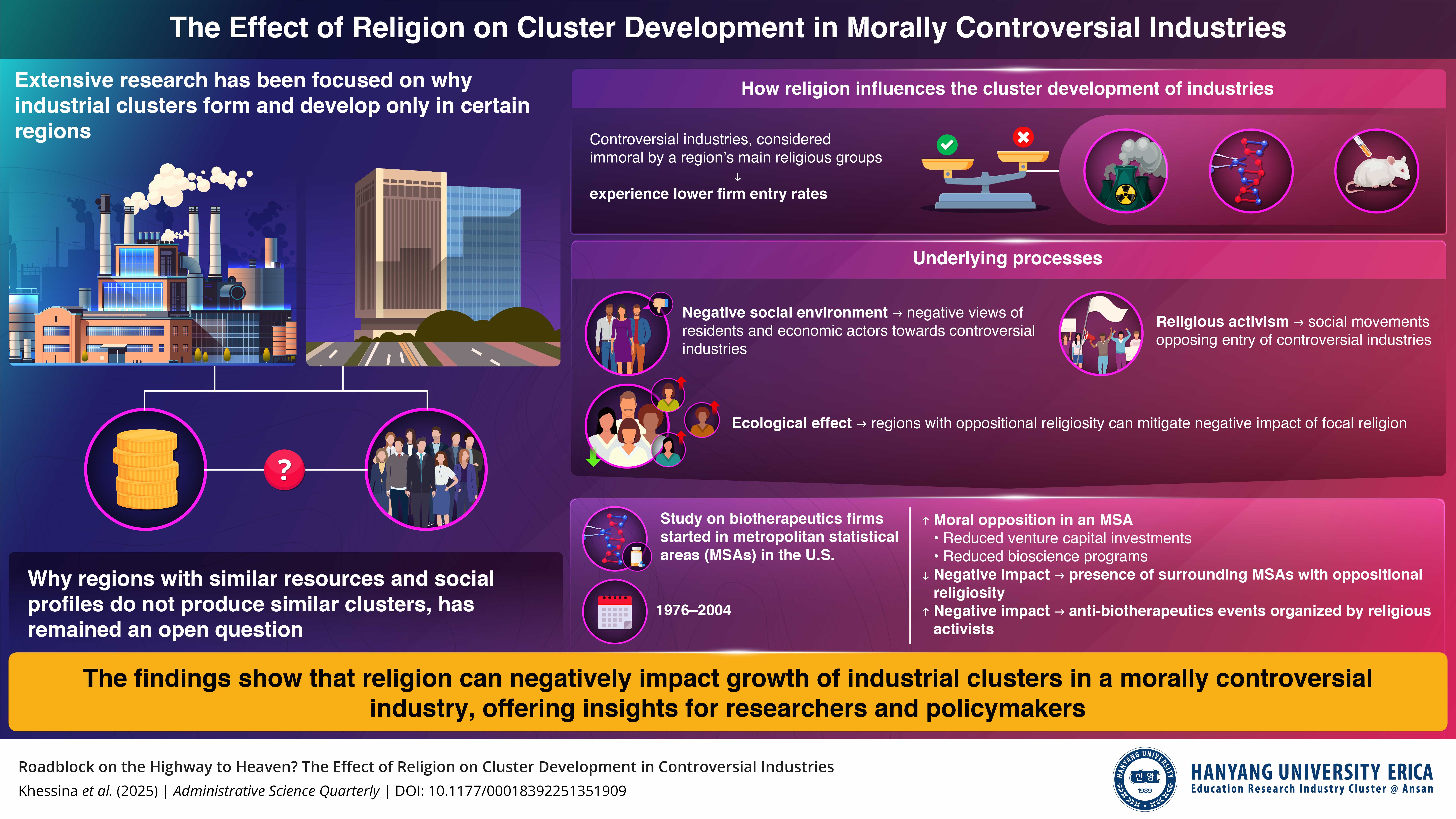
Considerable research has been done to understand why industrial clusters form only in specific regions, with most focusing on economic factors. But why regions with similar resources do not produce similar clusters has remained an open question. Now, researchers have developed a new theory, suggesting that the opposition from a region’s religious groups towards a controversial industry, which is perceived as immoral, may suppress cluster development of that industry in the region.
To answer this question, a research team led by Assistant Professor Yisook Lim from the School of Business Administration at Hanyang University ERICA, Korea proposed a new theory. They suggest that religion may play an important role in the development of industry clusters. “Religion has an essential role in the modern world and impacts not only individuals but also organizations, industries, and regional markets,” explains Dr. Lim. “We theorize that differences in religious compositions across regions can make it more or less feasible to start and run new businesses. Specifically, our paper introduces the concept of oppositional religiosity, which suggests that the moral stance of religious groups in a region can suppress cluster development in controversial industries.” Their study was made available online in the journal Administrative Science Quarterly on August 03, 2025.
Controversial industries are those that rely on morally controversial technologies, such as research on human embryos and animal testing, or those that offer controversial products or services, such as recreational drugs. In the study, the team drew on research in geographic clusters, sociology, economics, psychology, and the ecological theory of industry evolution to develop a theory that explains the link between a region’s religious composition and the entry of new firms in controversial industries.
Their theory consists of three related processes. First, regions dominated by people of religious groups that perceive a controversial industry as immoral and oppose it create a social environment that makes starting new firms difficult due to the negative attitude of residents and economic actors. Second, the theory proposes an ecological effect: the negative impact of a focal region’s oppositional religiosity can be reduced when the neighboring regions have higher oppositional religiosity, making new firm entry relatively easier in the focal region. Finally, it suggests that social movements by religious activists that target a controversial industry and its participants suppress new firm entry.
To test this theory, the researchers conducted a study on all biotherapeutics firms, perceived as a controversial industry, that started in U.S. metropolitan statistical areas (MSAs) between 1976 and 2004. The results supported their theory. Specifically, MSAs with higher proportions of groups that oppose biotherapeutics had lower entry rates for new firms. Entry rates were suppressed either directly or indirectly through lack of venture capital investments and decreased presence of universities with top bioscience programs. Furthermore, the results confirmed the ecological effect and also showed that higher levels of religious opposition to biotherapeutics in an MSA corresponded with lower rates of biotherapeutics companies entering that market.
“Our findings challenge the prevailing view that resource endowments always lead to cluster formation,” explains Dr. Lim. “Even with top educational programs, talent, and infrastructure, regions may still fail to form clusters in controversial industries if local opposition is strong. This demonstrates how social values can constrain economic development.” The team also noted that more research is needed in more religiously diverse regions to further test their theory.
This study offers important insights for both entrepreneurs and policymakers, encouraging them to consider cultural opposition, not just economic factors, as barriers to starting new businesses.
Reference
Title of original paper: Roadblock on the Highway to Heaven? The Effect of Religion on Cluster Development in Controversial Industries
Journal: Administrative Science Quarterly
DOI: 10.1177/00018392251351909
About Hanyang University ERICA
Hanyang University ERICA (Education Research Industry Cluster at Ansan) is a prominent research-focused campus established in 1979 in Ansan, South Korea. ERICA offers undergraduate and graduate programs. ERICA is renowned for its active industry-university cooperation, offering students hands-on experience through partnerships with various industries. This ensures that graduates are well-prepared to meet societal needs and excel in their respective fields. With state-of-the-art facilities and a supportive learning environment, Hanyang University ERICA empowers students to pursue their passions and contribute meaningfully to society, staying true to the university's founding philosophy of "Love in Deed and Truth."
Website: https://www.hanyang.ac.kr/web/eng/erica-campus1
About Assistant Professor Yisook Lim
Dr. Yisook Lim is an Assistant Professor at the School of Business Administration at Hanyang University ERICA. She conducts research on entrepreneurship, organizational theory, and inequality. She earned her Ph.D. in organizational behavior from Cornell University.