
Towards Enhanced Intersection Safety: Identifying Micro-Level Traffic Crash Hotspots / June-Young Park
Researchers utilize traffic conflict analysis to reveal the role of traffic conflict measures such as time-to-collision and post-encroachment time

Sponsored by

Sponsored by
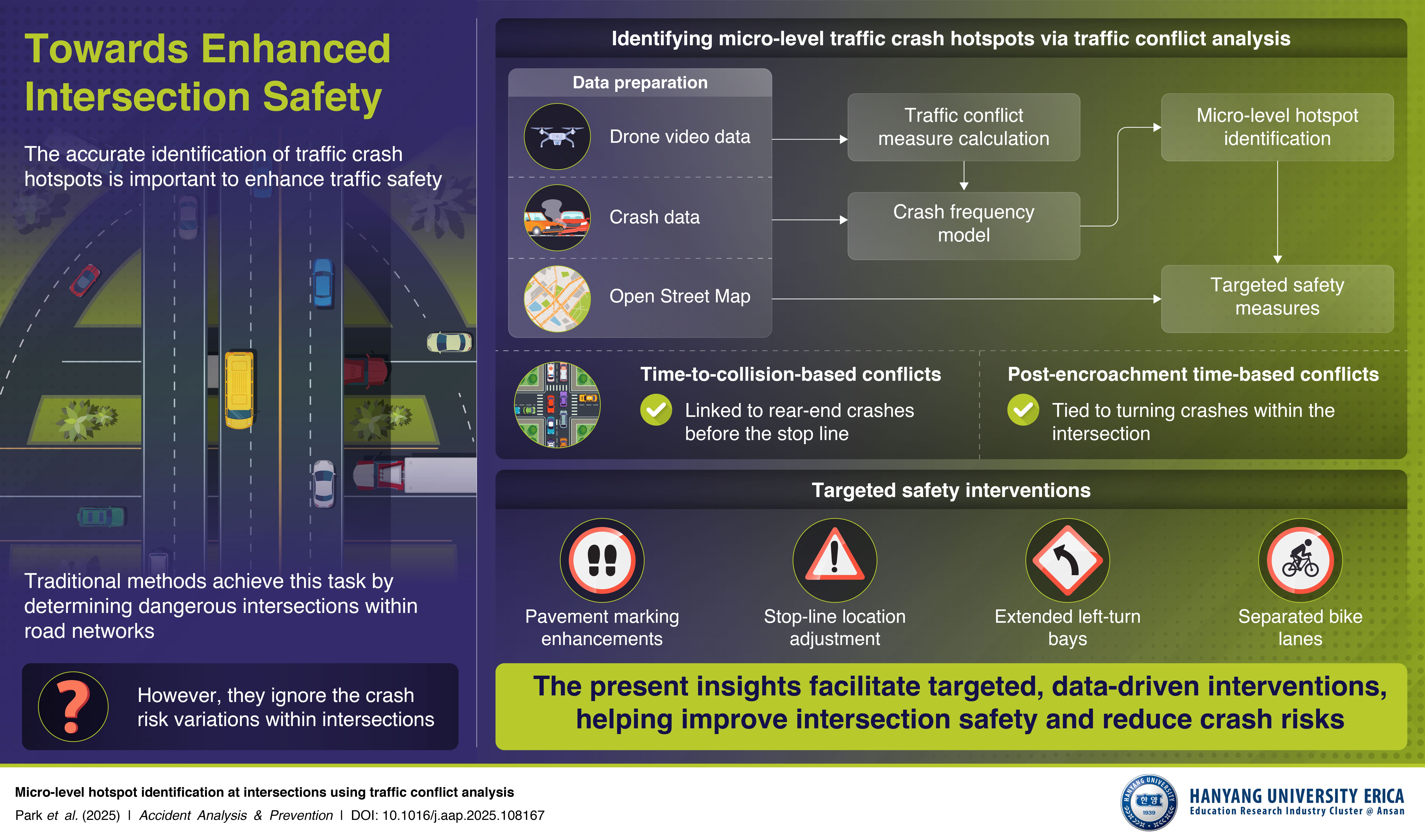
The accurate identification of traffic crash hotspots is crucial to ensure traffic safety. In a breakthrough study, researchers from Hanyang University ERICA have moved beyond traditional intersection-level analysis to identify micro-level crash hotspots within intersections. They reveal that time-to-collision and post-encroachment time are closely tied to micro-level crash frequencies. Furthermore, the study also suggests safety interventions, including pavement marking enhancements, stop-line location adjustment, extended left-turn bays, and separated bike lanes.
According to the Federal Highway Administration (FHWA), approximately one-quarter of all traffic fatalities occur at intersections, making intersection safety a critical focus in efforts to achieve zero deaths. Traditional traffic safety management has primarily targeted intersections at a macro or meso-level, identifying broadly hazardous locations. However, there is a growing need for micro-level safety management that empirically identifies the exact locations within intersections where risks are highest and implements targeted interventions.
Recently, in an innovative study, a team of researchers led by Juneyoung Park, a Professor in Transportation and Logistics Engineering at Hanyang University ERICA, and including Nuri Park, a Ph.D. student in Smart City Engineering at Hanyang University, and Post-Doctoral Researcher Dr. Yang-Jun Joo and Prof. Mohamed Abdel-Aty from the Department of Civil, Environmental and Construction Engineering, University of Central Florida, have demonstrated methods to identify micro-level crash hotspots using high-resolution trajectory data and traffic conflict measures. Their findings were made available online on 10 July 2025 and have been published in Volume 220 of the journal Accident Analysis & Prevention on 1 September 2025.
This research introduces a breakthrough in intersection safety by moving beyond traditional intersection-level analysis to identify micro-level crash hotspots within intersections. Using drone-recorded vehicle trajectories and traffic conflict measures such as time-to-collision (TTC) and post-encroachment time (PET), the research demonstrates that different measures are most effective depending on the crash type and location. For instance, TTC-based conflicts are strongly linked to rear-end crashes before the stop line, while PET-based conflicts are closely tied to turning crashes within the intersection. These insights allow for targeted, data-driven interventions, ultimately providing cities with a precise toolkit to improve intersection safety and reduce crash risks.
According to Prof. Park, their research provides a more nuanced understanding of where and how crash risks emerge within intersections. This detailed risk information enables safety practitioners to design targeted countermeasures, such as extending pavement markings, lengthening left-turn bays, or implementing separated bike lanes tailored to the unique conflict patterns at each site. “For instance, when the PET-based conflict risk for left-turning traffic is high, extending left-turn lane markings into the intersection can help guide vehicles more safely. Such markings are particularly effective in intersections with complex designs or limited visibility, such as those with misaligned left-turn lanes or multiple turning options. Furthermore, our findings complement police crash data, as traffic conflicts are directly observable and can be analyzed without requiring long-term data collection,” Prof. Park explains.
While currently at an early stage, the longer-term implications of the present study are significant: as connected and automated vehicles become more widespread and high-resolution traffic data becomes increasingly available, it will be possible to continuously detect, monitor, and respond to these micro-level hotspots in real time. “Over the next 5 to 10 years, such advancements could lead to dynamically adaptive traffic control, proactive hazard warnings, and infrastructure improvements that are precisely targeted to areas of highest risk, ultimately reducing crashes, injuries, and fatalities at intersections and transforming urban mobility safety,” concludes Prof. Park.
Overall, the goal of this research is to enhance traffic safety.
Reference
Title of original paper: Micro-level hotspot identification at intersections using traffic conflict analysis
Journal: Accident Analysis & Prevention
DOI: https://doi.org/10.1016/j.aap.2025.108167
About Hanyang University ERICA
Hanyang University ERICA (Education Research Industry Cluster at Ansan) is a prominent research-focused campus established in 1979 in Ansan, South Korea. ERICA offers undergraduate and graduate programs. ERICA is renowned for its active industry-university cooperation, offering students hands-on experience through partnerships with various industries. This ensures that graduates are well-prepared to meet societal needs and excel in their respective fields. With state-of-the-art facilities and a supportive learning environment, Hanyang University ERICA empowers students to pursue their passions and contribute meaningfully to society, staying true to the university's founding philosophy of "Love in Deed and Truth."
Website: https://www.hanyang.ac.kr/web/eng/erica-campus1
About the author
Prof. Juneyoung Park is currently a Professor in Transportation and Logistics Engineering at Hanyang University ERICA. He received a Ph.D. in Civil Engineering from the University of Central Florida in the USA. He is interested in Traffic Safety, Transportation Engineering, Data Mining Applications / Statistical Analysis in Transportation, and Big Data Analysis in Transportation & Logistics systems.
Nuri Park received a master’s degree in Smart City Engineering from Hanyang University, Republic of Korea. She is currently a Ph.D. student in Smart City Engineering at Hanyang University, Republic of Korea. She is interested in Traffic Safety, Traffic Simulations, Intelligent Transport Systems and Data Science in Transportation systems.
Dr. Yang-Jun Joo received the Ph.D. degree in civil and environmental engineering from Seoul National University, Seoul, South Korea, in 2023. He is currently a Post-Doctoral Researcher with the Department of Civil and Environmental Engineering, University of Central Florida. His research interests include intelligent transportation systems, driving risk assessment, and traffic safety.
Prof. Mohamed Abdel-Aty is currently a Pegasus Professor, a Trustee Chair Professor with the Department of Civil, Environmental and Construction Engineering, and a secondary joint appointment with the Department of Computer Science, University of Central Florida. His main research interests include ITS, simulation, CAV, and active traffic management. He is a fellow of ASCE and ITE. He is the Editor-in-Chief Emeritus of Accident Analysis & Prevention. He is a Professional Engineer.