
Revealing Brain-Inspired Hardware That Learns in Real Time Using Light and Timing / Se-Yong Oh
The scientists uncover a new path toward self-learning AI chips using spiking neural networks, furthering neuromorphic computing.

Sponsored by
Sponsored by
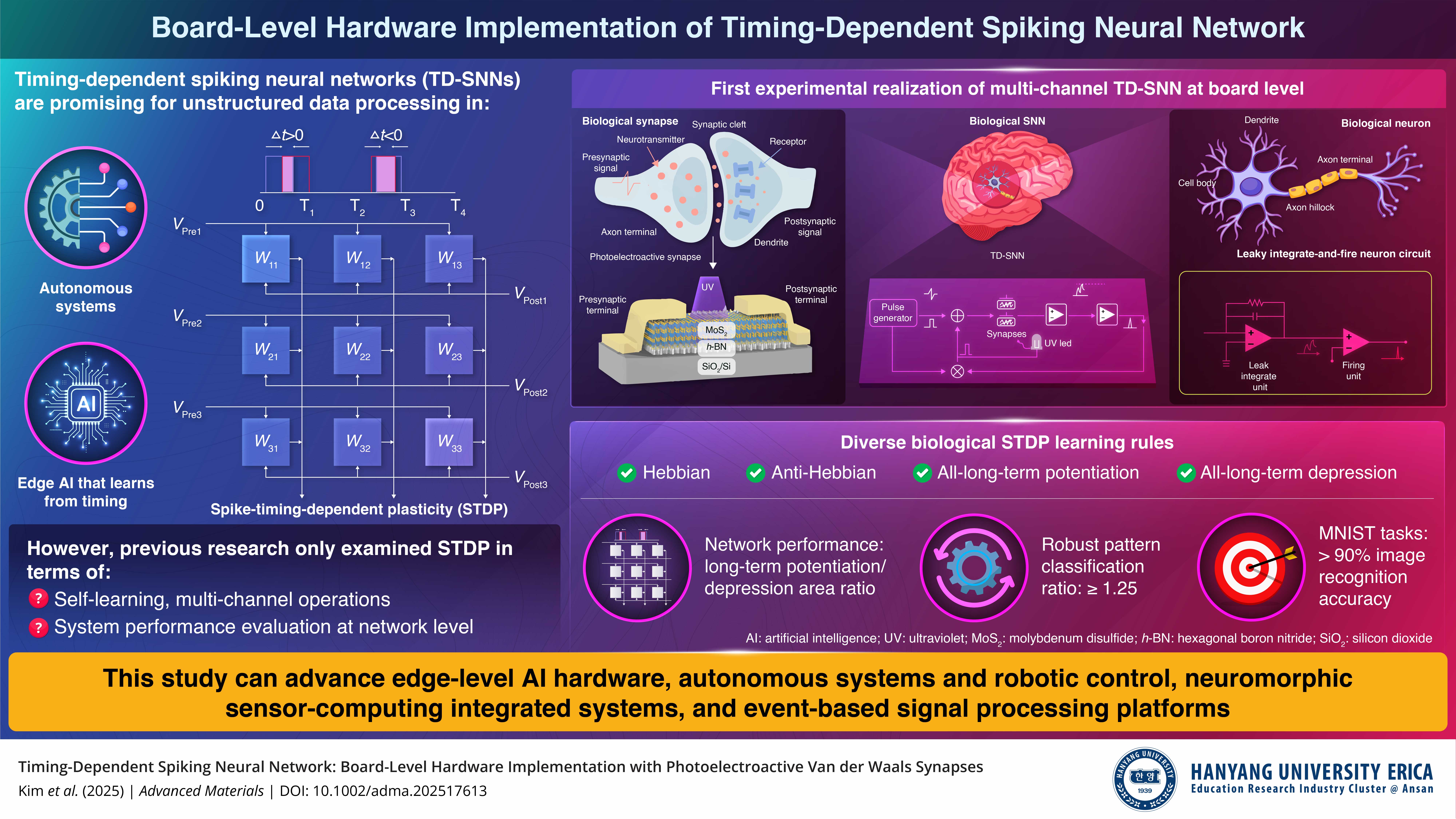
There is an urgent need for energy-efficient, real-time computing based on biological brains. Making advances in this direction, a team of researchers from Hanyang University ERICA have built a physical spiking neural network using light-sensitive nanoscale devices combined with analog neuron circuits, enabling learning directly in hardware rather than software. By controlling the timing between electrical and light signals, the system can strengthen or weaken connections much like the human brain.
Biological neural networks, such as the human brain, process and store information simultaneously through event-driven architectures that activate neurons and synapses only when needed. Inspired by this efficiency, researchers have developed spiking neural networks (SNNs) for real-time, event-driven processing in applications such as autonomous systems and edge artificial intelligence. Recently, timing-dependent SNNs (TD-SNNs) have gained attention for their ability to learn from the precise timing of signals.
In a significant step toward practical neuromorphic computing, a research team from the Republic of Korea and the United States, led by Dr. Seyong Oh, Assistant Professor in the Division of Electrical Engineering at Hanyang University ERICA, has demonstrated the first board-level hardware implementation of a multi-channel timing-dependent spiking neural network. The system emulates biological learning by modulating synaptic weights based on the temporal difference between electrical presynaptic signals and optical postsynaptic signals. The work was published in Advanced Materials on 08 December 2025.
The researchers integrated multi-channel photoelectroactive van der Waals heterojunction artificial synapses with analog leaky integrate-and-fire (LIF) neuron circuits on a printed circuit board (PCB). This integration enables simultaneous signal transmission and synaptic learning, allowing the system to exhibit competitive and cooperative behaviors observed in biological neural networks at the system level.
The hardware supports diverse spike-timing-dependent plasticity (STDP) learning rules, including Hebbian, anti-Hebbian, all-long-term potentiation, and all-long-term depression. Using experimentally extracted parameters, the team demonstrated robust pattern classification, achieving over 90% accuracy on MNIST image recognition tasks when the long-term potentiation–to–depression ratio exceeded 1.25.
“Since multi-channel artificial synapses and LIF neuron circuits are directly integrated on a PCB, our system is also well suited for verifying system-level operation and conducting scalability studies of hardware-based SNNs,” points out Dr. Oh.
The TD-SNN system is well suited for time-based neuromorphic computing, with potential applications in edge AI hardware, autonomous systems and robotics, neuromorphic sensor–computing platforms, and event-based signal processing. By demonstrating that learning and signal processing can occur simultaneously in hardware, this work points toward future low-power, real-time intelligent systems that operate continuously without reliance on cloud computing.
“Overall, our results mark a milestone in timing-dependent neuromorphic hardware, providing a foundational technical basis for the development of electronic systems that maintain energy efficiency while adapting autonomously in everyday applications,” concludes Dr. Oh optimistically.
Reference
Title of original paper: Timing-Dependent Spiking Neural Network: Board-Level Hardware Implementation with Photoelectroactive Van der Waals Synapses
Journal: Advanced Materials
About Hanyang University ERICA
Hanyang University ERICA (Education Research Industry Cluster at Ansan) is a prominent research-focused campus established in 1979 in Ansan, South Korea. ERICA offers undergraduate and graduate programs. ERICA is renowned for its active industry-university cooperation, offering students hands-on experience through partnerships with various industries. This ensures that graduates are well-prepared to meet societal needs and excel in their respective fields. With state-of-the-art facilities and a supportive learning environment, Hanyang University ERICA empowers students to pursue their passions and contribute meaningfully to society, staying true to the university's founding philosophy of "Love in Deed and Truth."
Website: https://www.hanyang.ac.kr/web/eng/erica-campus1
About the author
Dr. Seyong Oh is an Assistant Professor in the Division of Electrical Engineering at Hanyang University ERICA. His research focuses on next-generation semiconductor materials and bio-inspired electronics, including two-dimensional layered materials, ferroelectric devices, and neuromorphic hardware systems. His group develops artificial synapses and spiking neural network hardware integrated with flexible and skin-interfaced bioelectronic platforms for intelligent sensing and smart healthcare applications. Before joining Hanyang University ERICA, he completed postdoctoral training at Northwestern University in the research group of John A. Rogers. He received his Ph.D. in Electrical and Computing Engineering from Sungkyunkwan University.