
Revealing Binder-Free Graphene Hosts for Stable Lithium Metal Anodes / Won-Cheol Yoo
Researchers develop a new host material for lithium metal anodes that significantly improves their long-term stability and performance

Sponsored by
Sponsored by
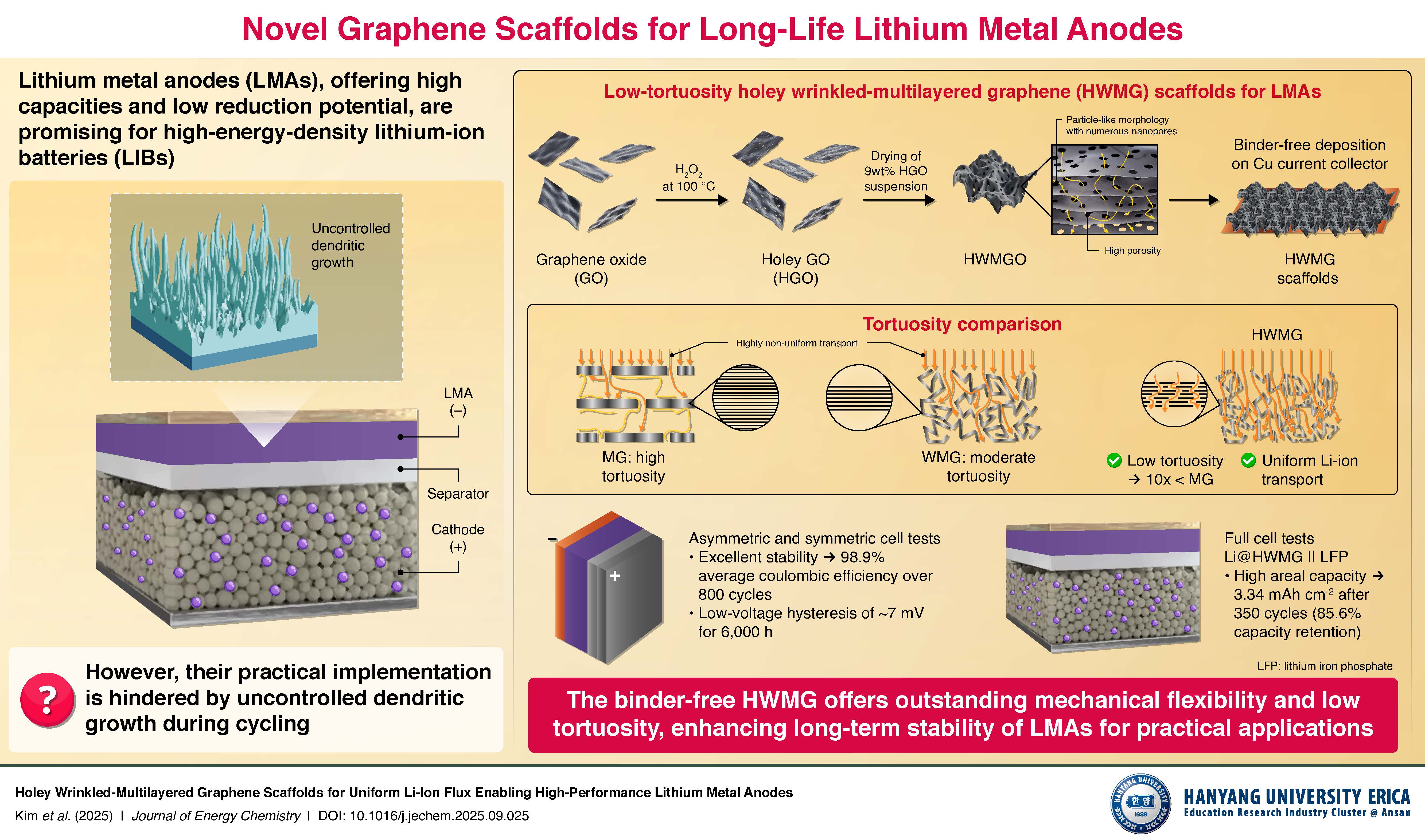
Lithium metal anodes (LMAs) offer significantly higher theoretical capacities than current graphite-based anodes used in lithium-ion batteries. However, LMAs experience uncontrolled dendritic growth during battery cycling, reducing their stability and therefore practical application. Now, researchers have developed a novel binder-free host material for LMAs, called holey wrinkled-multilayered graphene, that effectively suppresses dendrite growth while accommodating large volume changes, significantly enhancing long-term cycling stability.
The global push towards renewable energy has led to an increasing demand for high-energy-density batteries. To surpass the energy density limits of conventional lithium-ion batteries (LIBs), researchers have now turned to lithium metal anodes (LMAs), which offer nearly ten times higher theoretical capacity than traditionally used graphite anodes, making them attractive for next-generation high-energy-density LIBs.
However, LMAs suffer from uncontrolled dendritic growth during battery cycling. This reduces efficiency, energy capacity and also increases risk of short circuits, limiting their practical ability. Host design, where specially engineered scaffold materials are used to stabilize Li ion transport, is an effective approach to mitigate these issues. A successful LMA host should have a lithophilic surface, high electrical conductivity, mechanical flexibility and importantly, low tortuosity, which enables effective Li-ion transport through the electrode. But, candidate host materials with all these properties are limited.
In a new study, a Korean research team led by Professor Won Cheol Yoo from the Department of Energy and Bio Sciences, and Department of Applied Chemistry at Hanyang University ERICA has developed a new host material for LMAs called holey wrinkled-multilayered graphene (HWMG), enabling high performance and long cycle life. “Our HWMG scaffold features a low-tortuosity, highly porous architecture that effectively suppresses dendrite growth while accommodating large volume changes, enabling uniform Li-ion flux throughout the electrode,” explains Prof. Yoo. Their study was made available online on September 24, 2025, and published in Volume 113 of the Journal of Energy Chemistry on February 01, 2026.
To fabricate HWMG scaffolds, the researchers first converted graphene oxide (GO) nanosheets into holey GO (HGOs), which were then restacked in a high concentration solution and then dried to form holey wrinkled-multilayered GO (HWMGO). HWMGO was then directly deposited on a copper current collector, without any binder materials, to create HWMG scaffolds.
Structural analyses revealed that HWMG features a particle-like morphology with numerous nanoporous and high porosity, as well as excellent mechanical flexibility. The researchers also tested and compared the tortuosity of HWMG with multilayer graphene (MG) and wrinkled-multilayered graphene (WMG), both lacking nanopores. HWMG showed the lowest tortuosity and facilitated highly uniform Li-ion transport, while both MG and WMG exhibited significantly higher tortuosity and consequently, inhomogeneous Li-ion transport. Notably, the tortuosity of MG and WMG increased further with the addition of binder materials.
As a result, LMA electrodes with binder-free HWMG hosts demonstrated enhanced electrochemical performance with an average coulombic efficiency of 98.9% over 800 cycles in asymmetric cell tests and a low voltage hysteresis of approximately 7 millivolts over 6000 hours in symmetric cell tests. Moreover, full cell tests showed high areal capacities and stable cycling over 350 cycles, demonstrating practical viability.
“This novel binder-free HWMG scaffold has strong potential for next-generation lithium metal batteries that require stable, long-term operation, particularly for those used in electric vehicles and grid-scale energy storage systems,” concludes Prof. Yoo. “Moreover, its simple and scalable fabrication offers a practical pathway to bring high-performance lithium metal batteries closer to commercialization.”
Reference
Title of original paper: Holey wrinkled-multilayered graphene scaffolds for uniform Li-ion flux enabling high-performance lithium metal anodes
Journal: Journal of Energy Chemistry
DOI: 10.1016/j.jechem.2025.09.025
About Hanyang University ERICA
Hanyang University ERICA (Education Research Industry Cluster at Ansan) is a prominent research-focused campus established in 1979 in Ansan, South Korea. ERICA offers undergraduate and graduate programs. ERICA is renowned for its active industry-university cooperation, offering students hands-on experience through partnerships with various industries. This ensures that graduates are well-prepared to meet societal needs and excel in their respective fields. With state-of-the-art facilities and a supportive learning environment, Hanyang University ERICA empowers students to pursue their passions and contribute meaningfully to society, staying true to the university's founding philosophy of "Love in Deed and Truth."
Website: https://www.hanyang.ac.kr/web/eng/erica-campus1
About the author
Dr. Won Cheol Yoo is a Professor in the Department of Energy & Bio Sciences and Applied Chemistry at Hanyang University (ERICA). His group specializes in the design and development of advanced nanostructured materials, including metal–organic frameworks, carbonaceous materials, graphene, and functional composites, for environmental and energy technologies such as atmospheric water harvesting and lithium- and zinc-metal batteries. Before joining Hanyang University, Prof. Yoo completed his postdoctoral research at Chemical Engineering from the University of Minnesota, where he also earned his Ph.D. in Materials Chemistry in 2010.