
Training the next generation of green talent
As the demand for green talent outpaces supply, higher education must move beyond static curricula to develop adaptive, AI-augmented problem solvers

Sponsored by City University of Hong Kong

Sponsored by

Sponsored by
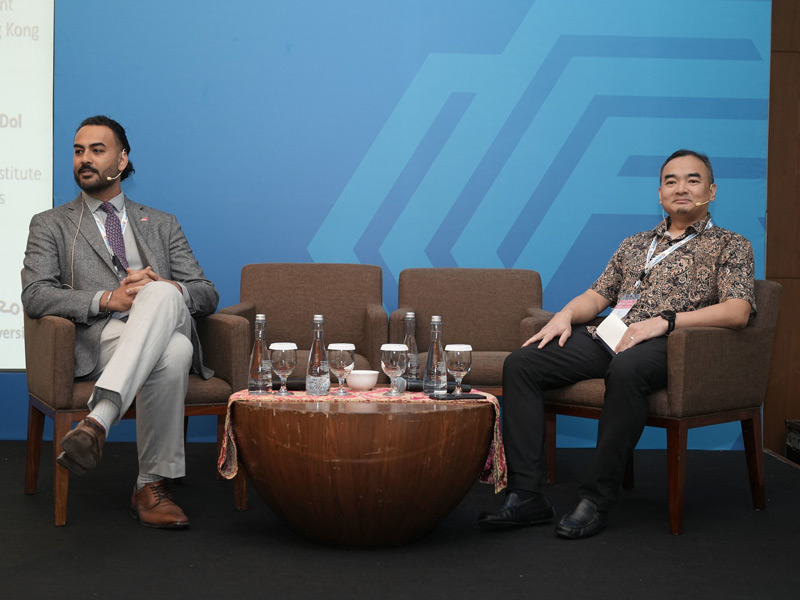
As the drive towards decarbonisation and green energy transition ramps up, experts are predicting a shortage of specialised talent with the skills to navigate complex, evolving systems. A session – held in partnership with City University of Hong Kong (CityUHK) – at the 2026 THE Global Sustainable Development Congress, discussed strategies for developing professionals equipped with AI and technical skills.
“The trend towards net zero for each country requires massive investment in renewable energy,” said Shauhrat Chopra, associate dean for undergraduate studies at the School of Energy and Environment at CityUHK. “In East Asia, the big advantage has been the industrial production of renewable energy technologies.” The challenge, however, is managing system complexity and integration.
The increase in AI use exemplifies this challenge. Low carbon intensity does not necessarily lead to lower total emissions when demand growth supersedes efficiency gains. The additional data centres required to meet AI demand pose environmental challenges that regions must grapple with at every stage of their lifecycle, from establishment to end of life.
AI could also help institutions find the green talent needed to mitigate sustainability challenges. “We are in an era that is not just about transition but about transformation,” said Sharul Sham Dol, director of the Research Institute for Sustainable Futures at Abu Dhabi University in the United Arab Emirates (UAE). A hidden bottleneck is talent quality. “Almost 40 per cent of core skills will change in the next four years, and green talent demand is growing faster than supply,” added Dol. The professionals in high demand are those who can combine STEM fundamentals with AI capabilities and human judgement.
Prioritising partnership and collaboration is one way of creating the industry-ready green talent that organisations require. These graduates will be needed in a variety of fields, with aerospace, water security and offshore renewable energy among the key technology sectors facing the greatest skills gaps.
“A collaborative AI-augmented framework is necessary for building the next generation of sustainability professionals,” Dol said. The Research Institute for Sustainable Futures has partnered with the Youth for Sustainability initiative by Masdar and Majra in the UAE to deliver sustainability programmes with AI elements, bringing STEM knowledge, AI capabilities and sustainability literacy together.
Empowering students to take charge of global challenges provides significant promise for alleviating AI’s environmental burden. According to Chopra, a key factor in encouraging this is entrepreneurship. CityUHK has established an incubation programme called HK Tech 300, which has funded over 860 student-led startups. One example is SustainOpedia, an interactive, AI-driven lifecycle assessment platform designed to streamline Scope 3 emissions disclosures by helping enterprises process upstream and downstream emissions data.
Technology is more effective at solving complex problems when core frameworks are geared towards creating tangible outcomes. AI must be viewed less as a trend and more through the lens of specific use cases. AI adoption should focus on complex, purpose-driven problems rather than frivolous applications, given its environmental and compute costs, Chopra concluded.
The panel:
- Shauhrat Chopra, associate dean for undergraduate studies, School of Energy and Environment, City University of Hong Kong
- Sharul Sham Dol, director, Research Institute for Sustainable Futures, Abu Dhabi University