
Tackling real-world issues head-on
With the unique ability to bring together research, commercial expertise and collaboration, higher education institutions are well placed to not only respond to today’s challenges but also actively shape the next iteration of technological applications

Sponsored by City University of Hong Kong

Sponsored by

Sponsored by
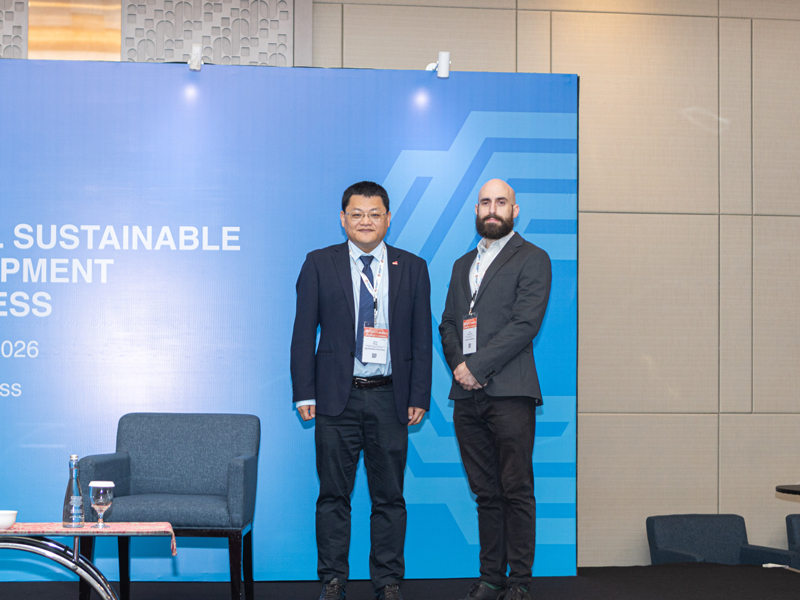
Innovation driven by higher education institutions is shaping the world around us, from medical AI systems that accelerate disease screening to online platforms that help people conquer fear of public speaking. A session – held in partnership with City University of Hong Kong (CityUHK) – at the 2026 THE Global Sustainable Development Congress, showcased innovative projects at CityUHK and the University of Cambridge in the UK.
Research suggests that public speaking is one of the most common fears among the general population. During the session, Chris Macdonald, director and founder of the Immersive Technology Lab at the University of Cambridge, said that speech anxiety affects more than 80 per cent of students in the UK. “We know that it is detrimental to mental health and physical health. It limits academic attainment and career progression,” he said.
The research team at the lab decided to develop a solution to address this problem by combining exposure therapy with digital technology. Widely recognised as effective, exposure therapy involves patients progressively confronting their fears by facing the source of their anxiety. However, cost and long waiting lists for treatment in the UK are barriers to access.
Macdonald created an online platform with tailored course materials to develop an individual’s core skills and a virtual reality (VR) training environment to practise speaking and build confidence. “I created a gamified mechanism where, as you complete tasks, the training simulations become increasingly challenging,” he said. The tool is globally available free of cost and can be accessed without a VR headset. It is now used in more than 130 countries and is on track to have treated one million cases worldwide.
The platform is one example of the innovative solutions being developed on university campuses to create societal impact. Shiqi Wang, associate dean of internationalisation and industry at CityUHK’s College of Computing, provided more examples, such as autonomous driving technologies, embodied AI and medical AI. “In medical services, we have a new system that has been deployed in five hospitals and 46 community centres,” he said. The AI-based tool offers rapid disease screening and has already achieved considerable impact in clinical settings.
CityUHK’s breakthroughs in automatic algorithm design are revolutionising how new AI platforms are developed. “We know that nowadays large language models can help us write the source code for programming,” said Wang. “But our technology can automatically design these algorithms.”
Technology could help optimise AI platforms to efficiently construct more complex systems. Wang echoed Macdonald’s point about the need for research to focus on real-world challenges. CityUHK’s research priorities also include smart education for the digital era. It has developed immersive experiences that support visual learning, address additional educational needs and personalise the academic journey for each student.
The speakers:
- Chris Macdonald, director and founder, Immersive Technology Lab, University of Cambridge
- Shiqi Wang, associate dean of internationalisation and industry, College of Computing, City University of Hong Kong