
Preserving cultural heritage in the digital age
While AI offers ways to reconstruct and interpret cultural artefacts, institutions must view it as an auxiliary to human expertise

Sponsored by City University of Hong Kong

Sponsored by

Sponsored by
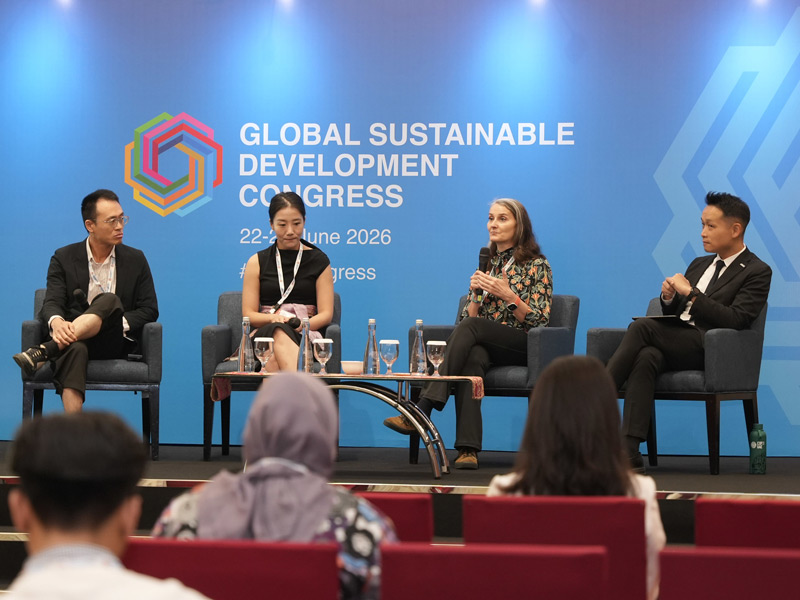
AI is increasingly used in digitalisation and restoration efforts to preserve cultural heritage for future generations. However, it also raises questions around accuracy and authenticity. During a panel discussion – held in partnership with City University of Hong Kong (CityUHK) – at the 2026 THE Global Sustainable Development Congress, higher education experts came together to explore the dynamic nature of cultural heritage and the challenge of equitable preservation efforts in the age of AI.
Caution is necessary regarding AI’s potential to create visual illusions instead of authentic historical records, said Elke Reinhuber, associate professor at the School of Creative Media at CityUHK. While AI offers valuable technical capabilities that students need, they must also learn to critically evaluate whether generated outputs reflect reality.
Shuo Sue Hua, associate curator at the University Museum and Art Gallery at the University of Hong Kong, argued that AI is most beneficial when used as a tool for provenance research rather than as a replacement for human researchers. Combining expert intuition derived from years of experience with digital analytical tools yields the most effective results, she said.
As AI can generate complete outputs such as images and text, users can circumvent the need to develop the required skills and expertise. These shortcuts can be useful for efficiency, but it is important to recognise that this bypasses the learning process, noted RAY LC, assistant professor at the School of Creative Media at CityUHK. It is only by working directly with generative AI tools that their capabilities and structural limitations can be discerned.
As technology continues to seep into people’s lives, cross-disciplinary approaches become essential for tackling the complex, interconnected challenges it brings. The intersection of cultural heritage, sustainability and AI is an area where this is especially important.
Tim Wong, ESG and sustainability hub lead at AECOM Hong Kong, said that the organisation collaborates with artists during early planning stages of built environment projects to run design-thinking workshops and capture important social metrics. AI can help map pathways for carbon reduction, environmental management and social impact. Factors such as sense of belonging, social cohesion and health and well-being are often used as key performance indicators for such projects, Wong said. By collecting project data and applying machine learning tools, AI can assist investors and planners in making better, data-driven decisions regarding sustaining cultural heritage assets and community spaces.
Societies have consistently sought to record and preserve the past using different kinds of physical tools. AI represents the latest of these tools, but preserving cultural fragments often presents interpretative challenges where the only viable response is a human one. AI opens up more diverse ways for viewers and interpreters to engage with artworks, but the human experience of sensory interaction cannot be replaced, said Hua.
The panel:
- Shuo Sue Hua, associate curator, University Museum and Art Gallery, University of Hong Kong
- RAY LC, assistant professor, School of Creative Media, City University of Hong Kong (chair)
- Elke Reinhuber, associate professor, School of Creative Media, City University of Hong Kong
- Tim Wong, ESG and sustainability hub lead, AECOM Hong Kong