
Protecting endangered languages
Adelaide University researchers are working alongside Aboriginal communities to strengthen at-risk languages.

Sponsored by

Sponsored by
When Indigenous languages disappear, they take with them rich cultural histories and unique human knowledge. In Australia, decades of colonial language prohibitions, child removals and forced relocations for Aboriginal and Torres Strait Islander Peoples have done irreparable damage. According to the Australian Institute of Aboriginal and Torres Strait Islander Studies, more than 250 First Nations languages were spoken at the time of European colonisation. By 2019, only 12 were being acquired by children as a first language. While others hold on, their existence is profoundly fragile.
In the wake of this decline, the need for language strengthening is urgent. For younger generations to learn and celebrate the languages of their ancestors, the languages must be retained and passed on. This is the work of the Mobile Language Team (MLT) at Adelaide University, steered by Karina Lester and Dr Paul Monaghan.
“We have demonstrated expertise in assessing the health of South Australia’s Aboriginal languages, strengthening and increasing the use of these languages, and in planning and advocating for stronger language futures,” says Dr Monaghan.
The MLT’s goal is to increase the use of the state’s 47 Aboriginal languages. Since 2009, they have been developing meaningful partnerships with Aboriginal communities, organisations, families and individuals. The team’s primary research methodology is what Lester calls: Nyawa, Kulila, Palyala. In the Pitjantjatjara-Yankunytjatjara language, this means “Look, Listen, Make it happen”. The approach prioritises consultation and co-design to ensure language interventions are community-led.
“It’s in partnership with regional and remote communities that our research makes the most difference,” Dr Monaghan says.
As well as partners around the country and world, the MLT has hubs in numerous regional centres and remote settings. The team works to access archives, record elderly speakers, and create language courses and learning resources. They train young community members in all aspects of language revival, building employment pathways as they go. Their members have even served on global language taskforces.
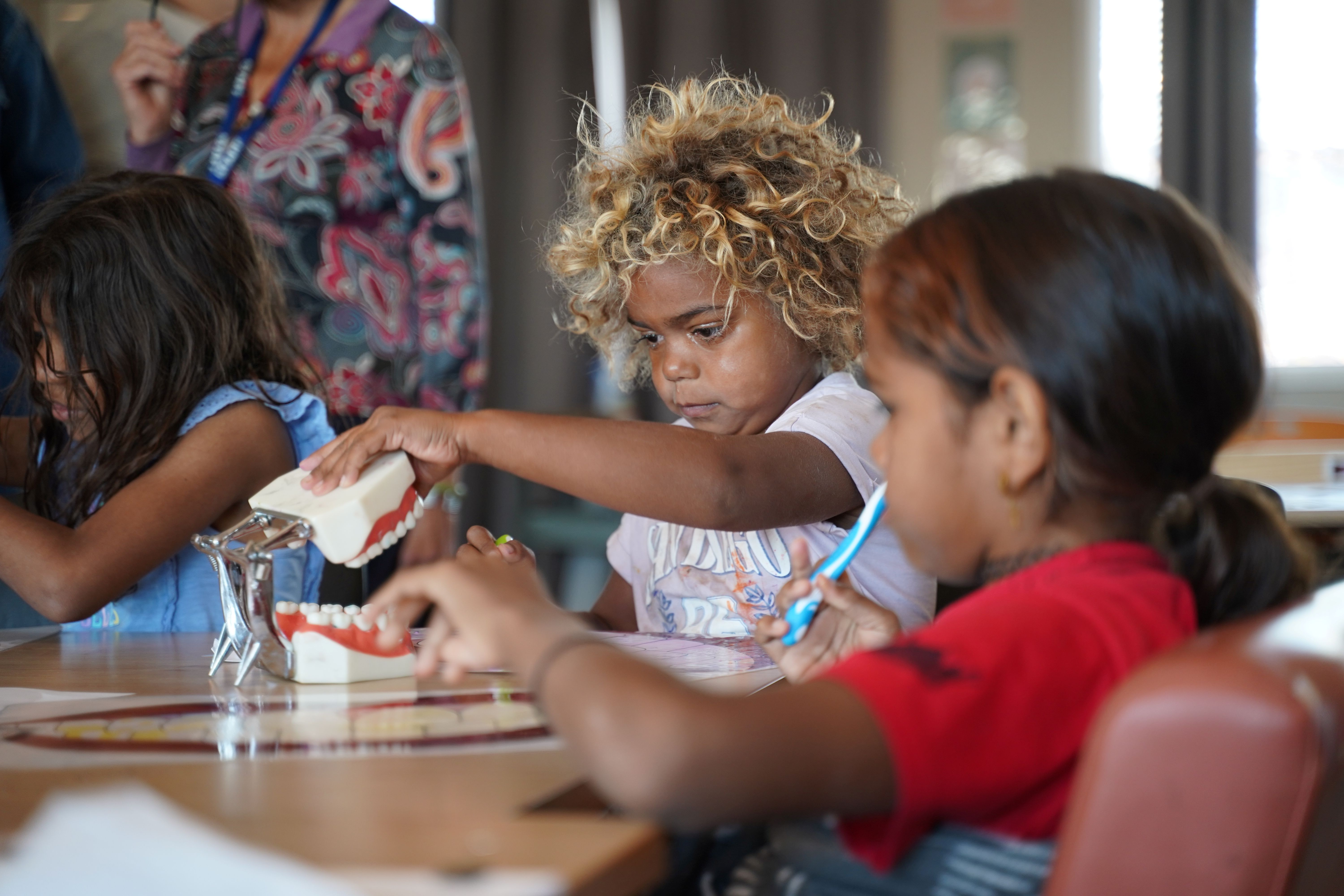
Recently, the MLT pioneered the Katiti Wiru (Healthy Teeth) project in partnership with the Oral Health Association of Australia. Katiti Wiru uses local language in games, storytelling and art to make oral health education engaging, fun and culturally grounded – all while advancing the goals of the Closing the Gap policy framework, a national initiative to improve outcomes for Aboriginal and Torres Strait Islander Peoples.
“Kaṯiṯi Wiṟu takes an innovative approach to improving oral health and strengthening the endangered Yankunytjatjara language in remote South Australian communities,” says Dr Monaghan. “Local content generates a strong sense of identification among participants, builds trust, and strengthens outcomes in oral health and in the health of the language itself.”
Katiti Wiru is an example of what Dr Monaghan calls “language +”, where language revival becomes a means to achieve other important outcomes.
“As a Mobile Language Team, we are primarily interested in strengthening Indigenous languages – but languages are not used in a social vacuum,” he says. “Their use is linked to benefits in a range of health, education, social, environmental and economic domains”.
With this holistic vision, the MLT is positioned to bring about real change in the field. The project plays a vital role in resisting the destruction of language in Australia and enabling justice and healing for First Nations Peoples.
On the horizon
There remains a long way to go in the fight to keep endangered languages alive. Dr Monaghan says ensuring Aboriginal and Torres Strait Islander languages survive into the future will take dedicated work from both communities and academics.
“Universities have an important role to play in providing opportunities for Indigenous people to undergo meaningful experiences with their heritage languages, to explore employment pathways, and to take the lead in creating language futures,” he says.
For the MLT, preserving languages in archives is not enough. They should be alive, strong, used meaningfully in everyday life, and passed on to future generations, with positive impacts feeding back into the wellbeing of communities.