ADVERTISEMENT
Hungary’s larger-than-life stature in global HE policy is about to shrink
Péter Magyar is likely to end the funding of foreign influence operations – but ideological control at home will be harder to overcome, says Liviu Matei

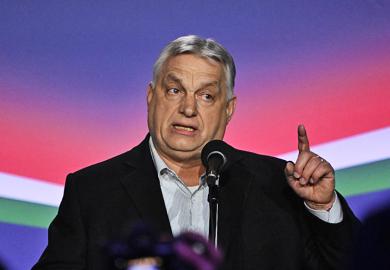
Source: NurPhoto/Contributor/Getty Images
During Viktor Orbán’s 16 years of authoritarian rule, Hungary has belied its small size by acquiring a disproportionate international profile and influence in higher education and science policy – but not through constructive developments.
Orbán’s self‑declared “illiberal” regime has been inventive in adapting, developing and exporting restrictive models of science and higher education governance. Initially, it imported repressive models from Russia and Turkey; early Orbán-era higher education laws echoed Russian provisions word for word, for instance.
But it then extended these approaches, adding layer upon layer of its own innovations. One example is the imposition of the so‑called new model of the university: public institutions funded by state‑controlled public companies and commanded by government cronies appointed for life to newly styled “original” governance bodies.
The government imposed the funding modalities as well as the actual sums, keeping public universities on a starvation diet while imposing on them an illiberal governance straitjacket. For example, MOL, a Hungarian oil and gas company, has been an actor in this exercise of strangling higher education at home while channelling huge amounts (from its own corporate funds/profits) towards foreign institutions controlled, de facto if not de jure, by the Hungarian government.
Domestically, the effect has been devastating. Entire institutions – such as research institutes of the Hungarian Academy of Science and the Budapest University of Theatre and Film Arts – were closed or seriously impaired when reorganised to fit the government’s template across disciplines and fields. In the STEM area, the Alfréd Rényi Institute of Mathematics, one of the most renowned maths institutes in the world, was coerced into discontinuing altogether a highly successful PhD programme in “mathematics and its applications”, unique in Hungary, because the government did not like the other academic partner (a university) in this joint venture.
ADVERTISEMENT
As a result of all the oppression, Hungary has experienced mass academic emigration since Orbán was re-elected in 2010 and a marked decline in the production, transmission, dissemination and use of advanced knowledge. I was among the tens of thousands forced to leave Hungary during these years, together with my family and my institution at the time, the Central European University, which relocated to Vienna.
Having developed its repressive governance architecture, Orbán’s regime then began exporting it abroad, to neighbouring countries, parts of Western Europe (no success in the UK despite sustained efforts), Central Asia and, most conspicuously, the US (Florida adopted more “elaborated” restrictive Hungarian regulations on academic freedom almost verbatim, to mention just one example). These exports were driven by systematic, well‑funded campaigns organised by the regime and paid for at great cost (billions of pounds equivalent) by Hungarian taxpayers.
One method was to establish and fund new institutions or take over existing universities, institutes of advanced study or thinktanks, such as Sapientia University in Romania or Modul University in Austria. Another was to create lavishly funded “intellectual” outlets within Hungary – thinktanks, research centres or autonomous educational institutions – with an external proselytising mission. The most infamous of those is Mathias Corvinus Collegium, nominally a small research centre, which has seen its public funding increase dramatically over the years to reach €1.5 billion (£1.3 billion), exceeding the combined budget of all public universities in Hungary.
Additional foreign influence measures have included funding Hungarian consultants to advise foreign public authorities on regulatory frameworks for higher education and research; financing foreign policymakers and officials to study and import Hungarian models; and supporting sympathetic public intellectuals, journalists and influencers abroad through grants, stipends and other payments (such as exorbitant speaking fees) to advocate for Hungarian-inspired models in their countries.
Most likely, following the remarkable parliamentary election on 12 April that swept Orbán from power in a landslide victory for his opponent, Péter Magyar, this active, pernicious international influence will stop. At home, however, the aggressive ideological control will not be so easy to turn off. The academic community and the incoming government face a long task of restoring sound governance, re‑establishing organisational autonomy and academic freedom, and repairing a system hollowed out by politically engineered institutions and structures.
Hungary must honour the commitments it signed in 2020 and 2024 – alongside nearly all other European states, except Russia and Belarus – to promote and protect the European Higher Education Area’s officially and jointly defined fundamental values. These are academic freedom, academic integrity, university autonomy, staff and student participation in governance, and public responsibility for and of higher education.
The new government must also ensure that Hungary fulfils its obligations under the Bonn Declaration on Freedom of Scientific Research, signed in 2020.
ADVERTISEMENT
Doing so would align research and higher education with Magyar’s declared aim of reorienting the country towards the West rather than the East.
Liviu Matei is head of the School of Education, Communication and Society at King’s College London. He leads the Global Observatory on Academic Freedom and represents the UK in the European Higher Education Area Working Group on the Fundamental Values of Higher Education. He was previously professor of higher education policy and provost at Central European University.
Read more about

Related articles

Featured jobs
ADVERTISEMENT