AutoDwell
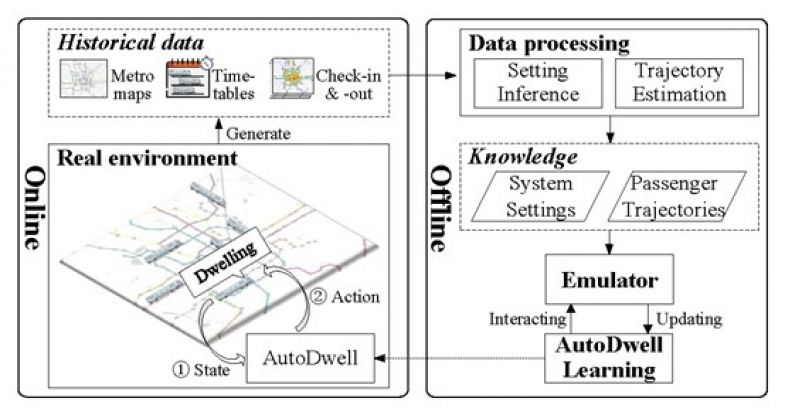
Research conducted by Zhaoyuan Wang has proposed a fine-grained, safe, and energy-efficient strategy to improve the efficiency of metro systems by dynamically scheduling dwell time for trains.

System framework
Research conducted by Zhaoyuan Wang has proposed a fine-grained, safe, and energy-efficient strategy to improve the efficiency of metro systems by dynamically scheduling dwell time for trains.

System framework
The past decade brought two major innovations to transportation: connected and autonomous vehicles (CAV) and transportation network companies (TNC) such as Uber and Lyft. The transformative impacts of these innovations have already been felt around the world, and are expected to continue to reshape the transportation industry. In the not-so-distant future, a significant portion of passenger trips may be served by CAVs, of which many would be shared through TNCs. Such a vision projects considerable benefits for the safety, efficiency, and accessibility of travel.
A team led by intelligent manufacturing scientist Guofu Ding has received a 40 million RMB (US$5,956,000) grant to further research and building into intelligent manufacturing technologies that can improve manufacturing efficiency and quality. Awarded by the Sichuan government, the funding will support the team’s work over two years.

Animal manure is a valuable resource. However, untreated manure cannot be used as a soil amendment due to insufficient biodegradation and phytotoxic ingredients, which would cause environmental damage. Aerobic composting is an effective way to reduce, render harmless and recycle husbandry manure, which could sufficiently convert manure into organic fertilizer.

Who’s asking the question? Why inclusion and research quality go hand in hand
By Professor Andrew Livingston, VP Research and Innovation, Queen Mary University of London

Beyond academia: how can universities deliver wider impact for social good?
By Professor Colin Bailey, CBE, President and Principal of Queen Mary University of London

A better tomorrow – why it depends on university partnerships
By Professor Andrew Livingston, VP Research and Innovation, Queen Mary University of London
National Cheng Kung University celebrates the successful endeavor of its student team TAO-HAI-REN in building the nation’s first human-powered submarine. After two years of hard work, the team is scheduled to arrive in Portsmouth, U.K. in July to compete in the biennial Europe International Submarine Races (eISR). The team’s name TAO-HAI-REN means “fisherman” in Taiwan. Before the team set off, a popularity poll was held to name the submarine, with the name “sat-ba̍k-hî”, meaning “milkfish” in Taiwanese, winning the popular vote.