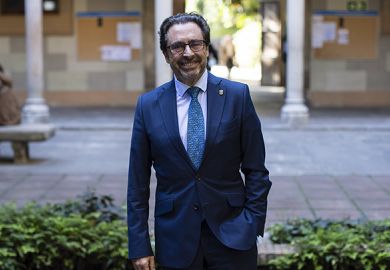
A Spanish academic has proposed a new model of student mobility that would involve sending Erasmus+ students to smaller towns or rural communities across the continent to help revive local economies suffering from population decline.
Under the “Orpheus” plan, students from the European Union could spend a semester or academic year living in a small town elsewhere in Europe while continuing their degrees online through their home universities.
“A British student could, for example, spend a semester in a small Spanish town facing population decline, while continuing their degree online through their home university or another participating university. There would be no need for a conventional university campus in the host town,” Luis de la Rasilla, a political scientist, told Times Higher Education.
He explained that students would also take part in “organised, face-to-face activities with local communities, contributing to social, cultural and economic life while gaining practical experience”.
“The idea is that successive groups of students would create a recurring presence in places experiencing demographic decline, helping to sustain local businesses, housing, services and employment.”
Unlike the conventional Erasmus+ exchange programme, students would be allowed to relocate within their own countries as well.
De la Rasilla has submitted a white paper outlining his proposal to the European Commission.
He said that he believes that the constant flow of students to neglected communities would create demand for accommodation, shops, transport and other local services which could encourage businesses to invest in these areas and more residents to settle there.
According to his own calculations, a community hosting 1,000 students every year could hypothetically benefit from between €7 million (£6.1 million) and €8.5 million in student spending. “These figures would not necessarily represent a net increase in European economic activity, since some student expenditure would be transferred from places of origin to host territories,” he added.
Asked whether online learning could undermine one of the main attractions of Erasmus+, the opportunity to study at another European university, de la Rasilla argued that students would still benefit from interacting with people from different backgrounds and gain practical experience through their involvement in local communities.
“Orpheus does not propose replacing physical mobility with virtual mobility,” he said, adding that conventional university exchanges would remain an option. “It proposes using digital teaching to multiply opportunities for physical mobility, freeing students from the requirement to study at a host university.”
He said he is hoping that the UK’s return to Erasmus+ could provide an opportunity for joint pilot projects.
“I am not asking the commission to adopt Orpheus immediately, nor to replace Erasmus+ without evidence,” he said. “I am asking it to examine whether the proposed model deserves to be tested through carefully designed pilot projects involving universities, public authorities and territories facing demographic challenges.”
Register to continue
Why register?
- Registration is free and only takes a moment
- Once registered, you can read 3 articles a month
- Sign up for our newsletter
Subscribe
Or subscribe for unlimited access to:
- Unlimited access to news, views, insights & reviews
- Digital editions
- Digital access to THE’s university and college rankings analysis
Already registered or a current subscriber?