Australian universities are being singled out to fight racism by a government whose international education policies could be helping to “polarise” views about minority groups, a webinar has been told.
Delegates at the higher education regulator’s annual conference have bristled at rules that saddle the sector with unique responsibilities to address “racism, marginalisation and other discriminatory conduct”.
A new regulatory standard requires universities and colleges to guarantee staff, students and visitors a “safe and inclusive institutional environment” that “prevents and responds to racism”. Institutions have until the end of the year to develop definitions of racism against Jewish, Muslim and Aboriginal people and other groups “specific” to their communities.
The standard also imposes obligations to provide guidance on how to “enhance safety and security on campus and online”, and to create an environment where “systemic, cultural and interpersonal forms” of discrimination are “clearly specified and understood”, among other things.
The Tertiary Education Quality and Standards Agency (Teqsa), which is holding its conference online for the first time, recently issued regulatory guidance about the definitions of antisemitism and Islamophobia. It is still developing its advice on how institutions should define racism against indigenous Australians.
A conference delegate said universities were already being pressured to define other forms of racism. “Why is there a need to single higher education out in this way when racism occurs in all corners of society?” he asked.
“[Should] the regulatory changes being introduced in universities…be considered across Australian society?” another delegate asked. “Racism doesn’t start at university,” a third observed. “It often begins…during childhood and school education. How can universities prevent racism from an early age?”
A fourth delegate said it was difficult for universities to “balance” their efforts to protect minority groups at a time when “broader government policies and public discourse” – particularly around international students – “may contribute to polarised views about these communities”.
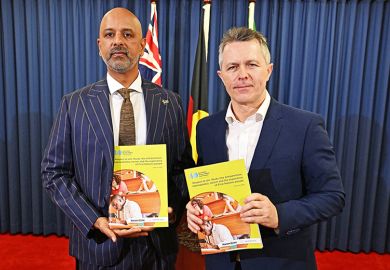
The new rules were informed by the Australian Human Rights Commission (AHRC), whose February report found that racism was “pervasive” in universities. “The study showed that universities are falling short of their duty of care to provide safe, inclusive and respectful environments,” AHRC president Hugh de Kretser told the conference. “It showed that racism at university isn’t confined to isolated incidents or individual behaviour – it’s systemic.”
The AHRC study also found that racism in universities “may be less severe than in other settings”. And an accompanying technical report, which was temporarily taken offline on the AHRC’s orders, suggested that response bias had led to significantly exaggerated findings about campus racism.
De Kretser acknowledged that incidents in universities were “a microcosm of what’s happening in Australia and across the world”. But administrators should embrace the new standard as an opportunity to “co-design” solutions, he said.
“[It] should be…about listening and making sure the experiences of the students and staff affected by racism are understood and taken into account in designing the governance frameworks and the policies and procedures and the complaint process and the curriculum,” he told the conference.
“Racism harms people and communities. It damages people’s identity and self-esteem, their sense of…belonging and their well-being and safety. Left unchecked, it leads to violence. It’s critical that we work together with the affected communities to address it.”
Mark Rose, first nations commissioner with the Australian Tertiary Education Commission, said administrators should not view regulatory obligations as a “negative”.
“It is a chance for us to stand up and define who we are,” Rose told the conference. “We are a great higher education system [but we] want to be better. We want to respond to…the wicked challenges before us.
“It’s not whether racism exists or not. It comes back to the…value system that the institution espouses. This process will lead universities and institutions to look in at themselves in a far deeper way.”
Delegates complained about the “short compliance timeline” for producing the new definitions. “The regulatory requirements were issued with a…1 January deadline over the summer break,” one noted. “Is there a risk that these time frames promote compliance-focused responses rather than meaningful cultural change?” another asked.
Teqsa CEO Mary Russell said the “short” timelines had been “set by government” to reflect the “urgency” of responding to “some of the most…live and contested issues of racism in our community”.
“We don’t expect…many higher education providers [will] have reached a consensus in their communities about what the definition should be,” Russell told the conference. “But…this is not the end of the conversation. Building…understanding about the ways [racism] manifests in academic environments will need to be a longer term conversation.”
Register to continue
Why register?
- Registration is free and only takes a moment
- Once registered, you can read 3 articles a month
- Sign up for our newsletter
Subscribe
Or subscribe for unlimited access to:
- Unlimited access to news, views, insights & reviews
- Digital editions
- Digital access to THE’s university and college rankings analysis
Already registered or a current subscriber?