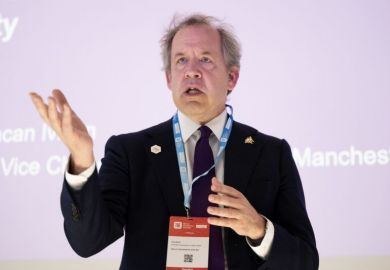
Collaborations between the Global North and South still too often fail to result in long-lasting benefits for universities on both sides, a conference has heard.
Speaking at the Times Higher Education Arab Universities Summit, the president of the Mediterranean Universities Union said that stronger follow-up was needed to ensure such relations had an enduring impact.
“Many of these agreements take place, end and leave no discernible impact in the university, in the sense that there is no follow-up with the institution and there is no sustainability of the effects of the collaboration,” Wail Benjelloun told the event, being held in Ben Guerir, Morocco.
Benjelloun, a former president of Mohammed V University in Rabat, argued that university internationalisation offices should be charged not just with recruiting overseas students, but that they should also be “responsible for the follow-up of these of these agreements”.
On the question of equity in such partnerships, Benjelloun explained that this did “not mean that everybody is paying the same on both sides, but it does mean that the European or Northern university is not the manager of the collaboration, with the Global South university being the recipient”.
Such partnerships must be “built on mutual trust”, transparency, and have to be a “partnership that contributes to both universities, not just to one as a capacity building operation,” he argued.
Speaking on the same panel, Alexandra Balafrej, the British Council country director for Morocco, said that while it was thought that universities in the Global North are more often adding value to partners from the South, such partnerships provide Northern universities with specialist local knowledge and context, and access to hard-to-reach communities.
She also said that such partnerships can quickly break down if trust between the universities is damaged, and said “trust is actually built in very unglamorous details”.
“It’s about details in governance, details in communications, calendars, who sits on which committee. Partnerships and the sustainability of those partnerships can be threatened when you have divergence around those details,” Balafrej said.
Mohamed El-Shinawi, president of Egypt’s Galala University, agreed. He added that universities will often “celebrate the signing of an MOU” (Memorandum of Understanding), only for such documents to end up “sitting in drawers”.
To counter this, universities should make sure before signing MOUs that they have “a clear strategy, and how is this going to be equal, and what’s the contribution of this?”
El-Shinawi said that as part of these partnerships, universities in the Middle East and Africa need to get better at highlighting the value they are able to bring to such partnerships.
“We in the South need to be very honest, and have to produce knowledge, not receive it. This is one of the things we have to discuss and be very clear about it,” he said.
“We in the Arab world, we have to start thinking how our universities are going to produce knowledge, and not just receive it.”
Register to continue
Why register?
- Registration is free and only takes a moment
- Once registered, you can read 3 articles a month
- Sign up for our newsletter
Subscribe
Or subscribe for unlimited access to:
- Unlimited access to news, views, insights & reviews
- Digital editions
- Digital access to THE’s university and college rankings analysis
Already registered or a current subscriber?