Universities across the Arab world should establish their own research council to boost their global reputation and create more closely aligned agendas, a conference has heard.
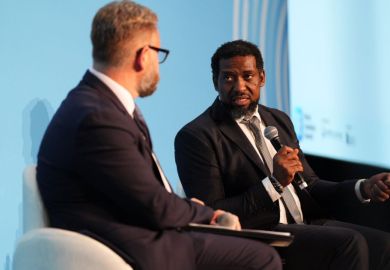
Speaking at the Times Higher Education Arab Summit at UM6P University in Morocco, Said Hamdioui, head of the computer engineering laboratory at Delft University of Technology, argued that research in the region lacks coordination.
Universities in the Middle East need to better focus on the “big challenges” facing the Arab world, but need better, formalised collaboration to do that, he argued.
“We need to create an Arab research innovation council, like they have in Europe. You would have governments, companies, and important stakeholders come together,” Hamdioui said, adding the countries need to have greater “close, cross-country collaboration”.
He said that such a council should “set shared priorities”, “select missions transparently” and “track delivery” to boost the region’s research outputs.
This could include creating an “Arab mission fund” Hamdioui said, which could provide “competitive funding for cross-border” university and industry teams. It would need to build “shared capabilities” to share experience, training, testing and facilities through “complimentary regional hubs”, as well as developing “deep-tech ventures”.
Universities should come together in a “single consortium” where they can “solve a clear, defined problem – like they do in Europe”, according to Hamdioui.
He said that in Arab universities, funding is not necessarily the problem but “leadership and application”. There are many “visions” for the reach of higher education across the region, “there are so many ambitions, so let’s combine them”.
“We need to advocate for this today, and we don’t need to wait for everyone for this to happen. A small coalition can gain momentum and start acting. It’s always a few people that change the world.”
Speaking at another conference session, Farida Fassi, professor of physics at Mohammed V University, also advocated for greater scientific collaboration.
She noted that one of the major periods of scientific acceleration in Europe occurred in the 12th and 13th centuries after Arab scientific discoveries were translated into Latin, helping shape “the course of scientific progress for generations”.
The Arab world should look back at this history, “not simply as a source of pride but as a foundation for new curiosity, research creativity and innovation”, Fassi said.
“We must also strengthen our international partnerships, connecting our Arab research with the global scientific community, to accelerate discoveries for our shared challenges,” she said.
“Our vision is clear: to position the Arab world as a global scientific leader, helping shape the future of scientists and humanity.
Register to continue
Why register?
- Registration is free and only takes a moment
- Once registered, you can read 3 articles a month
- Sign up for our newsletter
Subscribe
Or subscribe for unlimited access to:
- Unlimited access to news, views, insights & reviews
- Digital editions
- Digital access to THE’s university and college rankings analysis
Already registered or a current subscriber?