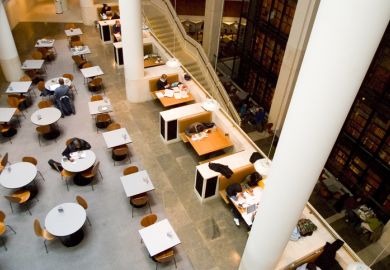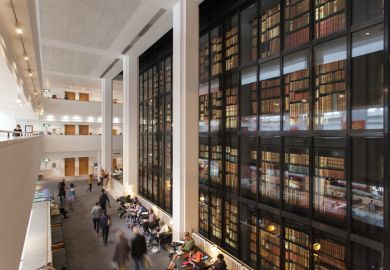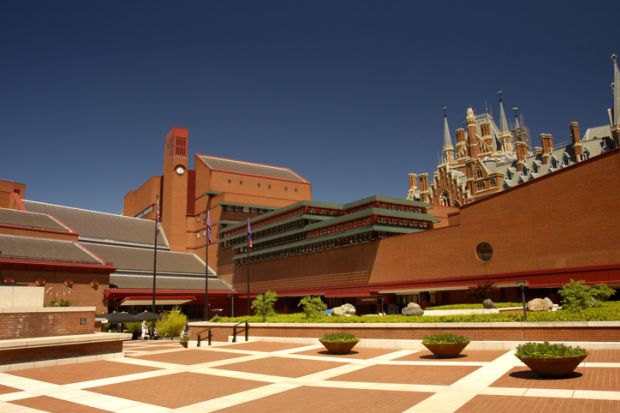
British Library staff are “furious” about the flagship institution’s plan to repurpose some of its reading rooms as paid-for workspaces, according to a union leader.
Many academics have voiced concern over the library’s plans to turn its science and social sciences reading rooms into “a flexible workspace and generate a new revenue stream”.
Unions now say that library workers share many of these fears. Speaking to Times Higher Education, Noel McClean, deputy general secretary of Prospect union, said its members are “are furious about the proposed repurposing of the reading rooms” as well as a separate plan to outsource security arrangements.
The union has urged the library to pause the plan and warned that it will consider moving to a ballot for industrial action if they do not.
“The repurposing of the reading rooms, done without staff consultation, goes entirely against the British Library’s key function, which is to provide access to the national collection of published books and content,” said McClean.
Workers at the British Library undertake the staggering task of cataloguing every book in the UK. Much of this activity happens in its Yorkshire-based Boston Spa site, which stores more than 170 million items.
“Reducing this access undermines the incredibly taxing work done to ensure the national collection is available to all,” McClean said.
A spokesperson for PCS, another union representing library workers, said it is “currently in dispute with the British Library over three issues” the two raised by Prospect and the 2026-27 pay offer.
They said our members are “deeply concerned” about the proposed closure of the science reading room and the impact it will have on both the service that the library provides and their job security.
“It is deeply concerning that a space dedicated to public research, learning and scholarship could be repurposed for commercial gain. The British Library is a national institution, and its priority should be protecting and improving access to its services, not turning valuable public space into a commercial workspace,” they said.
The library has suffered from the fallout of a major cyberattack in 2023 that impacted many of its digitised research resources, some of which are yet to recover.
It did announce earlier this week that its UK Web Archive has at last been restored, enabling users to search millions of archived UK websites.
The fresh discontent among staff comes after last year 300 PCS members participated in a two-week strike action over its 2025-26 pay offer, which ended with the union accepting a revised deal.
Explaining the plans for the reading rooms previously, a spokesperson said they were part of a six-year programme to put the library “on a more sustainable financial footing and ensure it remains accessible, relevant and world-leading for everyone – with core services free to use”.
Science and social science research services will be preserved and relocated to the library’s remaining eight reading rooms, they added, saying that usage figures showed that the anticipated level of demand could be accommodated.
Addressing the staff concerns, a spokesperson said: “As part of this process, we will be undertaking a service review of a number of teams at the library. We are consulting with staff and aim to keep them as informed as possible, but we are confident that the library needs to make changes to continue as a world-leading resource.
“We are grateful to every member of staff who has worked for the British Library and our focus will now be on engaging with and supporting affected employees.”
Register to continue
Why register?
- Registration is free and only takes a moment
- Once registered, you can read 3 articles a month
- Sign up for our newsletter
Subscribe
Or subscribe for unlimited access to:
- Unlimited access to news, views, insights & reviews
- Digital editions
- Digital access to THE’s university and college rankings analysis
Already registered or a current subscriber?