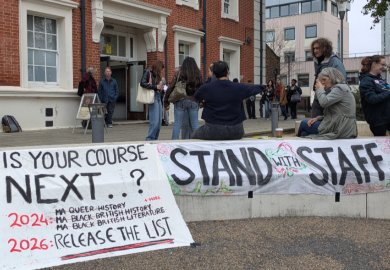
Cardiff University is facing more potential strike action after staff remaining at the institution warned they face “dangerous, unhealthy and unmanageable” workloads.
The University and College Union (UCU) branch at Cardiff has declared its third industrial relations dispute since the university first announced plans to cut 400 jobs at the start of 2025.
Cardiff agreed to reduce its job cuts targets amid heavy criticism and the threat of strikes and a marking boycott from the union, as well as agreements to not carry out compulsory redundancies in 2025 and 2026.
But UCU said that more than 170 academics have left the university since the announcement, with professional services roles also cut.
The UCU branch said that the university has failed to rule out compulsory job cuts in 2027 after “intense” summer negotiations between management and the union.
It has also failed to agree on commitments on job security and workload, UCU said. A consultative ballot on strike action will be held in November, with a view to staging walkouts in early 2027.
UCU also claimed that staff cuts combined with changes to the time they are allocated to do research and teaching, has meant those those who remain “are facing dangerous, unhealthy, and unmanageable workloads” because “an already existing workload crisis is getting even worse”.
A Cardiff UCU spokesperson said it understands the financial deficit the university faces “is real” but added: “the university has a lot more accessible cash than other struggling HE institutions”.
“Making cuts is always about priorities. Jobs, staff welfare and our ability to provide an excellent education for our students should always be a top priority, and not the first things to go.
“The threat of industrial action from our members has so far limited the damage inflicted by management’s planned cuts and poorly managed, chaotic restructuring exercises. In 2025 and 2026 we forced them to abandon their compulsory redundancy plans, as well as to guarantee no detriment to the many hundreds of staff whose roles were changed and professional lives upended by these constant shake ups.”
Peter Hill, a UCU Wales official, said that it “maintains a red line against compulsory redundancies”.
“Similarly, we recognise the effects of job losses are felt by those who remain within the university. Impossible workloads and reductions in research time erode quality education to students’ disadvantage,” he said.
A university spokesperson said it was “disappointed” to learn of UCU’s proposed industrial ballot through the media “rather than through dialogue with the university” – a claim which the union heavily denied.
The spokesperson said that Cardiff recognises “that this has been an incredibly difficult and challenging period of change” but said it could not rule out further job cuts.
“The university has always sought to work constructively with our trade union colleagues to help manage staff workloads and ensure that any necessary reductions in staffing levels are made over time and, wherever possible, through voluntary means. Whilst compulsory redundancies will always be our last resort – like any organisation, they can never be completely ruled out,” they said.
They added that it is “disappointing that industrial action is being considered”. “We’d urge UCU to continue to work with us, in partnership, as we do everything we can to secure the long-term future of our university.”
Register to continue
Why register?
- Registration is free and only takes a moment
- Once registered, you can read 3 articles a month
- Sign up for our newsletter
Subscribe
Or subscribe for unlimited access to:
- Unlimited access to news, views, insights & reviews
- Digital editions
- Digital access to THE’s university and college rankings analysis
Already registered or a current subscriber?