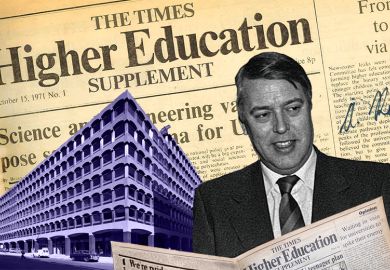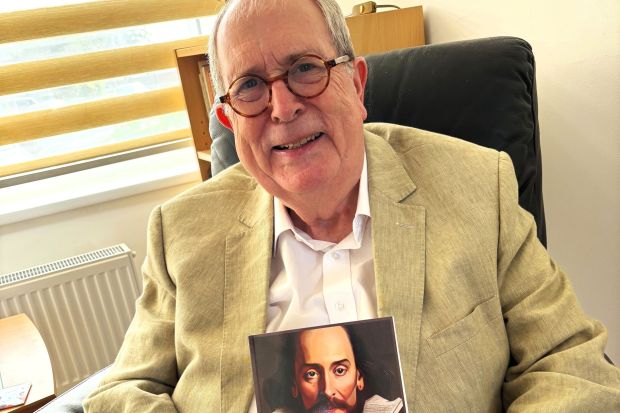
The founding vice-chancellor of what is now Wrexham University has turned to novel-writing to continue his efforts to introduce academia to a wider audience.
Michael Scott, an authority on Shakespeare and Elizabethan drama and current senior fellow at Blackfriars Hall, Oxford, has written or edited more than 50 books as an academic, but hopes Shakespeare, Sex and the Psychotherapist, the third and final novel in a trilogy about the Bard, will ultimately engage more readers.
Scott’s novel follows Jacob Fortune, a time-travelling psychotherapist from the 21st century, who arrives in Stratford-upon-Avon to help assure the playwright of his place in history.
But the book also explores Shakespeare’s existence in Protestant England, including long-running speculation surrounding his potential, secret personal commitment to the Catholic faith.
It completes a series begun by Scott’s books Hamlet and the Psychotherapist and The Scottish King: Macbeth and the Psychotherapist.
Scott admitted that some of his colleagues in the field “think I’m a bit strange”.
“It’s not mainstream academia,” he said of his project, “but at my age I don’t need to be [doing] mainstream academia any more.” Overall, he said, his peers had been “very encouraging”.
Scott’s career began at the then Sunderland Polytechnic, as professor of English and head of the School of Humanities. He became a pro vice-chancellor at De Montfort University, from which he received his PhD in 1989. From 2001 he oversaw the transformation of the North East Wales Institute of Higher Education into Glyndŵr University, which is now Wrexham University, and served as its founding vice-chancellor for more than 14 years.
“I was always interested in universities not for the elite but universities for the people,” he said.
“The whole aim [at Glyndŵr], always, was to try and get people who didn’t feel that university was for them to go to a university, and that’s what we achieved, really.”
The former vice-chancellor joked that the sector’s recent emphasis on ensuring students are well prepared for a tough jobs market looked like “people are saying this is all strange new stuff”, but that Glyndŵr had long worked to incorporate thinking about employability into degrees – with conversations with aerospace industry and local business informing courses.
Scott’s approach to access was informed by his own introduction to his subject, he says.
“When I was about 14, I wasn’t doing too well at all. I was [an] adolescent and all the rest of it I suppose, but things weren’t going very well, and [so] my aunt took me to Stratford.”
There, he saw a production of Richard II by the legendary establishing director of the Royal Shakespeare Company (RSC), Peter Hall.
“It blew me away,” Scott said. “The next year, I saw Peter Hall’s production again, of Hamlet, and [actor] David Warner came out and he was dressed just like my elder brother, as a university student, and he talked in a Birmingham accent. I just absolutely started to fall in love with Shakespeare.”
Later, while working at Sunderland Polytechnic, Scott encouraged actors from the RSC to come to work with his students, introducing “kids who’ve never been to a theatre” to the art.
Scott moved to Oxford just over 10 years ago with his wife, intending to retire. However, his spouse became ill and subsequently died in 2016.
“I’d done a year working with another college in Oxford and Blackfriars Hall saw my publications and they brought me back into academia,” explained Scott, who has since remarried, after reconnecting with a former friend from primary school who had also lost her husband.
But publishing his latest novel harks back to his fundamental ethic throughout his decades of working in higher education, Scott says.
“What I’ve been about throughout my career, as a Shakespearean, is trying to get rid of the fear of Shakespeare as this impenetrable force of influences [only] for very clever people,” he said.
“I've done a number of critical books, but it struck me that maybe one way to get to an even wider audience about Shakespeare was to write some novels, about him or about his plays…so [the reader] can get the enthusiasm for Shakespeare, and what he was trying to do.”
“There’s biography after biography of Shakespeare’s life, all trying to beat one another,” he said. “This is a story about him telling his life story.
“I thought it would give a freshness to the whole thing, and to the fact he was just an ordinary guy, really, who made it.”
Shakespeare, Sex and the Psychotherapist is published by Edward Everett Root Publishers.
Register to continue
Why register?
- Registration is free and only takes a moment
- Once registered, you can read 3 articles a month
- Sign up for our newsletter
Subscribe
Or subscribe for unlimited access to:
- Unlimited access to news, views, insights & reviews
- Digital editions
- Digital access to THE’s university and college rankings analysis
Already registered or a current subscriber?