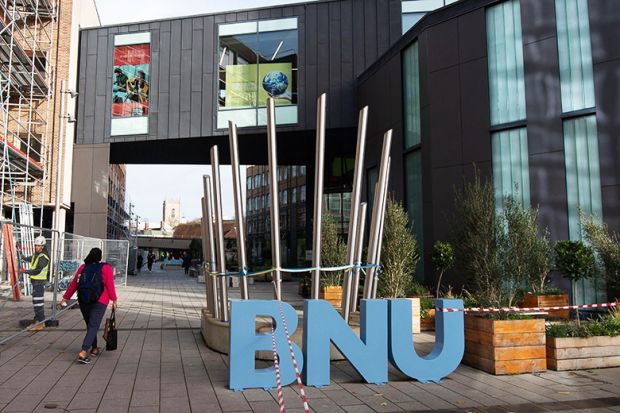
Soaring student visa refusal rates may see more UK universities stripped of their ability to recruit foreign students, experts have warned, following the Home Office’s decision to suspend a full university’s licence for the first time in a decade.
While officials have not said why it suspended Bucks New University’s student visa licence on 30 September, the penalty has intensified concerns over new compliance metrics for UK universities enrolling foreign students which took effect in June.
The High Wycombe-based institution was itself the last university to face this sanction in 2015, later regaining its sponsorship powers, with only a handful of other institutions previously facing temporary bans on international enrolments.
Under the new Basic Compliance Assessment (BCA) rule, which took effect in June, universities with a visa refusal rate of 5 per cent or above (down from 10 per cent) will be classified as “red” with repeated breaches leading to the suspension or revocation of an institution’s licence to sponsor students.
Those tighter compliance rules have coincided with a spike in visa refusal rates, with Pakistan’s visa refusal rate increasing to 19 per cent for the 12 months ending on 30 June, up from 5 per cent, latest Home Office figures show. For the latest quarter, that figure rose to 34.2 per cent for Pakistani applicants.
For Nigeria, the refusal rate more than doubled year-on-year from 4.3 per cent to 11.7 per cent, before jumping to 25 per cent for the latest quarter. India’s refusal rate was statistically lower at 4.2 per cent for the past 12 months but this is almost twice the 2.9 per cent rate seen in the prior 12 months, with refusal rates standing at 9.1 per cent in the latest quarter.
Some vice-chancellors have reported a further “unexplained surge” in refusal rates since June, prompting them to suspend recruitment activity in certain territories to avoid falling foul of tighter compliance rules.
However, sector leaders are privately split on how many universities will be affected by non-compliance with the new BCA rules, with some vice-chancellors privately stating it is an issue affecting a small group of teaching-focused institutions that have relied heavily on “higher-risk” markets for international students.
“This isn’t affecting the more selective end of the sector yet, although it isn’t great for the global brand of UK higher education,” one Russell Group leader told Times Higher Education.
Another leader of a UK research-intensive university said the bulk of non-compliance resided in “four or five institutions whose identities are well known” and action was “long overdue”.
Others disagreed, stating risk of non-compliance was affecting all types of institutions including some members of the Russell Group of research-intensive universities.
Charles Knight, a higher education consultant who was previously associate dean at Salford Business School, said lower-tariff institutions had been badly hit by the new compliance rules and UK Visas and Immigration (UKVI) decision-making which coincided with a sharp downturn in international student mobility.
“As international students have declined overall, high-tariff institutions in the UK have taken what is left of the students from safer markets such as China or the US. Everyone is left operating in countries with higher visa refusal rates such as Pakistan, Bangladesh, Nigeria and India,” explained Knight.
With visa refusal rates from these countries rocketing over the past 12 months, UK universities have been forced to consider whether they should “fight it out for the lower-risk students or withdraw from markets altogether”, he added.
“If you continue to play in high-risk markets you risk having your sponsor’s licence revoked but if you don’t you run the risk of running into revenue problems,” he added.
“There is definitely potential for a large significant institution to have their licence pulled,” said Knight, adding that this could prove politically difficult for the Labour government as “either the BCA rules are implemented [with the loss of a sponsor’s licence] or UKVI are not seen to implement their requirements and things become political”, he added.
With the financial turmoil that would ensue if a major university lost its visa licence, the restrictive nature of the new UKVI rules could eventually force Labour to review the wider UK higher education funding model, which currently sees universities spend £3,000 more annually per undergraduate than the £9,790 fees that they receive, he added.
“Universities are caught in a wider political debate about immigration but the current administration are not inclined to deal with the complexity of reforming student fees to make institutions financially sustainable,” said Knight, adding that this situation left “universities reliant on retaining their international fee income [to stay solvent] while UKVI are making it increasingly difficult to stay compliant”, he said.
Gary Davies, deputy vice-chancellor at London Metropolitan University, said the government must seek to balance the imperative to control immigration with its desire to grow external education income to £40 billion annually over the next four years.
“Universities are trying to remain compliant with the rules but they have also been told by this government and previous administrations to generate income by selling educational opportunities. It’s becoming increasingly difficult to pursue these two objectives,” he said.
“If the Home Office isn’t careful it will turn a sector which is very compliant with its rules into looking like a sector that looks like it’s full of fraud, which would be very unfair,” said Davies.
Some of the reasons for visa refusal given to London Met by the Home Office were hard to reconcile with the requirements set down in official guidance, he said.
“Students have been turned away because they couldn’t recall the opening hours of the library or give a description of how they compared courses on offer in Canada to those available in the UK. One was refused because they ‘gave the impression that their primary motivation for taking a law course was to further their professional ambitions rather than a more general academic interest in the subject’,” he said.
Rejecting the suggestion that this issue was affecting only a small number of institutions, Davies said research-intensives could not be complacent about relying on Chinese students forever given demographic changes.
That may mean higher-tariff universities would also increasingly need to engage in the markets with higher refusal rates that they had previously avoided, said Davies.
“China has a planned economy and it is increasingly keeping students at home, or sending them to Hong Kong or Singapore which are much more culturally aligned compared to the UK. They’re not going to the US or UK in the same numbers that they once did and that trend is set to increase,” he continued.
“At some point we will need a conversation with ministers about how institutions of all types can constructively engage in markets where students still want to come to the UK.”
Register to continue
Why register?
- Registration is free and only takes a moment
- Once registered, you can read 3 articles a month
- Sign up for our newsletter
Subscribe
Or subscribe for unlimited access to:
- Unlimited access to news, views, insights & reviews
- Digital editions
- Digital access to THE’s university and college rankings analysis
Already registered or a current subscriber?