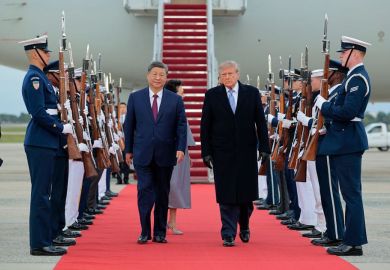
Chinese president Xi Jinping’s invitation for 100,000 “young Americans” to study in China has been well received by the global higher education sector, but there is some wariness about how substantial the exchanges will be.
Speaking at the White House during his state visit last week, Xi issued a formal invitation to 100,000 “young Americans” to come to China for exchange programmes over the next five years.
The 100,000 figure builds on Xi’s 2023 initiative to invite 50,000 Americans to study on exchange programmes in China over the following five years. That target was reached two and a half years ahead of schedule, Xi said, but there is no official data confirming how long any of the American students spent in China.
There is also no official definition of study-abroad exchanges in China; they can be characterised as anything from short-term cultural trips or internships to semester-long exchanges or undergraduate study. Yet a two-week trip and a full-time degree “count very differently in terms of meaningful academic integration”, observed Lizzi Lee, a fellow at the Asia Society Policy Institute’s Center for China Analysis.
In that sense, while Xi’s latest invitation was “politically significant”, it was potentially “less so” for higher education itself.
“Xi’s wording is ‘young Americans coming to China for exchanges and study’, so this can include short study tours and other programmes,” she noted.
In that sense, the initiative is unlikely to significantly affect the “huge asymmetry” between the two superpowers in terms of student flows.
Although Chinese student enrolment – mostly for degree-level programmes – in the US has dropped in recent years, it continues to hover around 260,000. By contrast, analysis from a report by NGO US-China Education Trust found the number of US degree students in China sits at 2,000 in 2026, down from 11,000 in 2019.
According to Philip Altbach, emeritus professor at Boston College’s Center for International Higher Education, a figure as low as 2,000 is evidence that Xi’s initial 50,000 offer bore little fruit in terms of increasing full-time enrolment of US students in Chinese universities.
“Getting a Chinese visa is now very complicated,” he said. “Given geopolitical issues, I do not think that this initiative will result in much, just as the earlier invitation did not. And relations are worse now.”
Despite a backdrop of increased hawkishness in the US – several top Chinese institutions were placed on the US national security list last month – Lee said that the significance of Xi’s announcement is that “educational exchange is being preserved as other parts of the relationship become more security-focused”.
Both sides can see “value in maintaining personal and institutional contact”, Lee continued. There is an “obvious public diplomacy dimension” of inviting more US youth to China, “increasing first-hand exposure at a time when mutual perceptions have deteriorated”.
Hamish Coates, formerly a tenured professor at Tsinghua University’s Institute of Education and now executive dean of Australia’s Holmes Institute, said that China “is more open than ever before in its history in so many respects”, which represents an unprecedented opportunity for US students to “understand contemporary Asia”.
However, he doubted whether students will engage with China in a meaningful way rather than going for “very transactional academic tourism”.
“I hope that they go and embed themselves in the real China and get outside of the foreign joint-venture operations, get outside of the Eastern seaboard, and go and study in real Chinese institutions where people don’t speak English or Spanish or Italian or whatever the case may be.”
Register to continue
Why register?
- Registration is free and only takes a moment
- Once registered, you can read 3 articles a month
- Sign up for our newsletter
Subscribe
Or subscribe for unlimited access to:
- Unlimited access to news, views, insights & reviews
- Digital editions
- Digital access to THE’s university and college rankings analysis
Already registered or a current subscriber?