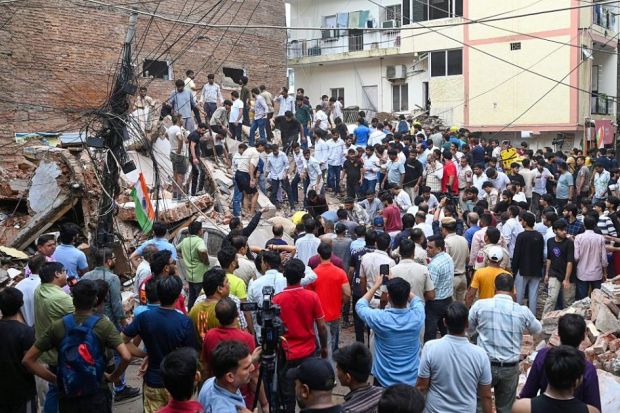
The collapse of a five-storey building that housed university students in Delhi has brought to the fore questions about the support and safety afforded to young people residing in India’s capital.
Following the collapse of the private accommodation, known as Hostel Daze, on 6 September, authorities have confirmed seven people dead and 12 were in hospital. It was feared there were students still trapped or buried in the rubble.
The building was situated in the Satya Niketan neighbourhood in the south west of the city, near the campus of the University of Delhi. Delhi police are investigating potential reasons for the collapse, and have arrested the building owner and his family.
Thousands of students from across India come to the capital for their tertiary education, but few of them secure on-campus accommodation. Owing to limited university infrastructure and resources, significant numbers of students therefore rely on private hostels, what is known as “paying guest” (PG) accommodation.
Delhi-based independent journalist Javed Khan told Times Higher Education that Hostel Daze held 15 rooms and roughly 75 beds, with students paying between 12,000 and 15,000 Indian rupees per bed each month. This is approximately £100 per bed in a shared room, “which is very expensive for students in India”, he said.
It has now emerged that the building lacked structural audits, emergency exits, and a fire safety certificate, according to reports.
“This fits a broader pattern in the Satya Niketan area, and across Delhi more generally, where residential structures near colleges are illegally converted or vertically expanded into PG accommodation to maximise rent,” said Khan.
“Because much of this construction happens without municipal sign-off, there is no reliable count of how many such buildings exist, which itself is part of the problem: enforcement agencies are working with an incomplete picture of what they’re supposed to be regulating.”
Monami Sinha, associate professor of economics at the University of Delhi, told Times Higher Education there was a shortfall of accommodation in the capital, comparing her institution’s intake of about 350,000 students with the 9,000 hostel beds available.
“The situation is very bad. To make it worse, [this] is the capital city with [a] very high cost of living,” she said.
Sinha explained that PG accommodation often leaves dozens of students sharing what are “unhygienic, unsanitary conditions…where there is not even space in the room to walk around”.
Such cramped conditions can mean PG accommodation is unsafe in emergency situations, and Sinha described them as “death traps”.
Some buildings also scale six floors, she added, despite the legal limit on most residential buildings in Delhi to a maximum of four floors.
“The areas which have illegal construction and unauthorised housing mushroom all over the place…that’s the only option available for students, and these are usually areas near the cluster of colleges,” Sinha continued.
“This is a death trap, and there’s absolute apathy from the government as well as the university administration, which could have built more hostels in all this time…It’s not like colleges don’t have land. There is no political will.
“Parents send their children to study; you don’t expect their dead bodies to come back home.”
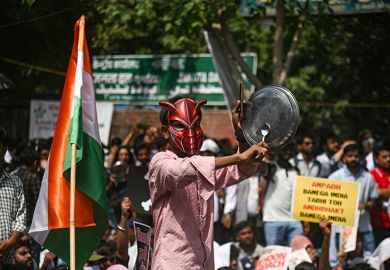
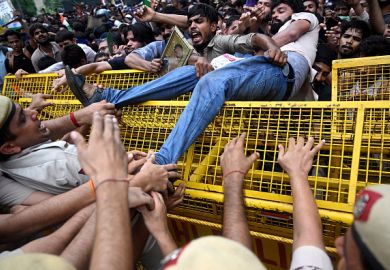
The hostel collapse has triggered protests in Delhi, including a candlelit march organised by the National Students’ Union of India, and interventions from the Cockroach Janta Party – which led protests against exam paper leaks – on social media.
The CJP has announced its seven core demands for safer student accommodation, including calls for an independent investigation, an audit of student accommodation to ensure they are structurally safe, and for compensation to be issued for injured students and family that lost loved ones.
Speaking to his 5.6 million followers on Instagram, CJP founder Abhijeet Dipke questioned the precarity of student accommodation in India, while state politicians have safe housing.
“Have you ever seen in the news that the office of a political party collapsed, or that the roof of a minister’s house caved in…Their homes remain completely safe and secure. Yet, right where students study and where students live, structures collapse. Who bears the responsibility for this, and how long will this continue to happen?”
Register to continue
Why register?
- Registration is free and only takes a moment
- Once registered, you can read 3 articles a month
- Sign up for our newsletter
Subscribe
Or subscribe for unlimited access to:
- Unlimited access to news, views, insights & reviews
- Digital editions
- Digital access to THE’s university and college rankings analysis
Already registered or a current subscriber?