Scientists are too focused on racking up journal papers because it will look good on their CV, with many publications lacking novelty or insight, the Nobel Prize-winning biochemist behind the pandemic-ending mRNA vaccines has claimed.
In a swipe at inconsequential publications, Katalin Karikó, the US-Hungarian scientist whose research at the University of Pennsylvania paved the way for a new generation of vaccines, told a scientific conference in Germany that her own career had been hurt by not producing papers as regularly as her peers.
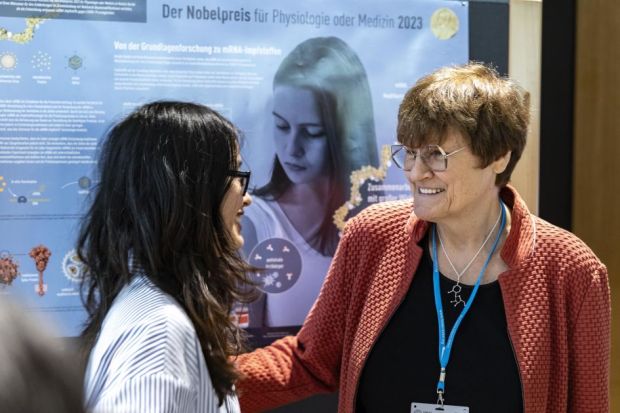
Speaking at the 75th Lindau Nobel Laureate Meeting, Karikó said internal pressures to publish were often the driving force behind some papers produced by her former colleagues rather than the desire to produce novel science.
“They published when they had nothing to say but their students wanted to graduate or bosses wanted promotion,”Karikó told the summit on 29 June.
Describing her own up-and-down career, Karikó explained how she moved from Hungary to the US at the age of 30 after her lab lost its funding but lost two further research jobs – at Johns Hopkins University and University of Pennsylvania, where she was also demoted – before her research was finally recognised.
Paying tribute to her Pennsylvania colleague David Langer, who offered her a position after Johns Hopkins withdrew its job offer, Karikó said her one piece of advice to young scientists was to “convince at least one professor with money that your idea is really great”.
“When he [Langer] learned I’d lost my job, he gave me a job and I danced around that lab for about 17 years,” she said.
Karikó was awarded the Nobel Prize for medicine and physiology with her collaborator Drew Weissman in 2023 for their work on RNA technology which laid the groundwork for mRNA vaccines used to combat Covid. She later became vice-president of German drug company BioNTech, now one of Europe’s largest biotech firms with a valuation of $23 billion (£20 billion). At its peak in 2021, the Mainz-based company was one of Germany’s biggest corporations with a $100 billion capitalisation.
Reflecting on her career, Karikó said: “I don’t say ‘you can be fired so many times and still win the Nobel Prize’ but there is always the opportunity.”
Register to continue
Why register?
- Registration is free and only takes a moment
- Once registered, you can read 3 articles a month
- Sign up for our newsletter
Subscribe
Or subscribe for unlimited access to:
- Unlimited access to news, views, insights & reviews
- Digital editions
- Digital access to THE’s university and college rankings analysis
Already registered or a current subscriber?