Universities must resist bending their missions to the priorities of overbearing funders, Times Higher Education’s Global Sustainable Development Congress has heard.
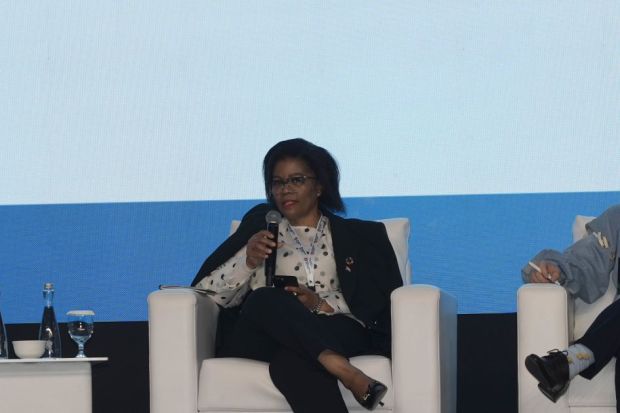
Ethicist Puleng LenkaBula said funding with strings attached was the “elephant in the room” for science innovation. “Financing for research and innovation must…be free of conditionalities that disable the researchers from pursuing the questions they want to undertake,” said LenkaBula, vice-chancellor of the University of South Africa (Unisa).
“If we only align our research to what the funders prescribe, we will forget the mission. This is [something that] we often are shy to speak about. Who determines the research and…innovation agendas? How do we ensure that [they] are responsive, not prescribed?”
Summer Xia, Indonesian country director with the British Council, said funders increasingly wanted to know whether the research they backed was “implementable, partnership-ready and relevant to public priorities”. He cited Indonesia’s National Research and Innovation Agency, which was orienting its funding around “strategic issues” like food, energy and health.
The UK’s International Science Partnership Fund was arranged around the four “major themes” of planet, health, technology and talent. “We are all on the same page,” Xia said. “That…is a clear message to the universities on how they should orient their research in order to increase their chances of securing funding.”
But LenkaBula said Unisa had made a conscious decision “to avoid dependency” by funding its research through internally generated resources. “We choose who we work with,” she told the conference. “We don’t do research because it’s prescribed by the funding agencies.
“[We want] funders as partners, not funders [with] prescriptive ideas on how we do research. If you are coming with conditionalities, you might as well go elsewhere.”
She said Africa had “learnt the hard way” from the Trump administration’s dismantling of the US Agency for International Development. “If he who pays stops, then the research stops. These are…ethical concerns that we should grapple with.
“At Unisa…we had our own funding, but there are universities in South Africa that had to stop their research. We have to be sensitive to our own independence.”
LenkaBula said it was important to choose research partners because of their “convergence” on topics of interest – not because of their deep pockets. And a “strong ethical or governance framework” helped universities avoid undermining their institutional values by accepting funds from organisations whose core business – in fossil fuels or defence, for example – was “contradictory to sustainability”.
“We must do research where we will all thrive,” she told the conference.
Xia counselled against a “binary” approach of either allowing or banning funds from certain sources. “Universities should use principled governance, not ad hoc reactions,” he said.
“The question is not simply, ‘is this controversial?’, but ‘under what safeguards, transparency and public interest tests would this be acceptable?’”
Register to continue
Why register?
- Registration is free and only takes a moment
- Once registered, you can read 3 articles a month
- Sign up for our newsletter
Subscribe
Or subscribe for unlimited access to:
- Unlimited access to news, views, insights & reviews
- Digital editions
- Digital access to THE’s university and college rankings analysis
Already registered or a current subscriber?