Given the devastation wrought to international development by the massive aid cuts recently imposed by the US and many other Western nations, some university development studies programmes are understandably concerned about their future student enrolment.
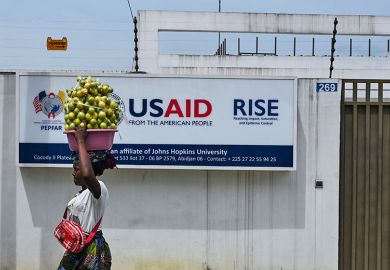
Since Donald Trump’s re-election in January 2025, the closure of USAID has led to deep cuts to hundreds of development projects around the world. And although their cuts are less dramatic, Canada, the UK, Germany and other European countries have also substantially reduced their development aid expenditures, leading to growing volatility in the aid sector.
Politicians are depicting development aid in broad strokes as wasteful spending for donor nations. There are also some optimistic accounts, from a different political perspective, of new possibilities for reducing aid dependency, which frequently has neocolonial and exploitative features. But when it is distributed ethically, equitably and in a spirit of genuine partnership and accountability, development aid often has beneficial outcomes for both donor and recipient states.
That is why the cost for the recent slashing of aid will not be paid solely in the health and lives of the poorest and most marginalised individuals in the developing world, as it is already doing. Development aid also benefits donors by lessening the likelihood of conflict within and between states, reducing the transmission of disease (including across international borders) and potentially opening markets as developing countries grow their economies and improve their human resources through expanded education and fulfilment of the rights of girls and women.
Yet in some respects, the field of development is beginning to resemble humanitarian aid and disaster response, given the food insecurity emergency and public health emergencies to which the aid cuts have led. Moreover, the cuts are ongoing and often come with little prior warning, so it is becoming increasingly difficult to reliably plan development programmes beyond the immediate calendar year.
You might well wonder, then, who would now choose to work in international development. And who, therefore, would sign up to study international development? But while concerns about a potential decline in student enrolment are legitimate, it’s not clear that they are warranted yet. And they may not be warranted at all if development studies practitioners and teachers can rapidly adapt to the earthquake that has hit them.
For the past 50 years, teaching development focused on grant applications and assessment, monitoring, management and evaluation of programmes. And there are no practical alternatives to resource-intensive healthcare needs, such as the provision of lifesaving antiretrovirals to prevent death from Aids. There are real limits to resilience and adaptability in situations of severe inequality and injustice and lack of access to basic, lifesaving needs.
Nevertheless, if they are to remain relevant and attractive to students, development studies programmes will have to provide insight into ways of pursuing development that are not as dependent on the expenditures of wealthy countries and lean into envisioning ways of coping and adapting, however intrinsically limited.
For instance, there are other mechanisms of pursuing development that focus more on disease prevention based on advancing indigenous capacity for collective action through behaviour change, such as improving sanitation practices. Communal action against harmful practices like child marriage and child labour can also be encouraged by community-based development projects, such as the so-called SEED-SCALE projects pioneered in partnership with Unicef and the “Locally Led Development” adopted by Heifer International and other development NGOs.
Of course, the flow of students into development studies degrees may still decline. But if it does, there are also ways to proactively mitigate that. Many stand-alone courses in the US and Canada are offered by schools of public policy or international affairs, and students who enrol on them typically have a strong interest in international studies and international affairs. Hence, they would also likely be open to enrolling on a master’s in international affairs, within which development studies was one track.
In the UK, development studies programmes are also offered as stand-alone degrees, but many universities also include development studies modules within degrees in regional studies, international affairs and social policy. So, again, development studies could be integrated within those degrees if there were a decline in student interest in stand-alone degrees.
Whatever the precise configurations in which it is taught, it is clear that development studies can continue to have a vibrant future by preparing its graduates for fulfilling careers responding to the challenging and changing conditions in which they will be working with creative pragmatism – creating foundations for a new form of development that is more community based, locally led and less dependent on the goodwill of external donors.
Noam Schimmel is lecturer in development practice and international and area studies at the University of California, Berkeley.
Register to continue
Why register?
- Registration is free and only takes a moment
- Once registered, you can read 3 articles a month
- Sign up for our newsletter
Subscribe
Or subscribe for unlimited access to:
- Unlimited access to news, views, insights & reviews
- Digital editions
- Digital access to THE’s university and college rankings analysis
Already registered or a current subscriber?