
The number of university students who view their course as good value for money has risen to the highest level in more than a decade, reflecting widespread positivity among current undergraduates despite public concern around graduate debt and jobs.
Results of the annual Student Academic Experience Survey, run by Advance HE and the Higher Education Policy Institute (Hepi), appear to transcend the gloomy mood around UK universities, with increases in several key metrics pointing to a “positive experience all round” for students.
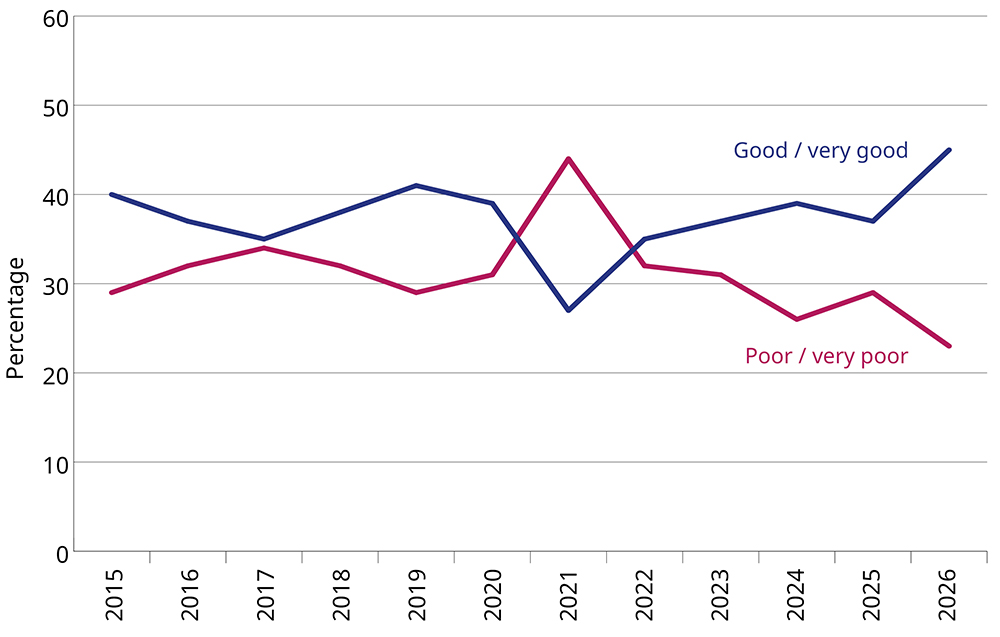
In a year dominated by discussions over the burden of student debt – and in which universities saw significant job cuts and industrial action – the number of students saying they believed their course was good value for money rose from 37 per cent in 2025, to 45 per cent in 2026 – the highest result since 2013, when it was 50 per cent. This came despite the first fee rise since 2017, with students charged £9,535 a year since September.
Based on a survey of more than 10,000 students, a report into the findings says the results were “striking”. Those who believed their course was “poor” value for money fell from 29 per cent last year to 23 per cent in 2026.
Students that perceived good value for money were most likely to say teaching quality and course content were the main factors driving their decision – with positivity about both factors increasing this year.
Value for money of your present course
The number of students who said their experience had “exceeded expectations” also reached a 10-year high, rising from 26 per cent in 2025 to 28 per cent. The number saying “it was worse” declined from 15 per cent to 11 per cent year-on-year.
Some 66 per cent of students also said that, if given the choice again, they would make no changes to their university or course choice – a significant increase on the 56 per cent who said the same last year.
Just 7 per cent said they would have chosen an option outside higher education, which “is a clear reversal from the significant increase we saw in 2025”, authors say.
The report speculates that a growing distance from the Covid pandemic may have “created a more stable environment for the current undergraduate cohorts to prepare for and choose their post-18 options and hence benefit from a clearer choice and better preparation”.
Asked by Times Higher Education why results had improved despite the negativity surrounding the sector, Advance HE chief executive Alistair Jarvis said: “What may be happening is that although there are overall cuts, universities are having to make very difficult choices about what to prioritise, and they’re prioritising the things that students are telling them are most important in their experience.”
He added: “Universities are picking out the areas of weakness and putting particular emphasis on those, so even if the overall picture is a reduction [in staff] and a reduction in the breadth of what they’re doing, they’re trying to effectively focus.”
However, despite the overall positive trends, the report says there “is still evidence of necessary choices needing to be made in terms of how much time students can spare to devote to their course, particularly outside the classroom”.
Among other findings:
- 70 per cent of students said they felt able to express their views on campus – up from 64 per cent last year. Just 10 per cent disagreed, down from 14 per cent
- Students from private schools were less likely than those from state schools to say that a lack of confidence in public speaking made them uncomfortable in expressing their viewpoint, at 36 per cent versus 55 per cent. However, private schools students were much more concerned about being “cancelled” for expressing their views, cited as a concern by 38 per cent of such students
- In a newly introduced question, 81 per cent of students said their universities were taking at least one action to support students with paid employment. The most popular answers included by providing part-time paid work at the university, helping students understand the skills they had gained from their employment, and providing flexibility around assessment deadlines
- As a growing number of students commute to university, the survey found that 12 per cent are spending more than 6 hours commuting each week, and 2 per cent over 10 hours.
Those partaking in paid term-time employment remained high but fell marginally from last year’s 68 per cent to 65 per cent this year. The average time spent on paid work was 13.8 hours, which was above last year’s figure but below 2024’s high of 14.5 hours.
The report adds that there is evidence students may be more aware of financial challenges when starting higher education, and may be more prepared for part-time work, but noted “these challenges can still cause disruption for many”.
Independent study hours were at their lowest level since the report began measuring them, standing at 11.1 hours per week, a significant fall from 13.8 hours in 2019.
The report speculates that students might be using artificial intelligence to make independent study hours more effective, and says it may be “speeding up some aspects of independent study, although whether this is always desirable or helpful to students and institutions is the subject of widespread ongoing debate”.
Rose Stephenson, co-author and director of policy and strategy at Hepi, added that while “we’re having such a negative conversation about higher education politically”, students are “clearly experiencing something else”.
She said when they first saw the survey results they had to look at it “quite critically” but the number of metrics that have improved supports an overall increased positive outlook.
A cohort who were younger during the pandemic and didn’t suffer as greatly from social anxiety during that period, and a growing understanding of the cost of living while at university means there is almost a “pleasant surprise about the social side of university, and I think that’s a little bit of a switch”, Stephenson said.
Register to continue
Why register?
- Registration is free and only takes a moment
- Once registered, you can read 3 articles a month
- Sign up for our newsletter
Subscribe
Or subscribe for unlimited access to:
- Unlimited access to news, views, insights & reviews
- Digital editions
- Digital access to THE’s university and college rankings analysis
Already registered or a current subscriber?