On 22 February, there was an issue about the editing of the 2026 Bafta awards ceremony for broadcast on the BBC. Or, rather, there were two – but you might only have heard of one of them. The misstep that was all over UK media and social media was the BBC’s failure to edit out the N-word shouted at two black award presenters by a person with Tourette’s Syndrome.
The editing scandal that you very likely haven’t heard about concerns the acceptance speech from British-Nigerian film-maker and writer Akinola Davies Jr (he won Outstanding Debut by a British Writer, Director or Producer alongside his brother Wale Davies). The speech contained a passage in support of migrants and “those under occupation, dictatorship, persecution and those experiencing genocide” and ended with “For Nigeria, for London, the Congo, Sudan, free Palestine”. That whole section hit the BBC’s cutting room floor. It seems they did have an editor on duty.
This selective behaviour by media and other official or semi-official bodies has become so frequent that there is actually a name for it – “the Palestine exception”. And, of course, academia is no exception.
A particularly clear case is currently in progress in France at the Université Paris-Saclay. Not yet a name to conjure with, Paris-Saclay is a “collegiate university”, a quite recent coming together of existing universities, grandes écoles, research institutes and colleges. With its concentration on science, technology and mathematics, Paris-Saclay is the flagship of French scientific and technical research. Its modest first aim is to enter the top 10 European universities (it is joint 68th in Times Higher Education’s latest world ranking, putting it joint 20th in Europe).
Following 7 October 2023, students on many campuses around the world set up encampments in protest against the ferocity of Israel’s response. This didn’t happen at Saclay. But the following summer a group of elected student representatives produced a statement of support for the people of Palestine that incorporated a set of demands for action by the university, especially about its links with Israeli institutions.
By that autumn, and with the students about to submit a strong motion in support of Palestine to the university’s Conseil d’Administration (similar to a UK university council), the university president, Camille Galap, kicked the issue sideways to Poléthis, the university’s 14-strong research ethics committee. He asked the committee to pronounce on just one of the points raised by the students: whether Saclay could continue working with Tel Aviv University. The issue was that Tel Aviv’s president had made a speech equating Hamas with the Israelites’ biblical enemy, “Amalek”. This was widely seen as calling for a genocide.
The Poléthis committee, however, took the view that it should address the wider question implicitly raised by the students: in the context of the Gaza war since 2023, do Israeli public institutions of higher education and research meet ethical criteria and fundamental principles? Its report was eventually delivered to the university president in December 2025, and its conclusion was clear: Paris-Saclay should carry out a thorough review to ensure that its partnerships with Israeli universities were aligned with academic values and that, meanwhile, it should suspend all its partnerships with Israeli universities and not establish new ones.
One month after sending the report to Galap, the Poléthis committee had still not received a response – and so posted its report on its own section of the university’s website. The university took it down and issued a statement: Poléthis had exceeded its brief and, furthermore, its recommendation of boycott – a proposal that Poléthis had not in fact made – was in direct conflict with the general position on boycott established by the competent committee set up by the Ministry of Education.
Really? In March 2022, following the Russian invasion of Ukraine, France Universités, the conference of the presidents of French universities, called for them “to suspend until further notice all forms of institutional cooperation with Russian universities”.
The Russian years-long invasion of Ukraine and Israel’s years-long assault on Gaza have been twin dominating issues over the same period. Israeli universities are central to Israel’s formulation and prosecution of its internal and external policies. Yet only Russian universities can and should be boycotted. An ethics committee that even suggests that there could be issues in cooperating with Israeli universities has clearly gone rogue.
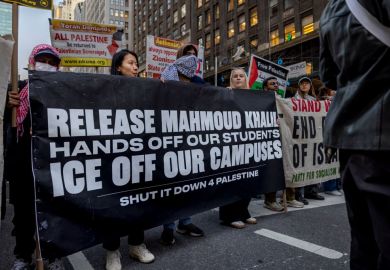
Paris-Saclay’s statement reprimanding its own ethics committee provides a prime example of the Palestine exception. That exception is a worldwide phenomenon, although it manifests differently by country. We can see it with no protective camouflage in the US, where universities have been browbeaten into submission and foreign students and faculty have been arrested and held with a view to deportation because of their Palestine advocacy.
Things are done differently in the UK, although the result in terms of freedom of expression is not dissimilar. Vice-chancellors and their senior management teams have excluded visiting speakers, cancelled meetings on campus, disciplined students and taken out injunctions. Posters referencing Palestine have been taken down from academics’ office doors. Even the government-appointed director for freedom of speech and academic freedom, Arif Ahmed, has warned universities against allowing too much free speech on this subject.
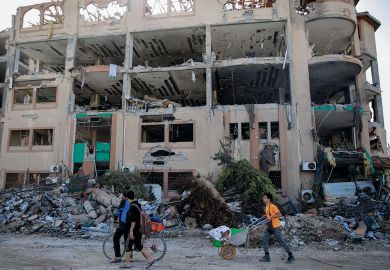
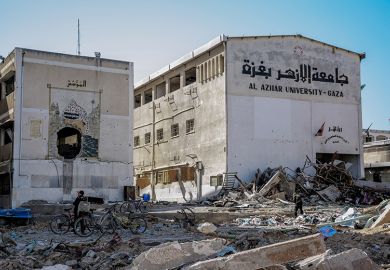
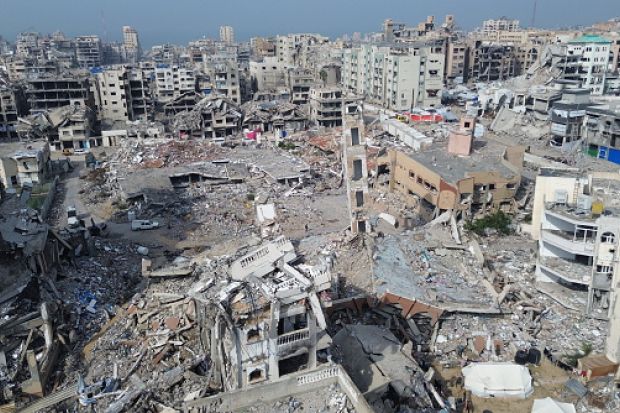
Over the past two years, the most respected international bodies, up to and including the United Nations, have concluded that Israel has committed war crimes and crimes against humanity, and on most observers’ reading of its judgment the International Court of Justice has found there to be a plausible case that Israel has been committing genocide. An additional and original feature of the assault on Gaza has been the targeted destruction of every one of Gaza’s universities. This unique, unprecedented strategy has given the world two coined words – scholasticide and educide.
To its credit, the Senate of SOAS University of London has passed a powerful motion deploring this destruction and resolving inter alia “to commit to refraining from partnerships with academic institutions that are instrumental to the commission, or support, or enablement of scholasticide”. There are, according to Universities UK, 142 universities in the country. As far as we are aware, then, 141 of them are exponents of the Palestine exception.
Jonathan Rosenhead is emeritus professor of operational research at the London School of Economics.
Register to continue
Why register?
- Registration is free and only takes a moment
- Once registered, you can read 3 articles a month
- Sign up for our newsletter
Subscribe
Or subscribe for unlimited access to:
- Unlimited access to news, views, insights & reviews
- Digital editions
- Digital access to THE’s university and college rankings analysis
Already registered or a current subscriber?