Browse the latest results of the Times Higher Education Sustainability Impact Ratings
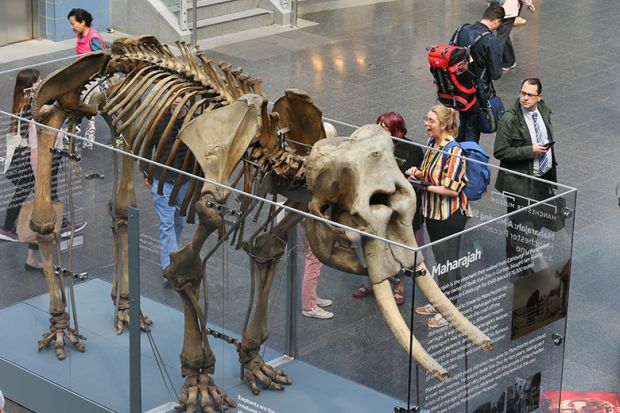
When an elephant skeleton appeared in Manchester’s Piccadilly station in 2019, it stopped commuters in their tracks. The elephant had famously refused to board a train from Edinburgh to Manchester in the 1800s and had to be walked to the city instead. The skeleton of Maharajah was later acquired by the University of Manchester’s museum and displayed at the station to spark conversations about extinction.
“The role of culture is to make you stop and think. So that’s about the imagination and sometimes taking things out into the places where people live and work, rather than waiting for them to come to us,” said Julian Skyrme, the executive director of social responsibility and civic engagement at the university.
It is an approach that has put the university at the top of the Times Higher Education Impact Rankings table for SDG 11 (sustainable cities and communities) for the past two years. Alongside environmental indicators, the ranking measures universities’ contribution to cultural life, which includes public access to spaces like museums, support for local arts and the preservation of cultural heritage.
Manchester runs four cultural institutions – the Manchester Museum, the Whitworth art gallery, the John Rylands Library and the Jodrell Bank Centre for Engagement – attracting around 1.5 million free public visitors a year.
But, for Skyrme, the real question is whether those spaces reach people beyond the university. Following a £15 million redevelopment, the Manchester Museum reopened in 2023 with Britain’s first permanent South Asian gallery, co-curated with 30 community members from the diaspora. It has since added a Chinese culture gallery and hosts a packed calendar of events, including a recent Lunar New Year celebration that drew 400 people and an annual Iftar (the breaking of the fast) that takes place in the South Asian gallery each Ramadan. Around one in five visitors since the redevelopment had never been to a museum before.
“Four generations of people dancing to music in a museum for Diwali. We don’t think that’s unusual, we think that’s quite normal,” Skyrme said.
Inclusion also means grappling with difficult questions about what the museum holds. The Africa Hub, developed with the Igbo Community of Greater Manchester, brings 40,000 objects of largely unknown provenance out of storage and into public view. Manchester’s African and Caribbean communities have been invited to help identify objects, fill gaps in the record and shape decisions about their future, including whether some should be returned.
“The worst thing you could do is pretend it’s just natural that these objects are here. Being honest about that, and using it to create dialogue, is what we’re trying to do,” Skyrme explained.
A commitment to opening up to surrounding communities can look different depending on context. Thousands of kilometres away in Punjab, India, Lovely Professional University (LPU) ranks sixth globally for SDG 11 and its focus is to open up access to facilities that people nearby would otherwise not have.
“A university is not meant for its students and teachers alone,” said founder and chancellor Ashok Mittal. “It is meant for the public at large.”
LPU opens its auditoriums (seating up to 15,000), sports halls and arts workshops freely to local communities. The university also has a dedicated museum that preserves regional craft traditions, displaying the embroidery and woodwork of women from nearby villages and helping them reach online markets.
Community engagement is embedded in the curriculum too. Every undergraduate must complete a credited module working with a local NGO, spending two months each year beyond campus. “When students go back to their villages during the holidays, they adopt a local NGO and work there,” Mittal explained. “They develop a project to help take care of the needs of that community.” Initially met with hesitation, it is now something students actively look forward to, he added.
For universities looking to strengthen their contribution to arts and heritage, both institutions say financial commitment is non-negotiable. Manchester spends about £58 million annually on its cultural institutions, while LPU invests the equivalent of several million pounds a year in infrastructure and programming – around 15 to 20 crore rupees on capital facilities alone, with a further 10 crores on recurring costs. But money is only part of the answer.
At LPU, Mittal points to institutional culture as the deciding factor. “Every university wants to do good for society. But you need the willpower and a team where it is in their DNA to continue to support the community.”
Skyrme suggests starting with a simple question: are the spaces and collections you already have genuinely open to the people around you? “We could choose not to have a public library, not to have a museum,” he said. “But these are enriching institutions, not just for our students and staff, but for the people of our city.”
seher.asaf@timeshighereducation.com
See the full results of this year’s Sustainability Impact Ratings
Register to continue
Why register?
- Registration is free and only takes a moment
- Once registered, you can read 3 articles a month
- Sign up for our newsletter
Subscribe
Or subscribe for unlimited access to:
- Unlimited access to news, views, insights & reviews
- Digital editions
- Digital access to THE’s university and college rankings analysis
Already registered or a current subscriber?