More than a third of students in the UK believe representatives of Reform UK should be banned from speaking at universities, despite the majority agreeing that higher education institutions should promote free speech.
Although “wokery” has been declared finished in some quarters, especially as a result of the re-election of Donald Trump as US president, research by the Higher Education Policy Institute (Hepi) suggests students are not becoming more liberal on free speech issues.
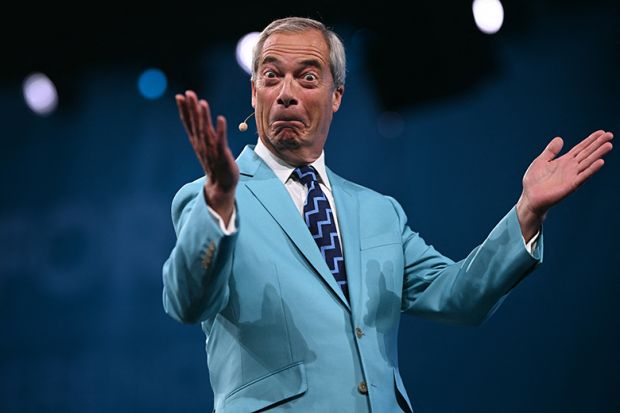
In particular, 35 per cent of students think representatives of Reform UK – the political party that led opinion polls for much of 2025 – should be banned from speaking at events on university campuses.
Hepi said this finding was higher than the previous results for any other political group. For example, in 2022, when a similar survey was conducted, 26 per cent of students felt that the English Defence League should be prevented from speaking on campus and, in 2016, 31 per cent of respondents wanted the British National Party banned.
Richard Tice, deputy leader of Reform UK, described the findings as “appalling”.
“British universities abandoned being centres of genuine learning, rigorous debate and intellectual challenge long ago, instead opting to become echo chambers of far-left indoctrination run by activist academics,” he said.
“University leaders bear responsibility for allowing this culture to fester in our institutions. The government must pull grant funding unless this is changed urgently.”
Two-fifths (39 per cent) of respondents to the latest survey also believe students’ unions should ban all speakers who “cause offence to some students”.
New laws that came into force last year strengthen the duty on English universities to protect free speech on campuses, including for visiting speakers.
Guidance issued to universities by the Office for Students (OfS) suggests that institutions could be in breach of the law if they cancel a visiting speaker event because the speaker’s views are unpopular, as long as the speech is lawful.
The results are based on a poll of roughly 1,000 full-time undergraduate students on free speech issues, conducted in late 2025. Students were asked almost identical questions to ones Hepi posed to their predecessors in 2016 and 2022.
Comparison of the results shows that between 2016 and 2022 students as a group became significantly less supportive of free expression, and current students hold similar views.
But the thinktank highlighted that the findings are “contradictory” in some places.
Despite some support for banning certain groups from speaking on campuses, a large majority of students (69 per cent) said “universities should never limit free speech” – up from 60 per cent in 2016 and 61 per cent in 2022.
Similarly, most students (71 per cent) support the current and previous governments’ approach to free speech in higher education, whereby institutions have to promote free speech and are monitored and regulated by a free speech champion at the OfS.
Although the vast majority (90 per cent) of students feel personally able to express their views without obstacle, about half (47 per cent) think “universities are becoming less tolerant of a wide range of viewpoints”.
The latter result is higher than it was in both 2022 (38 per cent) and 2016 (24 per cent).
More than half of respondents (52 per cent) also said they thought student societies were oversensitive, compared with 43 per cent in 2016 and 42 per cent in 2022.
“If it were ever right to use the loaded term ‘woke’ to describe contemporary students, then it seems clear the so-called ‘end of woke’ has not yet reached university campuses,” Hepi director Nick Hillman writes in the report. “However, in places the results suggest students’ views are contradictory or even confused, so labelling them with any such term may be unfair.”
Hillman added that he was “shocked” that so many students support banning Reform UK.
“The best way to take down democratic political parties that you disagree with is surely through free, fair and fierce debate – whether that is on campus or beyond,” he said.
“It is also clear that students recognise they may not always be well-equipped to draw their own lines on free speech matters. For instance, they express strong support for the free speech champion in the Office for Students whose job it is to oversee what actually happens.”
Register to continue
Why register?
- Registration is free and only takes a moment
- Once registered, you can read 3 articles a month
- Sign up for our newsletter
Subscribe
Or subscribe for unlimited access to:
- Unlimited access to news, views, insights & reviews
- Digital editions
- Digital access to THE’s university and college rankings analysis
Already registered or a current subscriber?