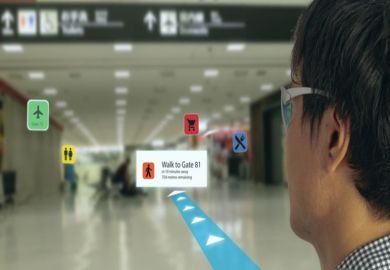
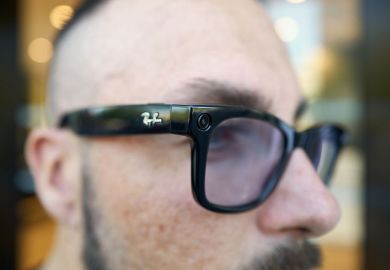
Wearing smart glasses to a university entrance exam in South Korea could result in criminal charges and a three-year ban from retaking the test, as government officials step up efforts to clamp down on cheating in assessments.
AI-powered glasses that provide audio and visual assistance to users have garnered attention in Korea in recent months after three students were caught using them during exams at universities in Seoul.
The Korean Ministry of Education has now announced that students found cheating on the national college entrance examination, College Scholastic Aptitude Test (CSAT), will face criminal prosecution, effective from next year.
Under current regulations, the results of students caught wearing or using AI glasses in exams are invalidated and they are barred from retaking the exam the following year. This one-year penalty will be extended to three years.
The ministry has also said that an official will be positioned at each of the 1,312 testing centres across Korea to detect any suspicious eyewear.
Criminal conviction stemming from cheating is not entirely unprecedented in South Korea.
John P. Dimoia, professor of Korean history at Seoul National University, said the new regulations are “very consistent” with the country’s approach to managing cheating in exams.
Students involved in organised cheating have received suspended prison sentences in the past. In 2005, some students who used their mobile phones to text and exchange exam answers in the CSAT were sentenced to eight months in prison, suspended for two years. “It’s always been fairly intense here,” said Dimoia.
David Tizzard, assistant professor of Korean studies at Seoul Women’s University and Hanyang University, agreed that there is a huge emphasis on “fairness and meritocracy” in Korean higher education.
“Korea believes that while its education system may be gruelling, it is at least gruelling for everyone equally. There’s not much in the way of subjectivity or allowing for people to get ahead without having done the requisite work.”
With Korea an early adopter of new technologies, Tizzard added that AI-assisted devices “are not a niche thing, but rather a facet of ordinary life for many” in the country.
“Considering the widespread use of AI and the heavy focus of fairness, it doesn’t surprise me that Korea is making an effort to curb this behaviour in the exam room despite how unrealistic it might seem to those outside the country.”
Theodore Jun Yoo, a professor at Yonsei University who also builds medical AI companies, told Times Higher Education that he supports the “strong deterrence” from cheating.
“Deliberate exam cheating should have serious consequences too, including prosecution where appropriate. I don’t think a three-year ban is too harsh,” he said.
Yoo advocated that Korea should still “embrace AI” while drawing a “clear line” on cheating.
“The problem isn’t the smart glasses themselves, but using them to get an unfair advantage on a high-stakes exam.”
Register to continue
Why register?
- Registration is free and only takes a moment
- Once registered, you can read 3 articles a month
- Sign up for our newsletter
Subscribe
Or subscribe for unlimited access to:
- Unlimited access to news, views, insights & reviews
- Digital editions
- Digital access to THE’s university and college rankings analysis
Already registered or a current subscriber?